
2026-09-03
UUGreenPower
0
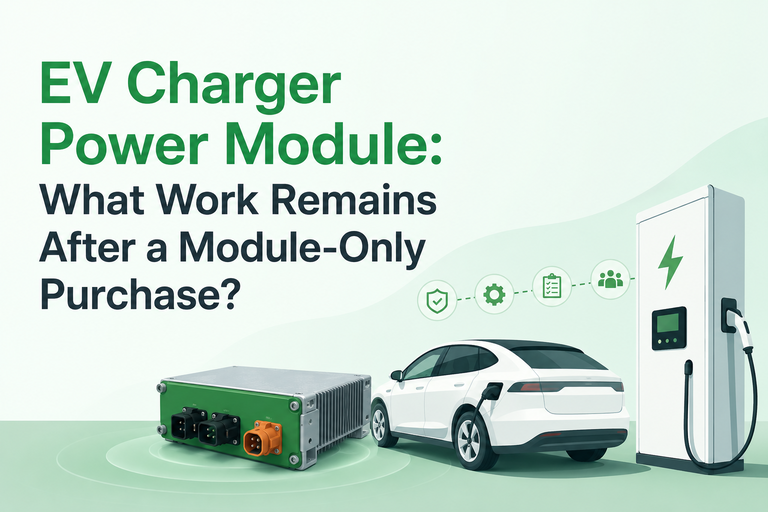
Buying an EV charger power module can remove an important power-conversion task. It does not automatically remove the work of turning that module into a tested, deployable charger. The buyer’s decision is which functions remain after purchase and who owns their evidence. Use one primary artifact: a Buyer-Side RACI.
Define the purchased object
Name the route before assigning work. A single charging module is one power-conversion object. A module pack or PMU component set is a separate configuration whose components, interfaces and acceptance scope must be identified. An integrated charger adds cabinet, connector, controls and other named functions. A controller/backend adds software and network responsibility. The word “module” cannot answer these questions by itself.
Use the Buyer-Side RACI
Retained workstream | Buyer-side question after a module purchase | Evidence or owner to assign |
Power path and protection | Who completes input protection, busbars, contactors, cables and output protection? | Electrical design record and acceptance owner |
Controller and firmware | Who integrates limits, alarms, power sharing, firmware and fault handling? | ICD, software baseline and test owner |
Vehicle and connector path | Who closes connector, vehicle communication and cable behavior? | System test plan and project owner |
Cabinet and thermal system | Who owns enclosure, airflow or liquid auxiliaries and environmental checks? | Mechanical/thermal design and validation record |
HMI, payment and backend | Which functions are in the charger and which remain in another system? | Interface map, configuration and software owner |
Certification and compliance | Which evidence applies to the module and which to the complete configuration? | Object-scoped certificate/test record and compliance owner |
Deployment and handover | Who performs commissioning, acceptance, training, spares and change control? | Contract/RACI, handover record and service owner |
The RACI is a responsibility tool, not a promise that a supplier performs each task. A module data sheet can support the power-stage row; it cannot prove the complete charger, backend or site result.
Trace the complete power path from input to vehicle connector in the same RACI. Record who owns protection, conversion, output switching, cables, cooling, connector behavior and vehicle-side controls. For a multi-module route, add the documented allocation and fault-isolation behavior rather than deriving a parallel or redundancy rule. Then connect the released configuration to integration tests, acceptance evidence, software versions and handover records.
The handover row should identify the controlled model and interface data, wiring or configuration information, test results, firmware baseline, open deviations and the party that accepts the result. It does not promise that a supplier supplies every document; it gives the buyer a way to see what is still missing before the charger is released.
Separate integration from operation
Integration creates a functioning charger: interface definition, controller behavior, vehicle communication, protection, enclosure and acceptance testing. Operation keeps the released product functioning: commissioning, monitoring, incident response, software release, spares and field changes. Ask what “support” means before assigning it. Engineering clarification, integration assistance, onsite work and an SLA are different scopes.
This distinction keeps a charging module vs complete charger review focused. A buyer may own integration while another party owns an agreed service, but the owner and evidence must be explicit. If a module pack PMU component set is proposed, do not infer parallel, redundancy, hot-plug or replacement behavior from the label; request the named configuration and system evidence.
Apply the RACI to supplier materials
UUGreenPower catalogue entries can provide named model evidence for output, current, cooling, efficiency or interfaces where the entry states them. Keep those fields tied to the model and page. Integrated-device entries are separate objects and should not be copied back to every module.
UUinside material can provide architecture context for components such as ACU, PMU, DCU, DSU, CMS and optional POS. It does not by itself establish a fixed BOM, turnkey delivery, white-label arrangement, backend responsibility, commissioning scope or service level for a project. Use the ICD, configuration baseline, acceptance plan and statement of work to close those rows.
Ask four final buyer questions
1. Which layer is actually being purchased: single module, PMU/module pack or integrated charger?
2. Who owns every retained function from controller and vehicle path to cabinet, backend and handover?
3. Which tests prove the component, and which tests prove the complete pairing and acceptance configuration?
4. Which responsibilities are documented, and which still require company, contract or client confirmation?
If an answer is unclear, keep the route conditional and name the next evidence owner. The missing work is part of the make-or-buy decision, not an inconvenience to hide in a package label.
Review the questions with engineering, procurement and the eventual acceptance owner so that a technical gap is not mistaken for a commercial inclusion.
Before approving the module-only route
The buyer-side RACI is complete when it shows what has been purchased, what remains with the buyer or integrator, which evidence closes each row and what changes reopen the decision. An EV charging module can be a sound component choice without being a complete charger. UUGreenPower product evidence should support only the named object, while the retained engineering and commercial boundary remains visible until the project approves it.
Charging Module vs. Complete Charger: How to Define Responsibility Boundaries in EV Charger Design
2026-09-03 NextSelf-Build vs. Single Module vs. Modular Solution: How to Compare Retained Work in EV Charger Projects
2026-09-04

