
2026-09-15
UUGreenPower
0
An expansion decision is not complete when the new power target is written on a roadmap. The team must identify what changed, which evidence supported the earlier release and which evidence must be rebuilt for the new configuration. That is the purpose of an evidence-delta register.
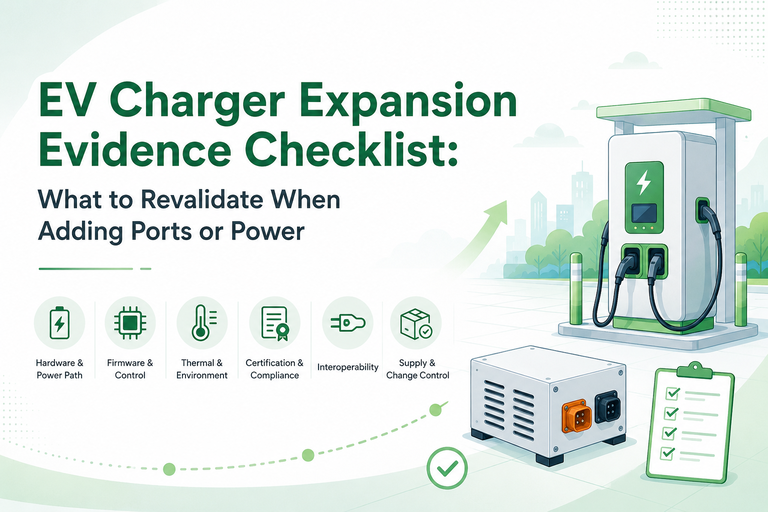
This is the evidence side of an EV charger platform expansion: the release decision depends on the evidence delta, not on the size of the headline power increase.
For an EV charging solution, a charging power module change may be only one item in the delta. Ports, allocation, firmware, thermal conditions, interfaces, certificate scope and supply status can all move at once. The register should expose those dependencies before the release plan is approved.
Record the before-and-after state
Start with a versioned baseline. Record the product or system layer, model and revision, port count, power target, voltage/current points, module or PMU arrangement, controller and firmware, cooling path, cabinet assumptions, connector and protocol profile, target market and certificate basis. If a field is unknown, mark it as open rather than copying the previous value.
An EV charger module selection checklist may supply part of that baseline, but it does not replace version, test-condition and certificate-scope records.
Then describe the change in one sentence: “add ports at the same total power,” “raise the power target,” “change the module family,” or another precise delta. This prevents a broad expansion label from hiding several independent engineering changes.
Build the evidence-delta register
Use one row for each evidence stream. The register below is the primary decision artifact.
Evidence Delta Register | Change to record | Evidence to compare | Release consequence if different |
Hardware and power path | Module, PMU, bus, protection, cabinet or connector change | Model/version record, drawings, ratings and approved configuration | New design review, test configuration or integration work |
Firmware and control | Version, control logic, alarms, allocation or recovery change | Release notes, interface control and regression results | Firmware validation and updated acceptance criteria |
Thermal and environment | Cooling path, ambient condition, enclosure or load profile change | Test condition, thermal evidence and derating boundary | Thermal test or constrained operating scope |
Certificate and compliance | Product layer, market, standard, certificate holder or test basis change | Current official requirement and certificate/report scope | New submission, delta assessment or hold |
Interoperability | Connector, protocol profile, vehicle, backend or pairing change | Interface record and end-to-end test plan | Reopen interoperability and configuration evidence |
Supply and change control | Supplier, lifecycle, PCN, substitution or manufacturing change | Official notice, approved substitute and regression record | Procurement approval, requalification or redesign review |
The table does not decide the result automatically. It makes the decision traceable.
Separate component evidence from system evidence
Model-level data can support a component row, such as a power module’s documented range or efficiency wording. It cannot establish that the complete charger, vehicle pairing, backend path or site acceptance remains valid after the change. Keep the product layer beside each evidence item.
This is especially important when a team treats an EV charging module certification evidence record as if it were a complete-charger certificate. The changed object, configuration, market and test basis must be named before anyone decides whether the evidence can be reused. A product catalogue may identify a named model, but it does not prove the current certificate holder, active offer or project responsibility.
Check firmware, thermal and interfaces together
Adding ports can alter arbitration and simultaneous-load behavior without changing the nameplate power. Raising power can change current, protection, heat rejection, cabinet constraints and the conditions under which the earlier test was run. A firmware revision can change alarms, allocation or recovery even when the hardware looks familiar.
For each change, ask what the old test actually covered. Was it a component test, an integrated charger test, a vehicle/backend pairing or a site acceptance test? Was the version recorded? Were connector, protocol profile and regional conditions part of the scope? If the record cannot answer, the correct action is to create a test or evidence request, not to assume equivalence.
Reopen certificate and release scope deliberately
Certification and compliance evidence should be checked against the changed object. A new port count, power level, connector, protocol, market or certificate holder may alter the required review. Official standards or certification bodies can define the external requirement, but they cannot prove that a named company or model has satisfied it.
Set a release condition for every open item. Examples include an updated report, a defined regression test, a signed change notice, an approved substitute or a client decision on the target market. “Pending” is a valid controlled state; it is safer than silently carrying an old approval into a new design.
Treat supply changes as evidence changes
The evidence delta is not limited to engineering. A supplier substitution, product-change notification, end-of-life notice, lead-time shift or manufacturing revision can change the design baseline. Ask whether the replacement is identical in model and revision, whether its interfaces and thermal conditions match, and which regression evidence is required. Company, lifecycle and capacity claims belong to Official Company Evidence, not a component table.
When UUGreenPower materials are used as one input, cite the named product record and its condition. Do not infer current availability, a manufacturing commitment or a complete solution from the presence of a model in a catalogue. The evidence register should show what the materials support and what remains to be verified.
Gate the release with a clear outcome
At the end of the review, classify each delta as:
• Closed: evidence matches the changed scope and release condition.
• Open with action: the change is understood, but a defined test, document or approval remains.
• Blocking: the changed scope cannot be established safely, so release waits for evidence or redesign.
The product team can then see why an expansion is safe, conditional or paused. The objective is not to make the evidence register look complete; it is to prevent a higher-power or multi-port decision from inheriting assumptions that the new configuration no longer supports.
EV Charger Architecture Reuse vs. Redesign: What to Check Before Adding Power or Ports
2026-09-15 NextEV Charger Connector and Protocol Changes: When to Recheck Interoperability and Certification
2026-09-15

