
2026-04-29
UUGreenPower
0
EV charging systems in Europe demand strict compliance, high electromagnetic compatibility, and optimized energy efficiency to ensure reliable operation under diverse conditions.
This article examines IEC standards, EMI Class B requirements, and high-efficiency design from a charging module perspective, highlighting how these factors impact system integration, safety performance, and overall EVSE reliability in real-world applications.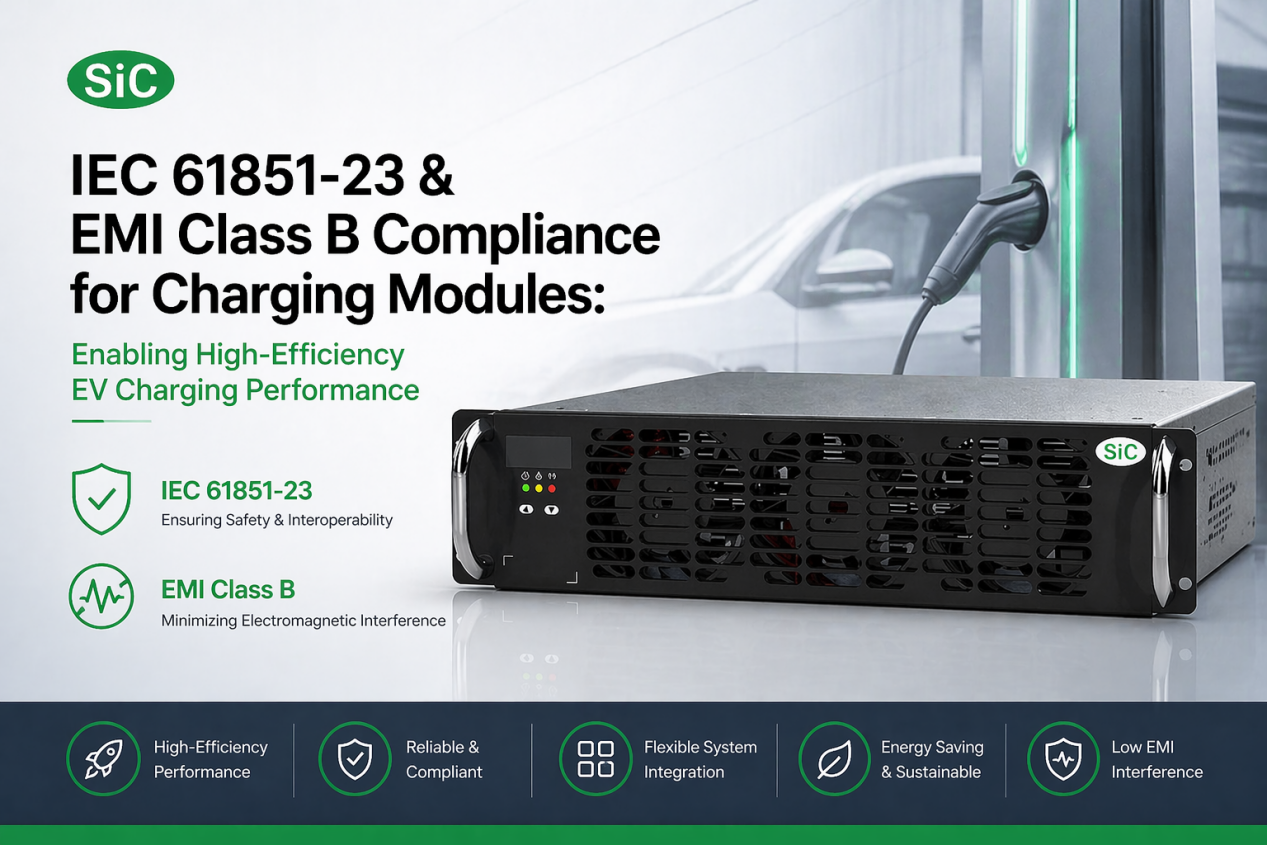
IEC compliance forms the backbone of EV charging safety and interoperability across Europe. For any charging moduleor EV charger power module, adherence to IEC standards ensures that the system operates within a unified safety framework, covering electrical protection, communication protocols, and operational behavior.
IEC 61851 establishes a standardized operational framework that addresses key challenges in EV charging systems, including:
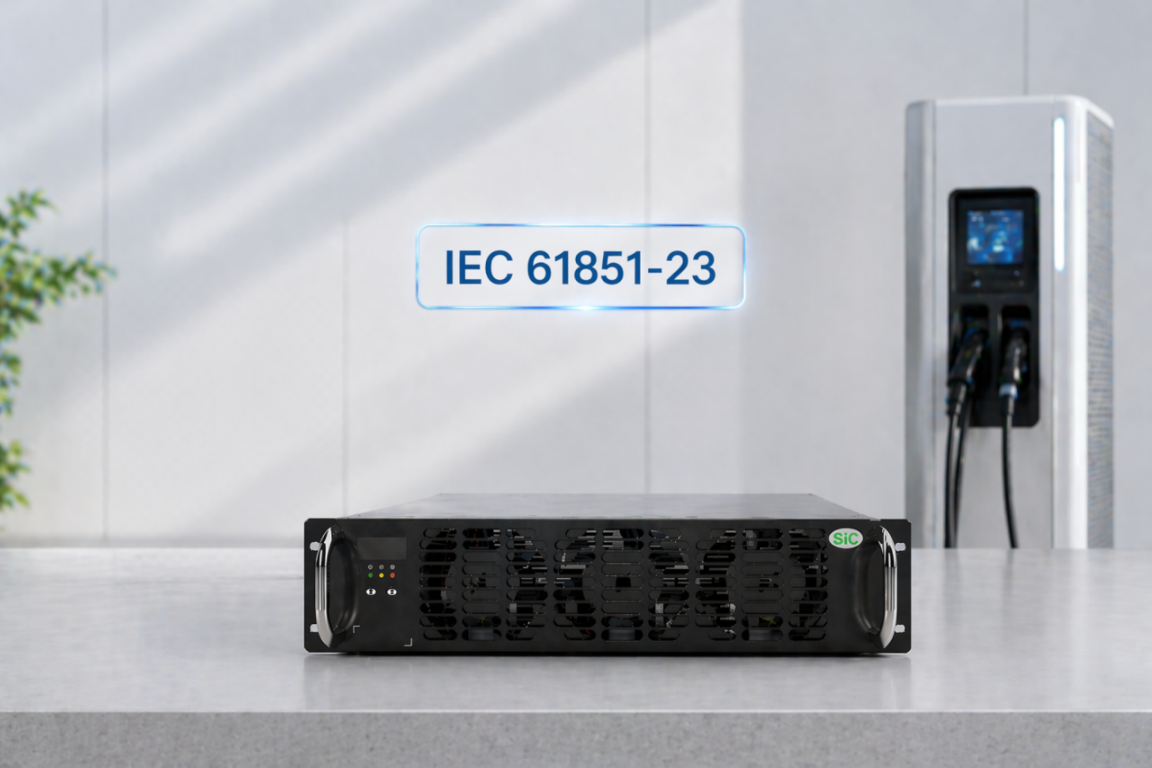
From a practical perspective, IEC 61851-23 is a critical standard for ensuring safe, consistent, and reliable DC charging performance across different vehicles and operating environments.
For DC charging modules like the UR100040SW-SiC(EU)-G2, compliance with IEC 61851-23 is particularly essential.
1. Ensures stable module interaction with EVSE control systems
IEC 61851-23 defines a unified control framework that ensures consistent coordination between the EVSE controller and the charging module during DC fast charging.
This system-level coordination is reflected in real charging operation, where stable control response and smooth transitions are essential. In the UR100040SW-SiC(EU)-G2 40kW module, this is demonstrated through DSP control and CAN communication, while its 300–1000VDC constant power range and 1s startup time support stable and predictable charging behavior.
2. Reduces cross-platform integration issues
IEC 61851-23 plays an important role in reducing inconsistencies across EV brands, EVSE platforms, and power module architectures by defining unified control behavior.
This benefit is reflected in the ability of charging systems to operate across different battery configurations without performance deviation. The UR100040SW-SiC(EU)-G2 demonstrates this through its 150–1000VDC output range and high regulation accuracy (≤±0.5% voltage / ≤±1% current), ensuring stable operation across platforms.
3. Simplifies multi-OEM system compatibility
One key value of IEC 61851-23 is enabling consistent charging behavior across different OEM vehicles and charging infrastructures.
In practical EV charging systems, this is reflected in whether a single charging module can maintain stable performance across multiple EV architectures. With 40kW constant power output (300–1000VDC) and standardized communication, the UR100040SW-SiC(EU)-G2 demonstrates this compatibility in multi-OEM environments.
4. Reduces certification iteration cycles
IEC 61851-23 improves the predictability of certification testing by defining standardized safety and operational benchmarks for DC charging systems. This benefit is reflected in more stable and repeatable system behavior during validation testing.
The UR100040SW-SiC(EU)-G2, with protection functions, alarm mechanisms, reverse-current prevention, and high efficiency (>97%, peak ≥97.5%), demonstrates stable performance consistency during certification processes.
5. Lowers system-level validation effort
IEC 61851-23 reduces system-level validation complexity by standardizing fault handling and test scenarios.
This is reflected in reduced need for custom validation logic when systems operate across different conditions. The UR100040SW-SiC(EU)-G2, with its -40℃ to 75℃ operating range, SiC-based reliability, and built-in protection design, demonstrates stable operation across diverse environments.
EMI (Electromagnetic Interference) standards define the allowable limits of electromagnetic emissions generated by electrical and electronic equipment during operation. Their purpose is to ensure that devices can operate normally without causing interference to surrounding systems such as communication networks, grid infrastructure, or other electronic equipment.
EMI standards are commonly classified into different levels, with Class A and Class B being two common categories.
| Aspect | Class A | Class B |
|---|---|---|
| Application Environment | Industrial | Residential / Commercial / Public EV charging |
| Emission Level | Higher tolerance | Stricter limits |
| System Sensitivity | Lower | Higher |
Class B is therefore more relevant for modern EV charging infrastructure due to its stricter requirements in real-world deployment environments.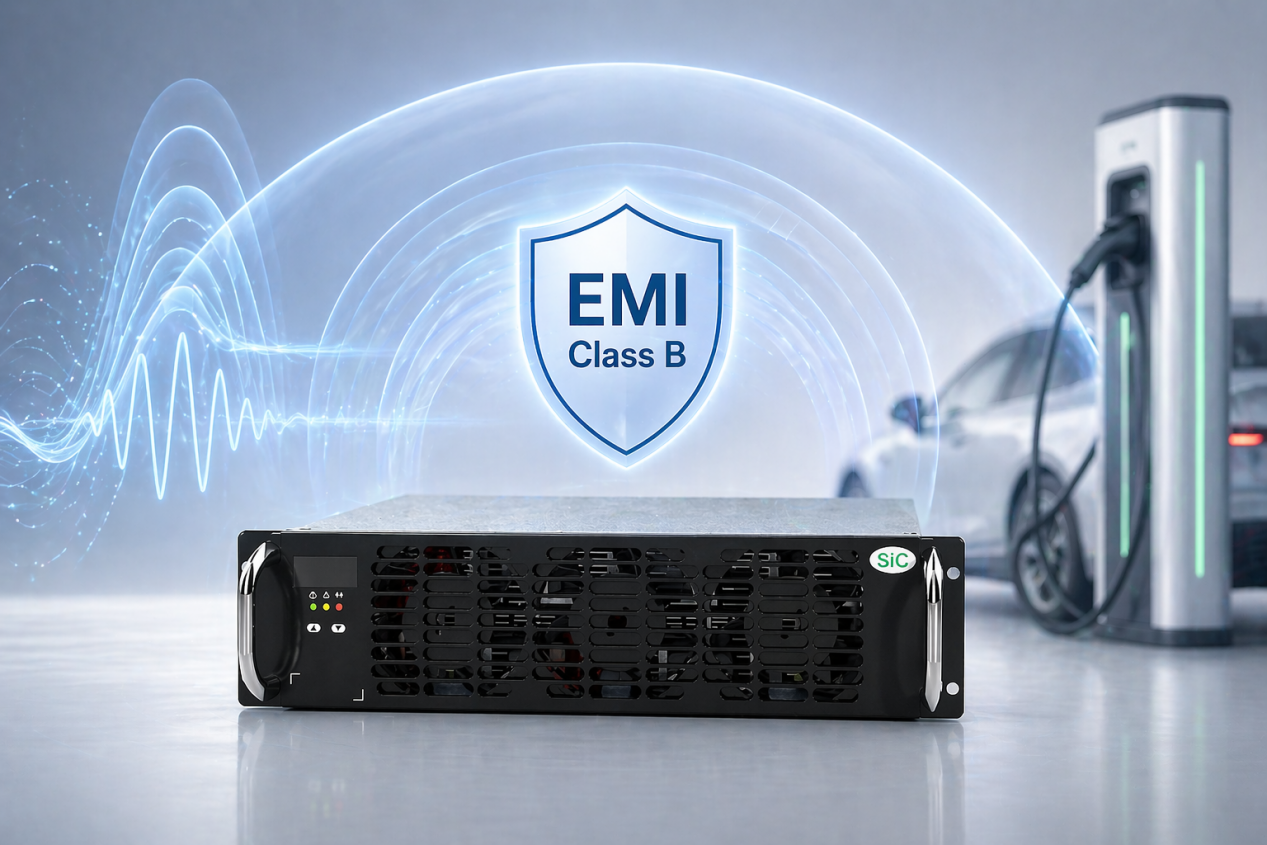
Building on IEC-defined system-level safety and interoperability, EMI Class B compliance is another key factor for stable EV charging operation. The UR100040SW-SiC(EU)-G2 40kW charging module meets this requirement and illustrates the following system-level benefits.
EMI Class B in real EV charging systems is reflected in the ability to maintain stable electromagnetic behavior even under continuous high-frequency switching conditions in dense deployment environments.
In practical applications, this results in a more stable system operation with reduced electrical disturbances during charging. The UR100040SW-SiC(EU)-G2 40kW charging module, with its SiC-based architecture, high efficiency (>97%, peak ≥97.5%), and low output ripple (≤1%), is an example of this stable operating behavior in real systems.
In real-world EV charging deployments, EMI Class B is reflected in reduced reliance on external filtering components due to cleaner electromagnetic behavior at the system level.
This means the overall charging system can operate with fewer additional filtering stages. The UR100040SW-SiC(EU)-G2, with its optimized internal design and SiC switching structure, demonstrates this reduced filtering requirement in practical EVSE systems.
EMI Class B is reflected in improved system robustness in compact and high-density EVSE environments, where multiple power modules operate in close proximity.
In such scenarios, electromagnetic stability directly affects layout flexibility. The UR100040SW-SiC(EU)-G2 supports this through its high-density modular design and support for up to 60 parallel-connected modules, enabling stable operation even in large-scale EVSE deployments where space and electromagnetic coupling are tightly constrained.
In practical testing and deployment, EMI Class B is reflected in more predictable electromagnetic behavior, which reduces uncertainty during EMC debugging and system integration.
This leads to more stable test outcomes and fewer unexpected adjustments. The UR100040SW-SiC(EU)-G2, with high-precision control (≤±0.5% voltage / ≤±1% current), illustrates this stable and predictable behavior in validation environments.
EMI Class B in real systems is reflected in consistent electromagnetic performance across the full operating range, which improves the likelihood of passing certification on the first attempt.
This is observed in systems with stable switching behavior and controlled emissions. The UR100040SW-SiC(EU)-G2, with high efficiency, low ripple, and SiC-based switching stability, is an example of such consistent performance in real EV charging applications.
In high-power EV charging systems, charging module efficiency determines how effectively electrical energy is converted into usable charging output with minimal losses during continuous operation. As charging power increases, even small efficiency differences are directly translated into higher heat generation, increased energy loss, and greater thermal stress on the overall charging system.
This makes efficiency not only a design parameter, but also a key factor affecting long-term system stability in EV charging safety and infrastructure reliability.In addition, charging module efficiency becomes even more critical in European EV charging environments due to high electricity tariffs, long operating hours, and widespread public charging infrastructure deployment. In practice, lower module efficiency directly leads to higher energy cost per kWh delivered and increased thermal load in outdoor charging stations.
This makes efficiency a decisive factor in the economic viability and thermal management requirements of EV charging infrastructure in Europe, especially in high-utilization public charging networks where energy throughput is continuous and operational margins are sensitive to losses.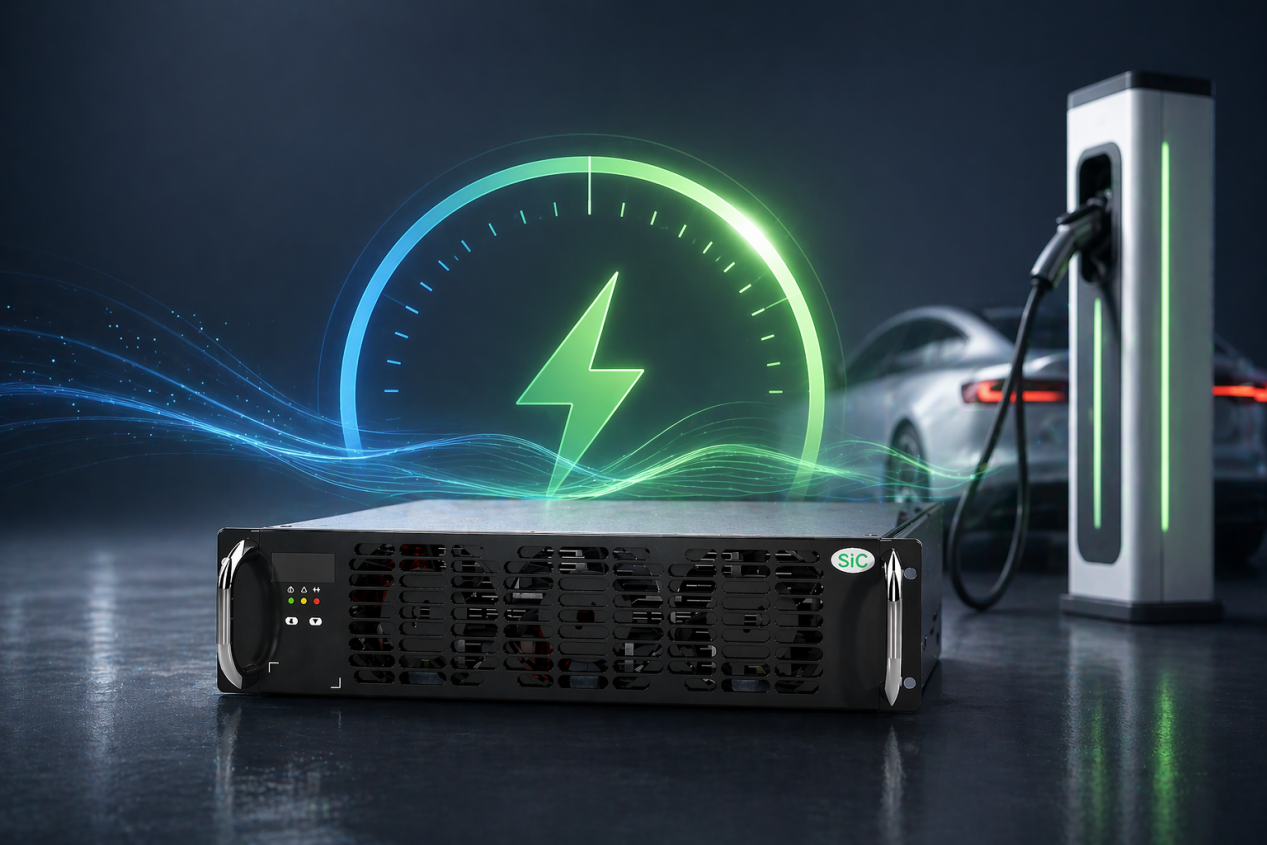
Taking the UR100040SW-SiC(EU)-G2 40kW charging module as an example, high efficiency becomes a key indicator that connects module-level performance with system-level stability in real EV charging applications. In this context, efficiency is not only about energy conversion, but also about how effectively thermal behavior, power delivery, and operational stability are managed under continuous high-load conditions.
In high-power EV charging systems, efficiency directly determines how much electrical energy is converted into heat during operation. Lower conversion losses result in reduced thermal accumulation, which is critical for maintaining stable system performance.
The UR100040SW-SiC(EU)-G2 achieves this through full load peak efficiency >97% and peak efficiency up to 97.5%, significantly reducing energy loss during high-power operation. Combined with its SiC-based architecture, this helps minimize unnecessary heat generation and supports stable long-duration charging.
Higher efficiency enables more compact power delivery by reducing energy waste within the conversion process, allowing more usable power output within the same physical footprint.
With a compact size of 300 × 84 × 437.5 mm and a high-efficiency SiC design, the UR100040SW-SiC(EU)-G2 supports higher power density integration in EV charging systems, making it suitable for space-constrained charging station deployments.
At the system level, efficiency stability directly influences thermal behavior during continuous operation. Lower losses reduce temperature fluctuations and help maintain consistent operating conditions across the charging cycle.
The UR100040SW-SiC(EU)-G2, with its high-efficiency operation and low output ripple (≤1%), ensures stable energy conversion performance, which contributes to improved thermal consistency under varying load conditions.
High efficiency reduces the amount of energy dissipated as heat, which directly lowers the demand for external cooling systems in EV charging infrastructure.
In the case of the UR100040SW-SiC(EU)-G2, the combination of SiC device technology and >97% full load peak efficiency helps minimize overall thermal load, enabling a more simplified cooling system design in real-world deployments.
Efficiency in EV charging systems must remain stable not only at rated conditions, but also across varying load levels during dynamic charging scenarios.
The UR100040SW-SiC(EU)-G2, with its wide constant power range (300–1000VDC) and high-efficiency performance profile, maintains consistent energy conversion behavior across different operating states, ensuring stable system-level operation in fast-charging applications.
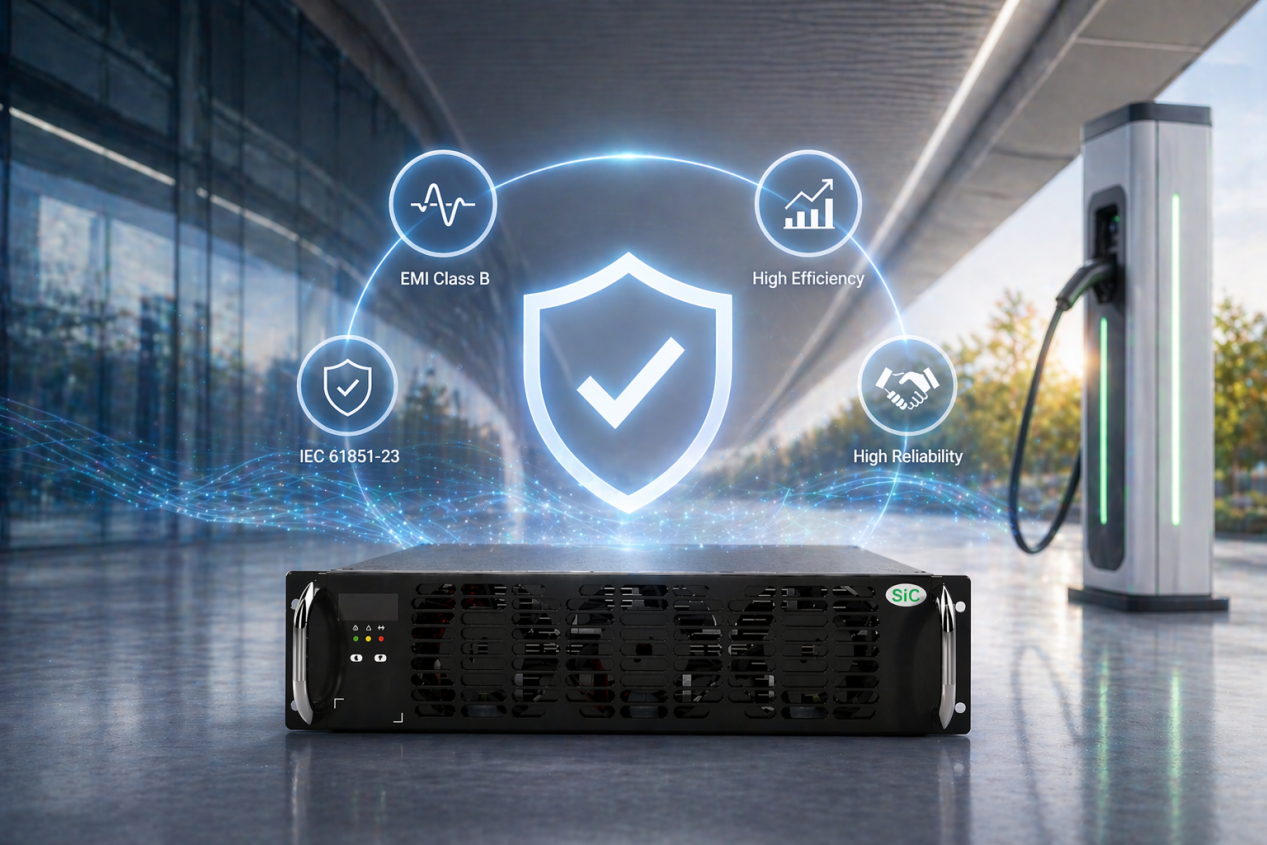
This article systematically reviews the importance of IEC 61851-23 compliance, EMI Class B requirements, and high-efficiency design in EV charging systems, highlighting how they contribute to system safety, interoperability, electromagnetic stability, and overall performance in real-world applications.
UUGreenPower’s UR100040SW-SiC(EU)-G2 provides high-reliability and high-efficiency charging module solutions for modern EV infrastructure. Contact us to learn more or explore potential cooperation opportunities.
Does the Wallbox DC Fast Charging have the opportunity to become the mainstream charging method?
2024-08-23 NextHow to Ensure Long-Term Stable Operation in Outdoor Charging? IP65 Charging Module Explained
2026-05-28

