
2026-05-30
UUGreenPower
0
Longevity in power electronics is often challenged by environmental stressors and internal thermal cycles that act on components over thousands of hours. When an ev charging module runs continuously at high loads, the electrical stress on capacitors and power switches can lead to gradual performance degradation. We recognize that identifying these vulnerabilities early is the key to maintaining a reliable infrastructure. By looking at how these units behave after years in the field, we can better prepare for the physical and electrical realities of long-term energy delivery.
Thermal Fatigue and Component Aging
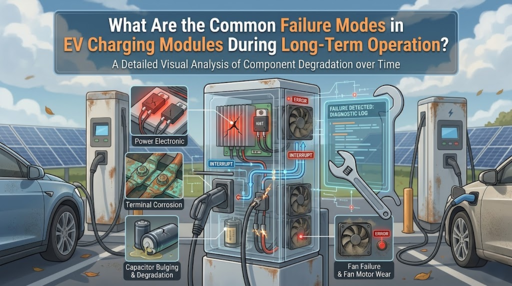
Heat is perhaps the most persistent enemy of any high-power ev charging module during its service life. Constant expansion and contraction caused by temperature fluctuations can weaken solder joints and stress delicate semi-conductors, eventually leading to circuit failures. We see that modules lacking efficient heat dissipation often suffer from "derating," where the system automatically lowers its output to protect itself, resulting in slower charge times for the user. Over time, this thermal cycling can dry out electrolytic capacitors, which are vital for filtering and stabilizing the current flowing into the vehicle.
Environmental Ingress and Corrosion
Outdoor installations expose internal hardware to a cocktail of dust, moisture, and salt air that can be incredibly destructive. If an ev charging module is not properly sealed, fine particles can settle on the circuit boards, creating conductive paths that cause short circuits or erratic behavior. Corrosion on connector pins and internal terminals is another frequent issue, as it increases electrical resistance and generates even more localized heat. At UUGreenPower, we emphasize the importance of high IP-rated protection to block these external elements from reaching the sensitive power conversion stages.
Grid Fluctuations and Electrical Stress
The stability of the local power grid plays a significant role in how well an ev charging module holds up over a decade of use. Frequent voltage surges, lightning strikes, or unstable input frequencies can wear down the protective varistors and input filters designed to guard the module. Repeated exposure to these "dirty" power signals can cause the internal control logic to glitch or lead to a total hardware shutdown to prevent damage to the car. We find that robust input protection is necessary to buffer the internal electronics from the unpredictable nature of the public utility supply.
Maintaining a high uptime requires a deep grasp of these failure patterns and a proactive approach to hardware design. Whether it is managing the inevitable heat or sealing out the damp morning air, the focus must stay on the small details that keep the power flowing. UUGreenPower remains dedicated to engineering solutions that anticipate these long-term hurdles, ensuring that every unit remains a stable link in the transport network. By addressing these failure modes head-on, we help operators secure their investments and provide a consistent experience for every driver who plugs in.
Which Cooling Methods Are Most Effective for Maintaining EV Charging Module Stability?
2026-05-30 NextThermal Management and the Reliability of Your EV Charging Module
2026-05-31

