
2026-06-01
UUGreenPower
0
Entering new regions requires a deep grasp of local regulatory landscapes to ensure every component meets rigorous safety expectations. When we integrate an ev charging module into a global project, we prioritize recognized benchmarks that guarantee hardware reliability and grid harmony. At UUGreenPower, we focus on securing the right passports for our technology, as these documents are more than just paperwork; they represent a commitment to operational excellence. By adhering to international frameworks, we help our partners avoid the friction often found in cross-border infrastructure deployment.
Verification for European Safety and Quality
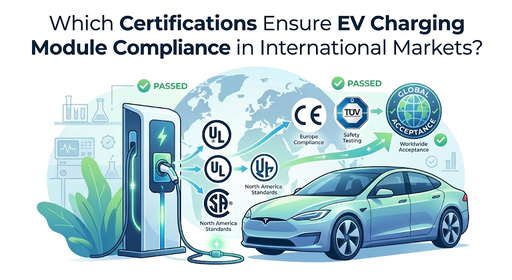
Europe represents a massive portion of the global infrastructure demand, making the CE mark a fundamental requirement for any ev charging module sold there. This mark confirms that a product complies with the Low Voltage Directive and Electromagnetic Compatibility standards, which are essential for safe public use. We often look toward TUV testing for additional validation, as their rigorous protocols provide an extra layer of assurance for technical teams. These certifications demonstrate that the equipment can handle the specific voltage and frequency requirements of European grids while maintaining user safety.
Requirements for North American Grid Integration
Expanding into North America necessitates a different set of technical hurdles, primarily centered around UL certification. A high-quality ev charging module must pass specific tests to satisfy local safety inspectors and insurance providers. Additionally, FCC compliance is mandatory to ensure that the electronic emissions from the power conversion process do not interfere with other wireless communications. We recognize that these stringent North American benchmarks are vital for gaining the trust of fleet operators and utility companies across the continent, ensuring the hardware is ready for heavy-duty use.
International Consistency Through Global Standards
Beyond regional safety marks, universal standards like IEC 61851 play a critical role in ensuring that a module works seamlessly with vehicles from different manufacturers. An ev charging module built according to these international rules ensures that the communication protocols and physical connections are consistent worldwide. We also value quality management systems like ISO 9001, which verify that the manufacturing process itself remains consistent and traceable. This holistic approach to certification simplifies the path to market and ensures that hardware remains reliable regardless of where it is installed.
Securing international certifications is the most effective way to protect your infrastructure investment and ensure long-term stability. By focusing on CE, UL, and IEC compliance, we provide a foundation of safety that allows for smoother deployments in diverse markets. These standards help mitigate risks and provide clear evidence of quality to end-users and regulatory bodies alike. As the industry matures, staying aligned with these evolving requirements will remain a core part of our mission at UUGreenPower to support a reliable, electrified future.
Where Do EV Charging Modules Fit Within Energy Storage and Microgrid Systems?
2026-06-01 NextWhat Design Considerations Improve the Lifespan of EV Charging Modules in Heavy-Duty Usage?
2026-06-02

