
2026-08-13
UUGreenPower
0
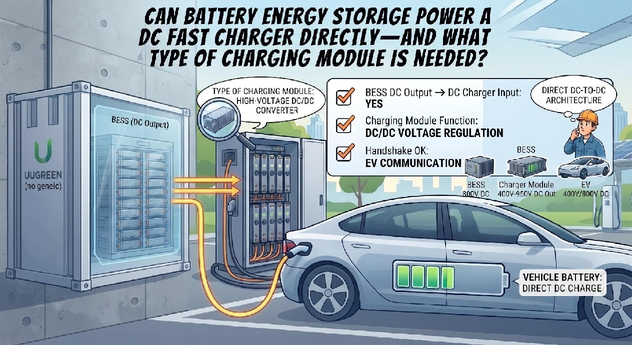
A battery energy-storage system and an EV battery both store DC energy, but their voltages, state-of-charge limits, fault energy and control objectives differ. An energy storage charging module or another controlled conversion stage is needed to regulate the transfer. Directly connecting the two battery systems could create uncontrolled current, unsafe voltage mismatch or protection problems. The correct architecture establishes clear electrical and control boundaries.
AC-Coupled and DC-Coupled Architecture Selection
In an AC-coupled site, the storage system and EV charger connect through their own conversion equipment to a common AC distribution system. In a DC-coupled site, storage and charging equipment may share a controlled DC bus through DC/DC conversion. Neither arrangement is universally preferable; the choice depends on existing equipment, voltage domains, operating modes, grounding, isolation, protection and control. Engineers should draw every intended energy path before selecting components.
Grid-Side, Vehicle-Side, and Control Coordination
An AC/DC energy-storage converter manages exchange between the AC supply and a storage DC bus. In a bidirectional design, it can rectify power when charging storage and invert power when supporting the AC system. Grid synchronization, power factor, harmonic performance and interconnection protection apply at this boundary. This stage does not replace the controlled DC/DC function between a storage bus and an EV when their voltage and safety requirements differ.
The vehicle-side converter follows the EV request. The energy storage charging module on the DC charging path must match bus voltage to the vehicle's requested voltage and regulate current throughout the session. Depending on the architecture, galvanic isolation and bidirectional capability may be required. The charger controller still coordinates pre-charge, contactors, insulation monitoring, cable limits and the vehicle protocol. The converter supplies controlled power; it does not independently decide battery limits.
Supervisory Control and BMS Coordination
Several controllers have to cooperate. The storage BMS protects the stationary battery. A site energy-management system decides when storage can support charging and preserves operating reserves. The charger controller manages the vehicle session, while the vehicle BMS communicates allowable voltage and current. The final command must stay inside all four boundaries. If storage state of charge falls or temperature rises, available charging power may be reduced even when the charger cabinet has a higher nameplate.
System Sizing, Protection, and Operating Modes
Storage power determines the instantaneous contribution it can make, while storage energy determines how long that contribution can continue. Engineers should model session duration, arrival pattern, grid input, storage state of charge and conversion losses over time. Module quantity must also be checked against bus voltage, maximum current and thermal derating. A high-power converter cannot sustain output after the available stored energy or BMS limit is reached.
Protection deserves a system study. For an energy storage charge module, confirm input type and voltage, output envelope, direction of energy flow, isolation, communication, current sharing, cooling and fault response. Complete-system studies should address short-circuit energy, DC contactor ratings, pre-charge, discharge, insulation monitoring, grounding, protection selectivity and transitions among grid, storage and vehicle paths. Emergency and communication-loss states must be defined before commissioning.
Direction of Power Flow and Bidirectional Requirements
When is bidirectional hardware required? If energy only moves from storage to the vehicle, the vehicle-side stage may be designed for one direction, depending on the wider architecture. Bidirectional capability is required when the same stage must return energy to the storage bus or support another reverse-power operating mode. The grid-side stage may have a different directional requirement. Engineers should list every operating mode and arrow of power flow so they do not specify bidirectionality in one location while overlooking it in another.
Approved Operating Modes and Commissioning Tests
That operating-mode list should be approved before hardware selection and used again during commissioning tests.
Energy storage can support DC fast charging through controlled conversion and coordinated supervision, not through a direct battery-to-battery cable. The energy storage charging module must match the chosen bus, voltage range and operating modes. UUGreenPower lists energy-storage charging categories; current model data and complete-system validation remain essential.
Can Any EV Use V2G? What You Need for Bidirectional Charging
2026-08-12 NextEV Charging Module Voltage Range: How to Match Voltage, Current and Constant-Power Requirements
2026-09-02

