
2026-08-12
UUGreenPower
0
v2g allows a compatible vehicle to exchange energy with the grid through bidirectional charging equipment. Many EVs are designed only to receive energy through their charging interface. Support can also differ by market, model year or software version. A vehicle must explicitly permit controlled discharge through its hardware, battery-management system and communication implementation; an external charger cannot create that capability by itself.
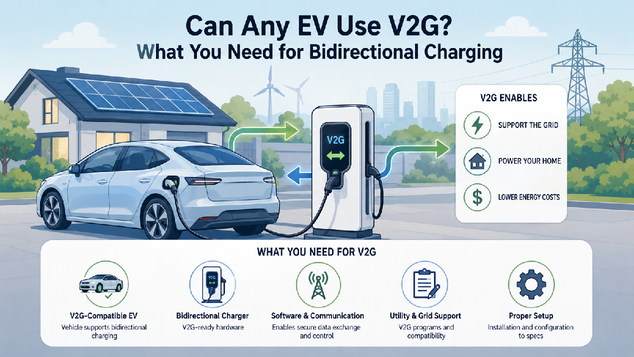
Bidirectional Use-Case Definition
Vehicle-to-grid refers to controlled exchange with an electricity network. Vehicle-to-home and vehicle-to-building describe supplying local loads, while vehicle-to-load can refer to powering appliances through a separate outlet. These modes may use different equipment, protection and approval routes. A vehicle that supports one does not automatically support the others. Buyers should confirm the exact mode rather than rely on the broad phrase “bidirectional charging.”
Vehicle, Charger, and Communication Compatibility
A conventional one-way charger cannot be converted safely through a setting. Bidirectional equipment needs power stages, sensing, control, synchronization and protection for both charging and discharging. The charger must follow vehicle limits and grid commands while preventing unintended energization. Depending on the architecture, it may also need galvanic isolation, anti-islanding functions and a defined response to loss of communication or utility supply.
Communication must align across the system. A functional v2g installation needs compatible communication between vehicle and charger, plus site control that schedules charging and discharging. A backend or aggregator may be required to receive grid or program signals. The vehicle owner or fleet operator may set departure time and minimum state of charge. All of these instructions must be resolved into a safe local power command that respects vehicle, charger and site limits.
Grid Approval, Operating Limits, and Pilot Validation
Exporting electricity can require utility review, approved protection, metering and compliance with local grid codes. Rules differ by jurisdiction and can change. Equipment capability alone does not authorize export. Islanded backup operation also needs a defined transfer, grounding and protection design; a grid-connected bidirectional charger should not be assumed to power a building during an outage unless that operating mode is explicitly designed and approved.
Operating Limits and Available Bidirectional Power
Real power depends on operating limits. Vehicle charge and discharge limits, battery temperature, state of charge, connector rating, charger output, site demand and grid instructions all influence actual power. A vehicle may reduce discharge to protect a minimum driving reserve. The site controller may pause export before a scheduled departure. Rated charger power is therefore an upper boundary, not a constant result in both directions.
What to confirm before deployment. For a v2g solution, confirm the exact vehicle and market version, connector, protocol, charge and discharge voltage range, power, grid-code support, anti-islanding behavior, metering, site wiring and authorization. The supplied 2026V3 catalogue includes 7 kW, 11 kW and 22 kW bidirectional solution categories, but compatibility and approved operating modes must be checked for the exact product, vehicle and jurisdiction.
Battery Reserve Policy and Pilot Testing
Ask who controls the battery reserve. Drivers and fleet managers need confidence that a vehicle will retain enough energy for its next trip. The operating policy should identify who sets the minimum state of charge, how departure schedules are updated and what happens when communication is lost. Vehicle warranty and participation terms should be reviewed from current official sources. A technically functional installation can still fail operationally if users do not understand or trust how charging and discharging decisions are made.
Controlled Pilot and Failure-Mode Validation
Plan a controlled pilot. Before wider deployment, a pilot should test normal charging, scheduled discharge, minimum-state-of-charge protection, communication loss, utility signal changes and user overrides. Logs should show which limit controlled each event. The pilot should also confirm that drivers can understand the displayed status and that operators can restore the system safely after a fault. This turns a compatibility claim into observed end-to-end behavior under the intended operating policy.
Not every EV can use v2g, and compatible hardware alone is not enough. The vehicle, bidirectional charger, communication, site controller and grid approval must align. UUGreenPower provides bidirectional charging categories for vehicle-to-grid and related applications; deployment should follow current vehicle, charger, utility and regulatory documentation.
Will a 22kW DC Wallbox Work with Your EV?
2026-08-12 NextCan Battery Energy Storage Power a DC Fast Charger Directly—and What Type of Charging Module Is Needed?
2026-08-13

