
2026-08-12
UUGreenPower
0
Not every EV model or regional version supports DC charging. Before choosing a wallbox, check the vehicle manual, inlet and listed charging-standard support. Some plug-in vehicles accept AC only, and a connector that looks familiar does not prove protocol compatibility. Vehicle capability is the first gate; external charging equipment cannot add a DC charging function that the vehicle was not designed to use.
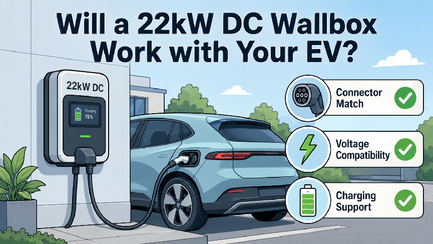
Vehicle, Connector, and Voltage Compatibility
The charger connector must physically fit the vehicle inlet and use a communication protocol supported by that vehicle version. CCS1 and CCS2 are not interchangeable solely because both belong to the CCS family. Regional imports can create additional uncertainty. The charger supplier should confirm the exact connector configuration, while the vehicle manufacturer or authorized documentation should confirm support for the intended DC charging method.
Make sure the voltage range overlaps. “22 kW” describes rated power, not battery voltage compatibility. The cited catalogue model family lists a 200 to 1000 VDC output range. The vehicle's actual charging voltage must remain inside the charger's controlled range. Compatibility also depends on current, accuracy, communication and protection. A wide voltage number should therefore be treated as one item in a complete interface check, not a universal vehicle guarantee.
Charging Power and Site Requirements
A 22 kW wallbox does not force 22 kW into every vehicle. The BMS requests allowable current according to battery temperature, state of charge and internal limits. Charging commonly tapers as the battery approaches a high state of charge. Cable temperature, AC supply, installation conditions and the charger's thermal controls can reduce output further. Lower displayed power can therefore be normal rather than evidence of incompatibility.
Site Supply and Installation Readiness
Confirm the site supply and professional installation. The DC charger still needs an appropriate AC input, protective devices, isolation, grounding and installation method. A qualified professional should verify the facility supply and local code requirements. Indoor or outdoor placement, cable reach, ventilation, drainage, mounting and network connectivity should be reviewed. Product enclosure ratings do not replace correct upstream protection or a site-specific installation assessment.
Environmental Ratings and Final Compatibility Review
The supplied catalogue lists the referenced 22 kW model family with IP65 and IK10 ratings. IP65 concerns defined dust and water-jet protection; IK10 concerns resistance to a defined mechanical impact test. Neither rating proves that every installation location is acceptable or that the unit can be submerged, obstructed or installed without required clearances. Current installation instructions remain the controlling reference.
Use a complete compatibility checklist. When comparing a wallbox EV charger, confirm vehicle model and market version, connector, protocol, output voltage, current, input supply, protection, enclosure rating, cable reach, network options and commissioning requirements. Ask whether any approved vehicle list is current and whether software updates affect support. The final check should combine charger documentation with the vehicle manufacturer's instructions rather than relying on one source alone.
Normal Charging Behavior and Fault Review
What a normal session may look like. A compatible vehicle may begin below 22 kW while the battery is cold, rise after conditions improve and then taper as state of charge increases. Another vehicle may remain below the rating throughout because its DC limit is lower. These outcomes do not change the charger's rating. Comparing the vehicle request, charger limit and measured output helps an operator distinguish normal charging-curve behavior from a site-supply, thermal or communication restriction.
No-Start Diagnosis and Escalation
If the vehicle does not start charging at all, the check should proceed from physical connection and vehicle support to protocol handshake, site protection and charger status. Repeated unplugging or assuming a higher-rated cable will solve the issue does not address a protocol or voltage mismatch. Clear fault information from both vehicle and charger can help a qualified technician identify the correct layer safely.
Compatibility confirmation should be repeated after significant vehicle or charger software updates when either manufacturer changes supported behavior.
A wallbox will work only when the vehicle, voltage range, connector, protocol and site supply align. UUGreenPower lists a 22 kW DC wallbox category; check the latest model sheet and current vehicle documentation before selection and commissioning.
UUinside: How Modular Components Simplify DC Fast Charger Development
2026-08-12 NextCan Any EV Use V2G? What You Need for Bidirectional Charging
2026-08-12

