
2026-08-12
UUGreenPower
0
A DC fast charger is a coordinated electrical and mechanical system. Power must enter safely from the grid, be converted into controlled DC output, reach the correct charging connector, provide a usable interface, and remain practical to assemble and maintain. UUinside organizes these functions into standardized units so charger developers can work with defined building blocks instead of starting with unrelated parts.
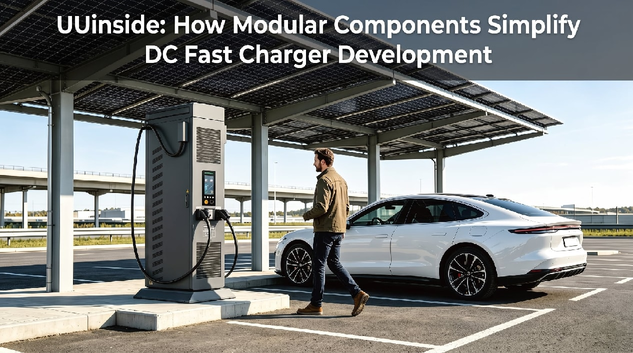
DC Fast Charging as a System Task
The charging module is essential because it converts AC input into the DC power requested by the vehicle. However, it cannot operate as a complete charger by itself. AC protection, output distribution, charger control, communication, display functions, connectors, cables, cooling, and safety logic must all work together.
This is why charger development is mainly an integration task. Even high-quality components can cause delays when their interfaces, ratings, software, and physical layouts have not been coordinated at system level.
Five Core Functions in Plain Language
UUinside divides the main charger functions into five core units.
The ACU handles "power in." It connects the charger to the AC supply and provides AC-side control, monitoring, and protection.
The PMU handles "power conversion." It changes AC power into controlled DC power and adjusts voltage and current according to commands from the charger system.
The DCU handles "power out." It manages the DC output path and sends converted power toward the required charging connector.
The DSU handles "user operation." It provides the screen, indicators, controls, emergency stop, and related user-facing functions.
The CMS handles "cable management." It supports and organizes heavy charging cables so they are easier to use and less likely to drag, bend excessively, or become disordered. A POS machine can be added when on-site payment is required.
Standardized Units Instead of Loose Parts
Standardization gives each unit a clearer functional boundary and defined place in the charger architecture. The customer is not simply given separate products and asked to determine how they should work together.
Instead, the ACU, PMU, DCU, DSU, and CMS are selected as parts of an approved configuration. This reduces repeated interface design and makes it easier to reuse engineering work across related charger models. Customization can focus on market requirements, cabinet design, branding, and project-specific features rather than rebuilding every basic function.
Pre-Testing Before Final Assembly
A key advantage of functional units is that they can be produced and checked before installation in the finished charger. This makes faults easier to isolate because each unit has a defined purpose and test scope.
Pre-testing does not remove the need for final system validation. After assembly, engineers must still verify protection sequences, controller communication, emergency shutdown, current sharing, connector operation, thermal behavior, and charger-level safety. It helps prevent basic unit faults from being discovered only after the complete cabinet has been built.
Scaling Across Power Configurations
UUinside supports different charger power levels through matched ACU, PMU, and DCU configurations. Higher output may require greater input-current capacity, more power-conversion capacity, and a higher-rated DC output path.
This is controlled configuration, not unrestricted mixing. Engineers must confirm electrical ratings, cooling capacity, mechanical fit, firmware compatibility, connector limits, and certification scope whenever a configuration changes.
Component-Level Maintenance with Configuration Control
When charger functions are separated into replaceable units, service teams can diagnose and replace the affected section instead of treating the whole cabinet as one repair item. This can simplify spare-parts planning and reduce unnecessary replacement.
Serviceability still depends on safe isolation, accessible placement, useful fault logs, compatible hardware revisions, and correct commissioning after replacement. "Plug-in" is therefore an assembly and maintenance concept, not permission for untrained personnel to remove energized components.
Modular Does Not Mean Universal
Standardized units make development more structured, but they are not automatically interchangeable across every charger. Connector standards, communication protocols, regional regulations, voltage ranges, and software behavior remain system-level issues.
UUGreenPower positions UUinside as a way to organize the main charger functions into defined, testable, and serviceable units. Its value comes from disciplined integration: clearer interfaces, reusable configurations, controlled customization, and a more practical route from component selection to a finished charger.
What Challenges Do EV Charger Manufacturers Face in Global Markets?
2026-08-11 NextWill a 22kW DC Wallbox Work with Your EV?
2026-08-12

