
2026-09-03
UUGreenPower
0
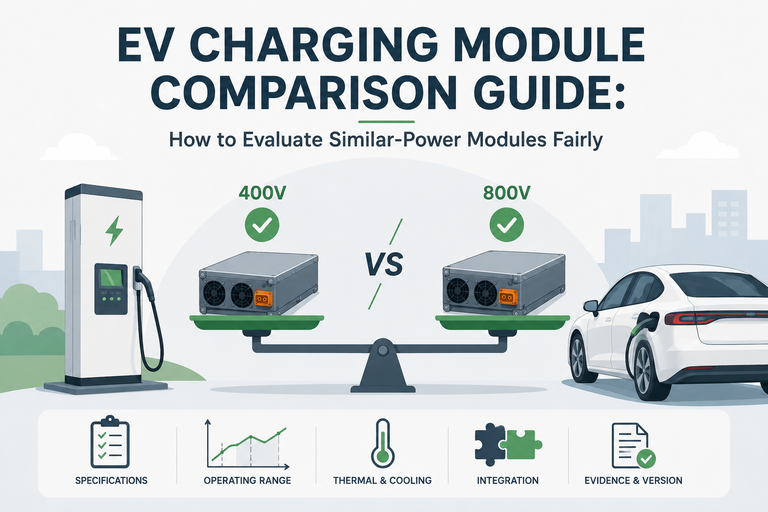
Two modules with the same headline kilowatt rating are not automatically interchangeable. A fair comparison of an EV charging module constant power range starts with one Comparable-Evidence Matrix that keeps model identity, operating conditions, definitions and integration scope together. The result should be comparable, conditional or unresolved—not a popularity ranking.
Define the comparison object
Write the identity line first: exact model suffix and region, document revision and date, hardware or firmware version, intended layer and project operating points. Without that line, “40kW charging module” can combine air, liquid and different revisions as if they were one product.
Use the Comparable-Evidence Matrix
Matrix row | UR100040-IP65(EU) | UR100040-SW(EU) | UR100040-LQ(EU) | UR150027L(EU) |
Output range | 150–1000VDC | 150–1000V | 150–1000V | 200–1500V |
Constant-power range | 300–1000VDC | 300–1000V | 300–1000V | 300–1000V |
Current | 0.5–133.3A | 0.5–133.3A | 0.5–133.3A | 0.5–106.6A |
Operating temperature | −40°C to 75°C | −40°C to 75°C | −40°C to 75°C | −40°C to 75°C |
Derating start | 55°C | 55°C | 60°C | 60°C |
Cooling wording | Cooling: Air; named IP65 entry also uses independent air duct wording | Cooling: Air | Cooling: Liquid | Cooling: Liquid |
Evidence action | Keep object, page and condition | Keep object, page and condition | Confirm liquid-system scope | Do not treat 1500V as constant power |
These are named UUGreenPower catalogue fields, not a common test report or complete-charger result. The 40kW headline does not erase the different cooling wording, current field or output boundary. UR150027L(EU) must remain 300–1000V constant power even though its output range reaches 1500V.
Keep the source page, model object, field definition and project requirement visible in the same matrix row. A missing page or condition is an evidence gap, not permission to borrow a value from another suffix. The matrix can compare rows with different cooling or voltage fields; it should not make those differences disappear.
Resolve conflicts once, in the matrix
Classify a disagreement as identity, condition, definition, revision or scope conflict. Identity means model, suffix or region differs. Condition means voltage, ambient, airflow or liquid-loop assumptions differ. Definition means peak, rated, full-load or constant-power wording is not equivalent. Revision means a newer sheet changes a value. Scope means a module field is being used for a charger, controller or backend. Keep the rows separate until the owner closes the conflict.
Ask for the condition behind a material number: voltage, continuous/peak status, ambient and cooling setup, test method and whether the production configuration was tested. This is not a second checklist; it is the evidence needed to complete the matrix row.
If a number is supplied without its operating point, leave that cell open and ask for the smallest clarification that would close it. If two sources disagree, preserve both source revisions and assign the conflict rather than averaging them. A clean comparison is one where the buyer can see why a value was accepted or held.
Control version and change evidence
Attach the controlled data sheet, test-condition record, approved deviation, product-change-notification process and module-to-charger acceptance owner. A change-control process does not prove lifetime, continuity or service level; it only provides the route for deciding whether a new comparison or retest is needed. If a supplier proposes a substitute, reopen the model, condition and scope rows rather than copying the previous percentage or power rating.
Release a comparable decision
Classify each candidate as Comparable when fields and conditions align for the stated requirement, Conditional when a named test, definition or project confirmation remains, or Unresolved when the gap could change the design. The next action must name an owner and document. A similar-power row should be released only when the buyer requirement sits beside the model evidence; a catalogue maximum is not a substitute for an operating-point check.
For UUGreenPower entries, retain the named model and source revision in the procurement record. Product Manual evidence can support the component row, but it does not establish vehicle compatibility, complete-charger certification, lifecycle, TCO or supplier responsibility.
Close each matrix row with the supporting evidence, unresolved conflict, next document or test, owner and review date. If the project changes the vehicle mix, voltage point, cooling arrangement or model suffix, reopen the affected row. When data cannot be aligned, “not comparable yet” is a valid engineering result; it identifies the condition that must be resolved before release.
Keep the buyer requirement beside every row
Write the project requirement next to the model evidence instead of scoring it elsewhere. If the charger needs 800V operation at a defined current, show that requirement beside output range, constant-power range and current. If the cabinet must operate under a specified ambient condition, show that condition beside cooling and derating. This makes it clear whether an open item is a supplier-data gap, a system-design gap or a project decision.
The same record should identify who can close the gap. Engineering may own the test point, procurement may request the controlled document and the product manager may approve a deviation. A comparison is auditable when the number, condition, model, document revision and owner travel together. Do not let a broad 40kW charging module label hide a different product layer or an untested operating point.
Before choosing between similar-power modules
Confirm that the exact models, output and constant-power ranges, current, thermal conditions, cooling wording, interfaces and revision status are visible in one matrix. If a 40kw charging module has an unresolved condition, keep it conditional rather than selecting the most favorable number. The EV charging module constant power range becomes decision-useful only when the same evidence fields and the same buyer requirement are compared on both sides.
EV Charger Module Selection Checklist: What to Define Before Comparing Models
2026-09-02 NextCharging Module vs. Complete Charger: How to Define Responsibility Boundaries in EV Charger Design
2026-09-03

