
2026-09-02
UUGreenPower
0
An EV charger module selection checklist is useful only after the charger team has frozen the requirements that the module must satisfy. If port count, vehicle voltage or concurrency is still moving, a detailed comparison creates false precision. The buyer should freeze the charger requirement, translate it into module evidence fields and then compare named candidates.
The same method applies when the shortlisted object is an EV charging module rather than a complete charger.
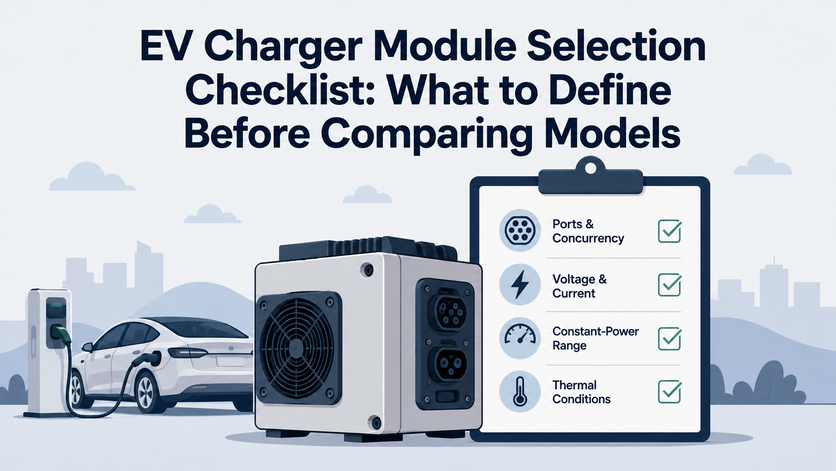
Freeze the charger requirement
Use one pre-selection checklist with an owner, revision and decision stage.
Charger requirement | Module evidence to request | Boundary to keep visible |
Ports and concurrency | Module behavior or documented allocation inputs | Complete-charger power sharing remains separate |
Voltage and current | Named model minimum/maximum and conditions | Do not infer lower-point performance from a headline |
Constant-power region | Stated range and test condition | Output range is not constant-power range |
Thermal environment | Operating range, derating start, cooling wording and setup | A start point is not a complete derating curve |
Interfaces and functions | Control, power and mechanical interfaces | HMI, payment, connector and backend need their own owner |
Evidence identity | Model suffix, document revision, date and deviations | Do not merge similar variants silently |
The table is a decision aid, not a test report. If a supplier gives only a maximum voltage, keep the low-voltage and constant-power rows incomplete.
Keep the product layer explicit
A single charging module, module pack or PMU, integrated charger and controller/backend are different review objects. The module comparison may cover power conversion and its documented interface. The charger team may still own cabinet integration, connector and vehicle communication, HMI, payment, networking, site commissioning and complete-charger certification work.
This avoids a common failure mode: a worksheet focused on an EV charger module can drift into requirements that actually belong to the complete charger. The buyer decision should determine the product layer being evaluated.
Use the exact model and condition from the UUGreenPower catalogue as a source example, not as a blanket performance claim. If a requirement belongs to another layer, place it in retained work rather than treating it as a missing module feature.
Mark evidence status before scoring
Use a short status flow: Ready to compare → Evidence incomplete → Clarification requested → Conditionally comparable → Release or hold. A row is ready when model identity, revision, voltage/current fields, constant-power field and relevant thermal conditions are present. It is conditional when a defined project test or responsibility remains open. Hold it when the missing item could change the architecture or safe operating envelope.
For each unresolved row, name an owner and requested document. “Supplier to confirm current at 400V under the stated ambient condition” is actionable; “looks compatible” is not. Keep version changes visible and reopen affected rows when the port count, power target, vehicle mix or model suffix changes.
Normalize the supplier row before comparing
Use the same evidence order for every candidate. First confirm the exact model and document revision. Then copy output range, constant-power range, current, temperature, derating start and cooling wording into separate fields. Finally identify which functions remain with the charger team: cabinet, connector, vehicle communication, controller, HMI, payment, backend, site work and complete-device evidence.
This prevents a familiar label from carrying an unstated conclusion. A 1000V charging module may still need a 400V current test; a model with a named IP field may still be only one component inside a cabinet; and a module interface does not automatically include the complete charger’s communication or service layer. Keep the missing row open with its owner instead of filling it from another model or from a package description.
The same discipline applies when a supplier sends a revised sheet. Store the prior and current revisions together, record what changed and state whether the change reopens the shortlist. If the baseline is not controlled, the team is comparing documents rather than candidates.
Release conditions
Before the shortlist is released, confirm:
• charger output envelope, port count and concurrency are version-controlled;
• voltage, current and constant-power requirements are separate;
• temperature and cooling conditions are recorded without inventing a curve;
• module, PMU, integrated charger and backend responsibilities are assigned;
• every open row has an owner and an evidence request.
If the first two conditions are not met, the team is still defining the charger rather than selecting a module. If only a named test or company document remains, keep the candidate conditional. If the missing fact could change the required module layer or power architecture, hold the decision.
The release note should also name the next review date and the evidence owner. That small control makes the checklist reusable when procurement, engineering and quality revisit the same model after a requirement or version change.
Before you compare models
The checklist is ready when it makes the next decision easier, not when it contains the most rows. Freeze the charger requirement, preserve the distinction between output range and constant-power range, and carry retained work into the architecture plan. Only then should an EV charger module selection checklist be used to compare named models and request supplier evidence from UUGreenPower. That sequence protects the buyer from treating a complete-looking worksheet as a released charger design.It also gives the supplier a precise clarification request.
1000V Charging Module: What to Check for 400V and 800V Charging Coverage
2026-09-02 NextEV Charging Module Comparison Guide: How to Evaluate Similar-Power Modules Fairly
2026-09-03

