
2026-09-04
UUGreenPower
0
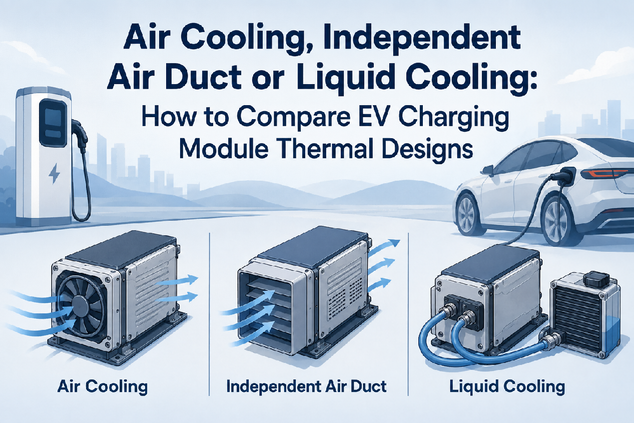
A liquid cooling charging module is not a complete thermal architecture. The buyer must match the named cooling wording to the protected object, cabinet boundary, auxiliary equipment, environmental conditions and service owner. Use one primary artifact: a Cooling Responsibility Worksheet. It compares documented model evidence and assigns the questions that remain outside the module.
Freeze the system conditions
Record target power and voltage, ambient and cabinet range, dust/water exposure, service access, acoustic or installation constraints, and whether a pump, heat exchanger or other liquid loop already exists. Also name who owns thermal testing, maintenance and acceptance. These inputs determine the evidence request; they do not allow a module label or IP value to be transferred to a complete charger.
Use the Cooling Responsibility Worksheet
Named route and model | Catalogue cooling wording | Model-level fields to keep with it | System question still open |
Cooling Air — UR100030-SW(EU), UR100040-SW(EU) | Cooling: Air / Air cooling | 150–1000V output; 300–1000V constant power; 0.5–100A or 0.5–133.3A; −40°C to 75°C; derates from 55°C | What cabinet airflow, environment and acceptance evidence apply? |
Independent air duct architecture — UR100030-IP65(EU), UR100040-IP65(EU) | Cooling: Air; named entry also says Independent air duct architecture | IP65 is tied to the named module; 150–1000VDC output; 300–1000VDC constant power; derates from 55°C | Which enclosure, openings and installation conditions are covered? |
Cooling Liquid — UR100040-LQ(EU), UR150027L(EU) | Cooling: Liquid | LQ: 150–1000V, 300–1000V constant power, 0.5–133.3A; UR150027L: 200–1500V output, 300–1000V constant power, 0.5–106.6A; both derate from 60°C | Which pump, heat exchanger, piping, coolant and maintenance scope is external? |
For the SW entries, keep only Cooling: Air, Cooling Air or “Air cooling.” Do not rewrite the wording as “Direct Air Cooling.” The independent-air-duct phrase remains tied to the named IP65 entries. The 1500V upper output listed for UR150027L(EU) does not change its 300–1000V constant-power range.
Keep object and responsibility separate
IP is an object-level question. Keep separate rows for the single module, module pack/PMU, integrated charger enclosure and installed site. A named module’s IP65 wording cannot be copied to the cabinet or complete charger. Request the object, model, configuration, test scope and validity when a formal claim matters.
Liquid auxiliaries also need their own owner. The Product Manual’s Cooling: Liquid wording does not define the project’s pump, heat exchanger, pipework, coolant service, maintenance schedule or auxiliary BOM. Ask what is inside the module, what is outside it and which test closes the combined arrangement.
Temperature is another separate row. The named p.5 and p.7 entries list derating from 55°C; the p.6 liquid entries list 60°C. These start points do not provide a complete output curve. Request the project-relevant table or curve instead of predicting performance, lifetime or reliability.
Apply the worksheet to the complete power path
Trace the route from the module to the cabinet and vehicle connector. For each row, record the named model, output and constant-power fields, current, ambient condition, cooling boundary, IP object, auxiliary components, test owner and change trigger. A module can meet its documented electrical envelope while the cabinet still needs a different airflow, liquid loop, connector or acceptance review. The worksheet should make that distinction visible before the supplier is asked to close a system claim.
For a liquid route, identify the pump, heat exchanger, piping, coolant specification, control signals, leak or fault response, service access and replacement responsibility. For the named independent-air-duct entries, identify the protected module object, cabinet openings and installation conditions. For a SW entry, keep the catalogue’s Air wording and request the system evidence required by the cabinet design. None of these questions should be answered by assuming that the module label covers the complete charger.
The same record should carry the operating point and the project’s environmental requirement. If a buyer needs a particular power at a particular voltage and ambient, write that requirement beside the model fields. If the source gives only a derating start, mark the curve as open. If the installation or auxiliary design changes, reopen the affected row rather than carrying a nominal cooling comparison into the release.
Decide the cooling route without ranking it
Classify the worksheet as fit for further review, fit with open system evidence or held. Use the first when the named model meets the electrical envelope and the system conditions are documented. Use the second when the module evidence is usable but an enclosure, auxiliary, service or acceptance row remains. Hold the route when an unresolved thermal or protection condition could change the architecture.
Do not use cooling as a proxy for TCO, uptime, reliability, lower maintenance or universal environmental performance. Those conclusions need their own evidence. A model comparison can still be useful when it shows exactly what the catalogue supports and what the system team must close.
The decision note should list the retained model rows, evidence supporting each, unresolved auxiliary or enclosure questions, responsible owners and the next review date. This keeps engineering, procurement and service teams comparing the same object and condition when the shortlist is revisited.
If a supplier proposes a different cooling configuration or model suffix, reopen the worksheet rather than treating it as an equivalent substitute. The evidence may remain useful, but the responsibility boundary must be checked again before release.
Before selecting the cooling route
Start with the operating environment and target envelope. Then preserve the exact cooling wording, output and constant-power range, current, temperature and derating fields. Keep IP attached to its named object, request the liquid auxiliary boundary and assign service ownership separately. With those rows complete, an EV charging module team can assess a liquid cooling charging module without turning a catalogue label into a universal performance claim for UUGreenPower.
How to Choose a Modular EV Charging Solution: Key Integration Checks for Charger Integrators
2026-09-04 NextIP65 Charging Module vs. Complete-Charger Enclosure: What Does the IP Rating Actually Cover?
2026-09-07

