
2026-09-07
UUGreenPower
0
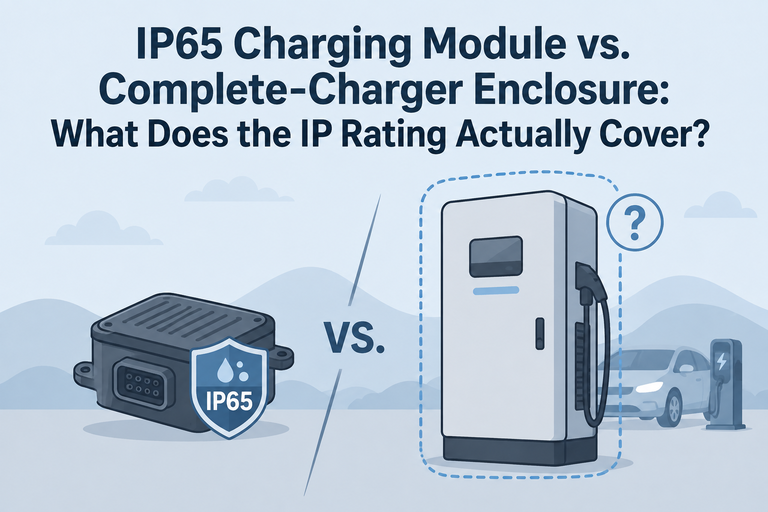
An IP65 charging module is meaningful only when the protected object, model and evidence scope are named. For a buyer evaluating an EV charging module, a single module, module pack, integrated charger enclosure and installed site are different objects. Use one primary artifact: an Object-Level IP Evidence Map.
Map the named object first
Named object | Catalogue-level IP wording | What the row can support |
UR100030-IP65(EU) | IP65 for the named module entry | The named module’s catalogue statement |
UR100040-IP65(EU) | IP65 for the named module entry | The named module’s catalogue statement |
UR100040-LQ(EU) | IP65 for the named liquid-cooled module entry | The named module’s catalogue statement |
URP100022(EU) | IP65 for the named module-pack entry | The named module pack’s catalogue statement |
UC22K1000-AY1-CCS1/CCS2; UC50K25P-EY2 | IP65/IK10 fields on named integrated-device entries | Only the named integrated-device configuration |
UR150027L(EU) | The p.6 entry does not list IP65 | Do not inherit UR100040-LQ(EU) wording |
These are separate UUGreenPower catalogue rows, not one universal “charger IP65” conclusion. The model and product layer must stay in the wording.
For each map row, record the source type, model or configuration, the claim it can support and the next owner. A catalogue row can be usable while a formal certificate, changed configuration or installed-site inspection remains open.
Keep module, pack, enclosure and site evidence separate
An IP statement for a module cannot be copied to a cabinet or complete charger. The enclosure may add doors, seals, cable entries, ventilation, liquid auxiliaries and service openings that change the protection question. A module pack or PMU also needs its own configuration and boundary. If a formal certificate or test report matters, request the object, model, version, holder, method, configuration, validity and exclusions.
The same rule applies to integrated devices. A named integrated configuration may list connector, display, network, IP or IK fields; those fields do not transfer to a separate module family. Ask the RFP owner whether the requirement applies to a module, pack, integrated device, cabinet or installed system. Put ambiguous layer language into a clarification row.
For each map row, record the source type and the decision it can support. A catalogue statement may establish that a named object is listed with IP65. A formal certificate or test report may establish a defined test scope, holder, laboratory method and validity. A project acceptance record may establish the installed configuration. These evidence types are complementary, not interchangeable.
If the buyer is evaluating a liquid cooling charging module, keep the cooling object and the IP object together only when the same named model and configuration are being discussed. The cooling wording does not prove enclosure protection, and IP wording does not prove liquid-loop performance. Request the responsible party for the combined system row instead of treating either label as the whole architecture.
Handle configuration and field conditions
IP evidence is tied to the configuration and conditions recorded by the source. Confirm whether the tested or listed object includes the production enclosure, covers, cable entries, cooling openings, connectors and service interfaces used by the project. If the installed design differs, retain the original record as context but request the evidence needed for the changed configuration.
Field work can reopen the protection question. A replaced module, opened cabinet, new cable gland or modified liquid loop may require inspection or a new acceptance step. Record who may perform the work, which seals and covers must be restored, what inspection closes it and how the post-change configuration is recorded.
When the evidence is incomplete, use Supported, Conditional or Held. Supported means the named object, wording and required scope are traceable. Conditional means the catalogue row is usable but a formal test, configuration or field inspection remains. Held means the missing object or condition could change the procurement decision. This status belongs to the specific row, not to the supplier or product family as a whole.
Do not turn IP into performance marketing
IP65 does not, by itself, prove uptime, reliability, longer life, lower maintenance or complete-charger environmental performance. Keep protection, thermal, reliability, service and site rows separate. A named module can be listed with IP65 while the cabinet, auxiliary system or field installation remains open.
For example, the catalogue can close “UR100040-LQ(EU) is listed with IP65,” while a formal certificate row may still need holder, scope and validity and the complete charger may still need enclosure evidence. Record the next owner beside the open row rather than turning the map into a general supplier status.
Keep the map with the RFQ and acceptance baseline. If the model suffix, enclosure, cable entry or installation condition changes, identify the affected row, request the new evidence and record the owner and review date. This prevents a previously valid object statement from silently becoming a system statement after release.
Before you release the IP statement
Ask: Is the object a module, pack, integrated device or complete system? Is the model and version explicit? Does the wording come from a catalogue, test report or formal certificate? Does it cover the configuration being procured? Have uptime, reliability, lifetime and maintenance claims stayed separate?
Air Cooling, Independent Air Duct or Liquid Cooling: How to Compare EV Charging Module Thermal Designs
2026-09-04 NextHighly Efficient EV Charging Module: How to Compare Peak, Rated and Full-Load Efficiency
2026-09-07

