
2026-09-08
UUGreenPower
0
Adding a connector, protocol version or communication implementation is a change-control decision. The team must identify what changed, which layer is affected and whether the existing evidence still describes the released configuration. The useful question is not whether an earlier approval “looks similar”; it is whether its named object, version and scope still match.
For teams delivering commercial EV charging solutions, use one primary artifact: a change-impact register. It makes the delta visible before the change becomes a new test, procurement or release obligation.
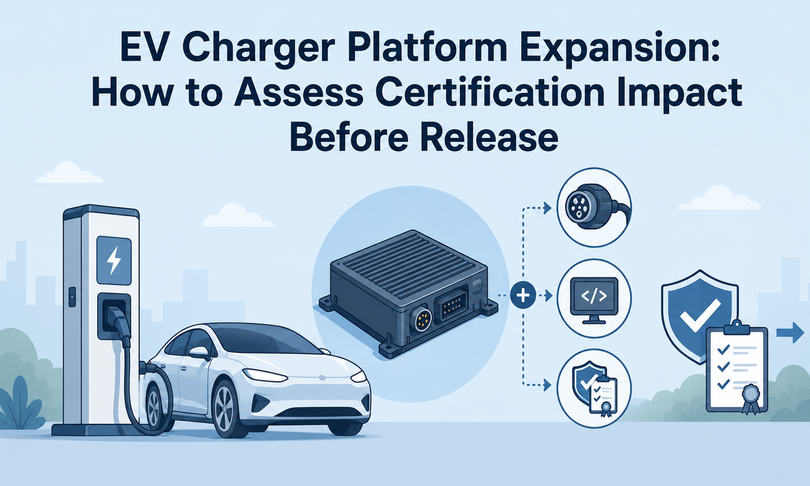
Define the change before reviewing evidence
Describe the changed object in plain language before asking what evidence is needed. A connector change may involve a pinout, cable assembly, vehicle-side interface or cabinet option. A protocol change may involve a stack, profile, firmware baseline or backend pairing. Record the concrete object rather than relying on a platform label.
Change object | Record before review | Evidence that may be affected |
Connector or cable configuration | Interface, pinout, rating, option and vehicle-side setup | Product specification, interface record, safety and functional tests |
Protocol version or profile | Implementation, version, profile, firmware and message behavior | Conformance record, software baseline, regression or integration tests |
Communication path | Controller, CSMS, network route and configuration | Interface control, pairing evidence and acceptance records |
Hardware/software release | Model, BOM, option code, revision and release date | Change notice, retest decision and release approval |
This register identifies review questions; it does not decide which certificate, regulation or test programme applies. That decision belongs to the applicable official requirement and the responsible project or compliance team.
Map the affected layer and baseline
Write a separate row for every layer touched by the change. A named EV charging module may have a model-level electrical and control record. A module pack or PMU has a different integration boundary. An integrated charger adds enclosure, connector, communications and acceptance objects, while a controller or backend adds software and network scope.
If a connector is added to an integrated charger while the module is unchanged, do not use the module row as the complete change record. If firmware changes communication behavior, a catalogue parameter table cannot close the protocol or interoperability question. The baseline should therefore include the model or option, document revision, firmware, interface-control record and release date.
Keep variants separate until the project confirms that the same evidence scope applies. This prevents a familiar product name from hiding a configuration-specific test obligation and prevents an earlier module record from being treated as proof for the expanded charger.
Build the change-impact register
Use the following fields as the single decision artifact. Each row should have an owner and an open action where closure is not yet possible.
Register field | What to record | Decision use |
Changed object | Model, option, version, firmware and configuration baseline | Confirms exactly what is being released |
Interface delta | Electrical, mechanical, vehicle-side or communication boundary | Identifies the affected layer and test context |
Evidence inventory | Reports, declarations, certificates and test records with scope | Shows which documents name the same object and version |
Retest trigger | Function, regression, conformance, pairing or acceptance review to consider | Records required, not required or unresolved |
Responsibility | Supplier, product, compliance, integrator and project roles | Assigns the decision instead of assuming one owner |
Open action | Missing document, test, official requirement or approval date | Prevents an open issue being hidden by a broad label |
Treat “certification impact” as a review trigger, not as a conclusion that a connector always needs a particular certificate or that a protocol change invalidates every prior result.
Keep protocol and interoperability questions separate
An expansion can change the pairings that need checking even when the protocol definition is familiar. Record the selected charger, controller or CSMS, vehicle-side setup, profile, network assumptions and test environment. A conformance review concerns a defined implementation and scope; an end-to-end interoperability check concerns the selected equipment and configuration working together. The project may require one or both, but the register should preserve the decision and owner.
Do not treat a protocol listing as a live project result, and do not assign a supplier’s certificate or interoperability responsibility without the applicable company, contract or interface evidence. The same rule keeps a product-material example from becoming a claim about UUGreenPower status.
Close the release and supply decision
Classify each register row as Closed, Conditional or Held. Closed means the changed object, applicable requirement and supporting evidence are identified and accepted. Conditional means the route can proceed with a named test, document or owner still open. Held means the unresolved item could change the architecture, evidence scope, interoperability result or release configuration.
Add one release-and-supply row even when the technical change looks small. A connector or protocol option can affect the BOM, firmware release, production instruction, service document, PCN or customer acceptance script. The purpose is to give the responsible team a place to confirm the consequence, not to predict it.
OCPP Conformance vs. Certification vs. Interoperability Testing: What’s the Difference?
2026-09-08 NextEV Charger Supplier Qualification Checklist: What to Verify at Product and Company Level
2026-09-08

