
2026-09-08
UUGreenPower
0
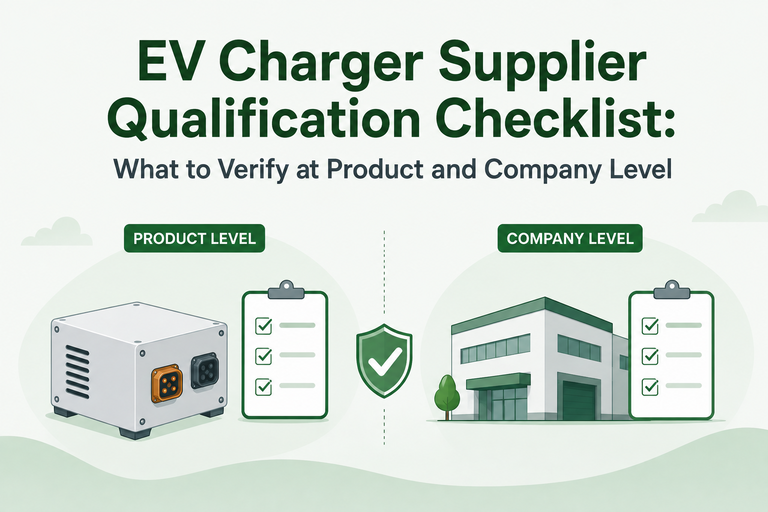
A module datasheet can be a useful starting point for voltage, current, efficiency and cooling. It cannot answer who manufactures the product, what quality system applies, how capacity is measured or what service is included. An EV charger supplier qualification checklist should therefore use one primary artifact: a Two-Track Qualification Matrix.
When an EV charging solution procurement team evaluates an EV charger module supplier, it should verify the contracting entity, purchased scope and delivery responsibilities through official company evidence.
Track the purchased object
Write the layer in the first column: single charging module, module pack/PMU, integrated charger, controller/backend or service/platform scope. Then record:
• model, suffix and document revision;
• output voltage and constant-power range;
• current, temperature, derating and efficiency wording;
• cooling wording and the named IP object;
• interfaces, protections, certificate/test scope and deviations;
• options, substitutions and change-control triggers.
Keep every row model-specific. A 40kW label does not authorize combining the voltage, current, efficiency or cooling fields of different 40kW models. A module record cannot be transferred to a complete charger, backend or site.
Track company and supply evidence separately
The second track covers the legal and commercial boundary when it matters to the decision:
• contracting and legal entity;
• official manufacturing or assembly scope;
• QMS certificate, site/process scope and validity;
• production capability and defined capacity basis;
• lifecycle, PCN and substitution process;
• active-sale and target-region status;
• MOQ, lead time, continuity and allocation terms;
• repair, training, escalation and SLA scope.
These are requests for official company or contract documentation. They must not be inferred from a model page, a catalogue logo or a general supplier statement. If the current method remains neutral, it can explain what to request without filling in the supplier’s answer.
Use the Two-Track Qualification Matrix
Area | Product/model evidence | Company evidence | Gate question |
Identity | Exact model, suffix, revision and layer | Legal/contracting entity | Are object and entity both named? |
Technical fit | Voltage, current, constant power, temperature, efficiency and cooling | Not a substitute | Does the model meet the frozen envelope? |
Protection/certification | Object, holder, lab, scope, region and validity | Current company status if relevant | Does evidence cover the purchased object? |
Quality/change | Test, deviation, acceptance and retest trigger | QMS scope, site/process and PCN | Who controls quality and changes? |
Supply | Configuration, options and substitution impact | Capacity, active sale, MOQ and lead time | Can supply risk be monitored? |
Service | Interface and acceptance requirements | Repair, training, escalation and SLA | Who owns support after delivery? |
Mark each row complete, complete with open evidence or hold. Do not hide an open company row inside a product score.
The matrix should also record why a row is conditional. A product row may need a revised datasheet, test report, deviation response or model confirmation. A company row may need a dated official document, contracting clarification or service attachment. State whether the gap blocks the RFQ, blocks award or can close during a controlled validation step.
Close product rows before company conclusions
Confirm the object first. HMI, payment, connector, OCPP backend, cabinet, site commissioning and CPO operation do not automatically belong to a single charging module. If a solution/platform is offered, request the interface control document, responsibility matrix and acceptance plan rather than treating a diagram as a fixed BOM.
Request the named model’s output range, constant-power region, current, temperature, derating start and efficiency wording with the source page. Ask whether each IP or certificate statement applies to the module, PMU, integrated charger or site. “Compatible,” “ready for” or a logo is not a formal certificate.
Make company rows measurable
For manufacturing, define whether the claim means design, assembly, contract production or another role. For capacity, define units, period, product/configuration, location and operating assumptions. For QMS, record holder, scope and validity. For service, state remote support, repair, spares, commissioning, field response or SLA. An official document may support one row without proving all the others.
Do not request or accept a company claim merely because a supplier label suggests it; request that evidence only when the procurement decision depends on the underlying fact. Record the owner, next document and review date for every conditional row.
Turn the matrix into RFQ questions
Ask:
1. Which exact product layer, model, version and interfaces are quoted, and which source revision supports them?
2. What output, constant-power, temperature, derating, IP and certificate conditions apply to that named object?
3. Which entity is responsible for manufacturing, contracting, QMS, supply and service, and what current official evidence supports each material claim?
4. Which integration, acceptance and change-control work remains with the buyer or integrator, and what must close before award?
An open row should state whether it blocks the RFQ, award or only a controlled validation step. “Pending official company evidence for service scope” is actionable; a general confidence score is not.
Keep requests proportionate to the decision stage. An early shortlist may need model identity and operating-envelope evidence; a final award may also need QMS, capacity, lifecycle, service and contract terms. Optional rows should not be silently converted into supplier promises.
Applying the review to UUGreenPower materials
UUGreenPower catalogue material can support named model rows. The UUinside solution-platform material provides architecture context for components and services, but it does not by itself establish a project’s contracting, manufacturing, fixed BOM, service or SLA boundary. Keep those matters on the company and contract track.
The same method applies when a team already owns part of the charger. Record which controller, cabinet, acceptance process or field service is reusable, which work remains with the integrator, and what evidence proves that reuse. A supplier label should not silently absorb those retained responsibilities.
Before supplier qualification
Release the checklist when the named product fits the frozen technical requirement, the company evidence required for this stage is traceable, and every open row has an accountable closure path. Otherwise record conditionally qualified or hold for evidence. A technically suitable EV charger module and a sufficiently evidenced supplier are related decisions, not the same claim.
EV Charger Platform Expansion: How to Assess Certification Impact Before Release
2026-09-08 NextEV Charger Module Manufacturer vs. Supplier vs. Factory: What Evidence Should Buyers Request?
2026-09-09

