
2026-09-09
UUGreenPower
0
Manufacturer, supplier and factory can describe different roles. A product catalogue can identify a charging module and its parameters, but it does not by itself prove who makes it, who contracts to supply it, which facility is responsible or what capacity is available. For an EV charging solution shortlist, use one primary artifact: a Supplier-Role Evidence Map.
When a buyer evaluates an EV charger module manufacturer, the product, entity, facility and contract claims should be recorded as separate rows.
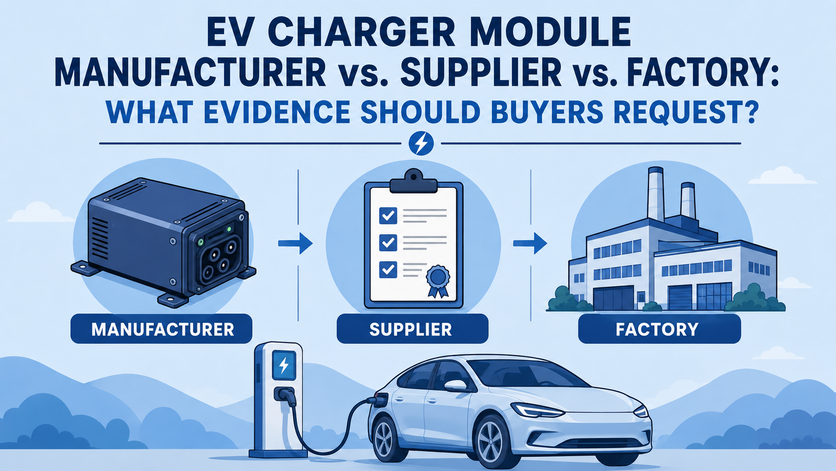
Separate the roles
Term | Buyer question | Evidence to request |
Manufacturer | Who makes or controls the named product/configuration? | Official company statement, entity relationship and change responsibility |
Supplier | Who contracts to deliver the purchased scope? | Legal entity, deliverables, terms and acceptance responsibility |
Factory | Which facility makes, assembles, tests or stores it? | Official facility scope, operating entity and quality records |
Capacity | What quantity, product and period does the claim measure? | Defined basis, assumptions, production evidence and time frame |
QMS | Which system covers the relevant production/delivery scope? | Holder, scope and validity of official QMS evidence |
One organization may appear in several rows, but one word is not proof of another.
For each row, preserve the exact claim wording, named object or entity, source date, scope, limitation and next evidence owner. The map is a control record for a procurement decision, not a glossary or a ranking of companies.
Keep product and company evidence on separate tracks
First identify the purchased layer: module, module pack/PMU, integrated charger or controller/backend. A named module entry can support model-level output, current, cooling, efficiency or IP wording when the catalogue states it. It does not automatically establish manufacturer identity, factory location, capacity, MOQ, lead time, active-sale status, QMS, service coverage or SLA.
This separation is especially important when a shortlist uses broad labels such as “manufacturer” or “factory.” Those labels frame the buyer’s question; they do not prove the underlying commercial or production role.
Define the manufacturer and supplier claims
Ask what “manufacturer” means for the named product: design, build, assembly or contract production; model/version/configuration; entity responsible for changes and nonconformities; and document/date supporting the role. Do not turn a product photograph, catalogue logo or architecture diagram into a manufacturing conclusion.
Supplier is a procurement relationship, not a synonym for manufacturer. Request the contracting entity, product/service layer, quotation and change-control responsibility, delivery and acceptance obligations, warranty/spares scope and any subcontracting arrangement. The word supplier should not promise a complete charger, backend, site delivery or service network unless those deliverables are documented.
Define factory and capacity claims
Factory language may mean ownership, operation, assembly, contract manufacturing or storage. Ask which entity controls the site, what product/configuration and period are covered, what testing and traceability apply, and how alternate sites or subcontractors are controlled. A DC charging module factory label does not prove that the facility makes every module family or supplies the complete charger.
Capacity is not measurable until its basis is defined. Record product, configuration, units or power basis, period, location, shifts, committed allocation and quality-release limits. Do not fill the gap with industry averages or unsupported assumptions.
Verify QMS, lifecycle and service separately
QMS evidence identifies a system, holder, scope and validity; it does not prove a module’s performance or available capacity. Continuity review should cover active-sale status, product-change notifications, substitution and end-of-life. Service review should state remote support, repair, spares, training, commissioning, field response or SLA, with owner and exclusions.
For each document, record issuing entity, date, product/site/process scope, model/configuration, region and limitations. One official document may support one row without answering the others.
Apply the map to a shortlist
For an EV charger module supplier, create separate product and entity rows. The product row records model, voltage/current, cooling, efficiency and test conditions. The entity row requests manufacturer/supplier/factory role, QMS, capacity, lifecycle and service evidence. This approach keeps the review neutral rather than turning it into a company profile.
Official material should be specific enough for the claim. A company profile may establish an entity and broad business scope without establishing the capacity of a particular factory or availability of a model. A quality certificate may establish a QMS scope without proving every configuration was produced under it.
If official material is incomplete, request the missing scope, check current UUGreenPower official company material, ask for a dated configuration-specific document or contract term, and use client confirmation only when official evidence cannot resolve the boundary. Do not replace the missing answer with a competitor list, industry average or unsupported external claims.
Avoid ranking language
Manufacturer and supplier comparisons can easily drift into “top” lists or ranking tables that imply endorsement. Use the same evidence rows for every candidate and mark each claim supported, conditional or open. It also prevents a broad commercial label from becoming an unsupported statement about any named organization.
Before the claim enters procurement
Ask whether the claim is about a product, entity, facility or contract; whether model/configuration and scope are named; which source supports it; whether the evidence covers the whole claim; and which capacity, QMS, lifecycle, supply and service rows remain open.
A buyer can use manufacturer, supplier and factory terms confidently when each is tied to its own evidence requirement. The result is a clearer RFQ and a defensible shortlist—not an automatic conclusion about who makes, supplies or operates a charging product.
EV Charger Supplier Qualification Checklist: What to Verify at Product and Company Level
2026-09-08 NextDC Charging Module Factory Claims: What Evidence Should Buyers Verify Before Procurement?
2026-09-09

