
2026-09-09
UUGreenPower
0
A supplier page may describe a factory, production capability or capacity without giving procurement enough evidence to rely on the claim. The buyer should identify the exact statement, define the evidence that would establish it and decide whether the gap blocks the current purchasing step. This is especially important when an EV charging solution will be supported over a multi-year programme.
Use one primary artifact: a Company Evidence Gate. It turns a broad page label into a bounded claim, evidence request, scope check and procurement decision.
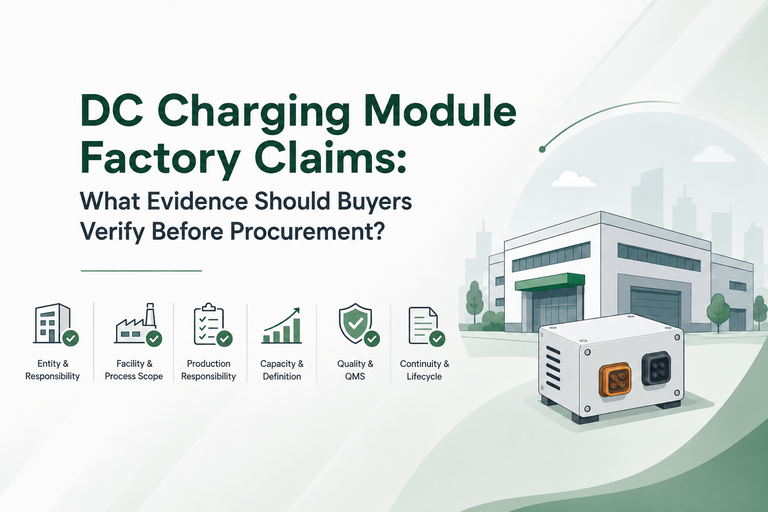
Name the claim before requesting proof
“Factory” and “capacity” are not single fields. A page may refer to a legal manufacturing entity, owned facility, contract manufacturer, assembly site, production line, stocking location or future capability. Write the claim so another reviewer can check the same object and responsibility.
Claim | Evidence question | Scope to record | Gate decision |
Manufacturing entity | Which legal entity is responsible for the purchased object? | Contracting party and named product layer | Supported, conditional or open |
Facility scope | Which site performs design, assembly, testing or final release? | Site, process and responsible entity | Scope confirmed or unresolved |
Production responsibility | Is the party making, integrating, sourcing or reselling the object? | Activity and contractual boundary | Role established or unverified |
Capacity | What unit, period, configuration and constraint does the number measure? | Product family, site and time basis | Definition usable or incomplete |
Continuity | How are lifecycle, PCN, substitution and allocation risks handled? | Selected model and programme assumptions | Controls evidenced or open |
The gate does not judge whether a page is honest or whether a large number is impressive. It records what the buyer can rely on for the present decision.
Set the gate around the purchased scope
Start with the object that will appear in the RFQ: a charging module, module pack or PMU, integrated charger, controller/backend component or another defined scope. Record the model or configuration where one is proposed. Then ask who designs, assembles, tests, releases and supports that object. These activities may sit with different entities or sites.
Do not accept a group-level statement when the procurement decision needs a site-level answer. Design, assembly, final test, warehousing and service can be described separately. The evidence request should name the facility, entity and process that matter to the selected configuration rather than copying a corporate adjective into the product row.
Define capacity and continuity together
Capacity has meaning only when its unit, period, product family, configuration and limiting constraint are visible. “Large factory” or “high capacity” cannot be compared to a programme requirement without that definition. A figure may describe one module family, complete-charger assembly, a shared line or a plan rather than an available allocation.
Continuity is a separate but related gate. Ask how lifecycle status, product-change notification, substitution, allocation and escalation are managed for the selected model. A stated capacity does not answer those questions. Keep the capacity row open if the programme depends on a promise that has not been defined by current official company or contract evidence.
Keep product evidence and company evidence separate
The product track asks whether the named object fits the electrical, thermal, interface and documentation requirements. The company track asks whether the entity can support the manufacturing, quality, lifecycle and contractual responsibilities being proposed.
A product catalogue may identify a named module or integrated object. It does not, by itself, prove legal manufacturer identity, factory ownership, output, MOQ, lead time or regional supply. For example, a UUGreenPower catalogue entry can be a product-source example while the company row still requires Official Company Evidence. This prevents a claim about an EV charger module factory from becoming a broader company conclusion by implication.
Apply the gate at the right procurement stage
At broad discovery, record the named company, purchased layer and basic product fit; a conditional candidate may remain. At RFQ or qualification, require current identity, production responsibility and relevant quality or lifecycle scope. At award, require the contracting entity, configuration, capacity definition, continuity assumptions and service obligations that affect the contract. During programme delivery, reopen the row if the model, facility or allocation basis changes.
The threshold is a decision rule, not a supplier ranking. A smaller-looking supplier with defined evidence may be more usable than a page with broad claims and no scope.
Close, condition or hold the claim.
Use four statuses in the procurement file: Supported when the current official document names the entity, object and scope needed; Conditional when one validity, configuration, contract or responsibility detail remains open; Unverified when the page claim lacks an official source or usable scope; and Not required at this stage when the question is recorded but does not yet block discovery.
For company-level statements, check current official company material first. If it still cannot establish the claim, record the unresolved item for client confirmation rather than writing an answer into the article or award file. Keep the open row visible, with an owner and next decision date.
Before procurement relies on the page
Ask: What object and entity does the page describe? What does its factory or capacity statement measure? Which current official document establishes responsibility and continuity? What decision remains conditional if that evidence is unavailable? When those questions have bounded answers, the buyer has a defensible evidence status. When they do not, keep the claim conditional or held instead of turning a supplier label into an unsupported conclusion about UUGreenPower or any other organization.
EV Charger Module Manufacturer vs. Supplier vs. Factory: What Evidence Should Buyers Request?
2026-09-09 NextHow to Shortlist DC Charging Module Manufacturers: A Buyer’s Evidence-Based Guide
2026-09-09

