
2026-09-09
UUGreenPower
0
A broad discovery search can return manufacturer pages, supplier portfolios, inquiry forms and product listings that describe different objects and responsibilities. The buyer’s decision is not which company deserves a ranking. It is which candidates should advance to a controlled evidence review.
For an EV charging solution, use one primary artifact: a Shortlist Funnel. It moves a lead from discovery to a verifiable shortlist without turning a page label into a qualification result.
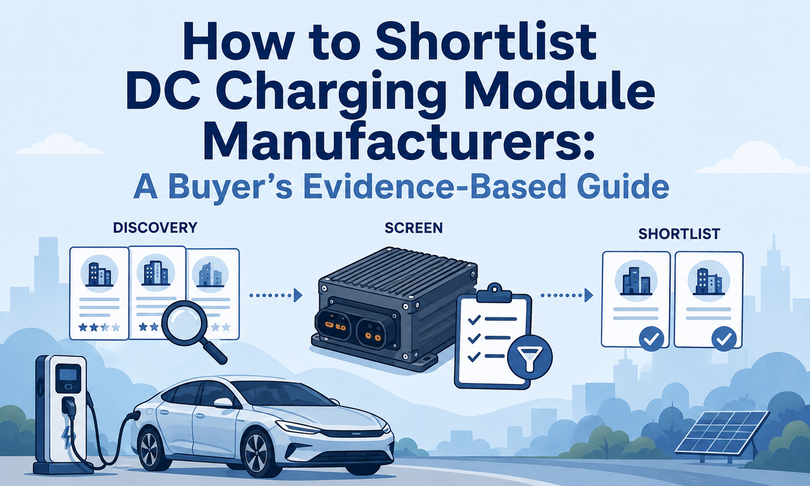
Start with discovery, not ranking
Discovery asks who might be relevant. Qualification asks whether a candidate can supply the purchased object and support the evidence the programme requires. Keep the first record lightweight: source page, company name, proposed product layer, named model if available and the question that caused the candidate to be opened.
A manufacturer or supplier label is a reason to investigate, not proof of manufacturing responsibility or factory scope. A technical page may identify useful fields without proving complete-charger, site or service capability. An inquiry page may show that a conversation is possible while leaving configuration, lifecycle and delivery obligations open.
Do not publish a Top 10 list or use factory size as a substitute for fit. A shortlist is useful when each remaining candidate has the same evidence questions applied to the same purchased scope.
Run the Shortlist Funnel
Funnel stage | Decision to make | Minimum record before advancing |
Discovery | Is there a plausible company and product route? | Source, company, product layer and initial reason for inclusion |
Minimum evidence screen | Does the proposed object deserve technical review? | Named model or configuration, basic interface/operating evidence and obvious mismatch |
Verifiable shortlist | Can the candidate be compared on the same fields? | Product evidence, company-evidence status, open risks and responsible reviewer |
Qualification handoff | Is the candidate ready for RFQ or formal review? | Required documents, continuity/service questions, owner and next decision date |
The funnel does not score supplier popularity. It records why a candidate advances, stays conditional or exits, and keeps an open evidence row visible.
Match the purchased layer before comparing features
Start with the object the programme plans to buy: a single charging module, module pack or PMU, integrated charger, controller/backend component or another defined scope. Record the model or configuration actually proposed. Then ask:
• Does the candidate address the required product layer?
• Is the model, revision and configuration named?
• Are the required voltage, current, cooling, interfaces and conditions documented for that object?
• Does the evidence describe what will appear in the RFQ?
• Which work remains with the integrator or charger manufacturer?
This prevents a plausible module supplier from being treated as a complete-charger provider. It also prevents a company page from substituting for model-level fit. If a candidate offers several layers, keep the roles separate instead of awarding confidence to the company as a whole.
Compare like with like
When several candidates reach the same funnel stage, compare the same fields in the same order. Check purchased-product fit, product-layer fit, model evidence, documentation revision, applicable certification or official requirement, company-evidence status, continuity and responsibility for unresolved work.
If one candidate supplies a module datasheet and another supplies only a complete-charger brochure, record the layer mismatch before comparing efficiency, price or capacity. If one company document is current and another is undated, record the validity gap rather than treating both as equal evidence. If a candidate appears as both manufacturer and supplier, retain one evidence record and add the roles; do not count several page types as independent proof.
When reviewing UUGreenPower materials, product information can help identify what needs verification, but it cannot by itself establish manufacturer identity, factory capacity, service scope or endorsement. Those conclusions require the relevant official company or contract evidence.
Use a stop rule when a material mismatch remains. A candidate should not advance simply because another page supplies an attractive parameter or a larger capacity statement. Keep the unresolved field attached to the candidate, identify the document or owner needed to close it and record whether the gap is acceptable for discovery, RFQ or award. This keeps the funnel progressive without turning incomplete evidence into a negative judgement about the company.
Prepare the qualification handoff
Before inviting a candidate into formal qualification, pass forward a compact record containing the proposed layer and model, required operating points and interfaces, documents received and their revisions, official requirement still to verify, company and manufacturing evidence still open, continuity and service responsibilities, unresolved risk, owner and next decision date.
State what would remove the candidate from the shortlist: an unresolved model identity, incompatible interface, missing official company document, unacceptable continuity gap or responsibility that cannot be assigned. These are decision rules, not a judgement about a company’s reputation.
Freeze a defensible shortlist
Ask whether every remaining candidate passed the same funnel stages for the same purchased layer and under the same evidence definitions. If not, it is still a discovery list. If yes, procurement can move to an RFQ with a clear reason for every inclusion and an explicit record of what remains conditional.
That is the practical value of translating a search for DC charging module manufacturers into a supplier-evidence shortlist: it produces an auditable decision record instead of a ranking statement, while keeping product evidence and company evidence on separate tracks.
DC Charging Module Factory Claims: What Evidence Should Buyers Verify Before Procurement?
2026-09-09 NextEV Charging Site Readiness Checklist: What to Verify Before Commissioning
2026-09-14

