
2026-09-14
UUGreenPower
0
An acceptance package is only as reliable as the site assumptions behind it. If the utility interface, layout, network path or environmental conditions are still moving, the project may write a test plan for equipment that cannot be installed, energized or accepted as described. The decision is whether the site inputs are mature enough to support commissioning planning.
An EV Charger project may use a fast charging solution, but readiness is a project evidence and handoff question, not a product-label conclusion. Use one primary artifact: a Site Input Freeze Map.
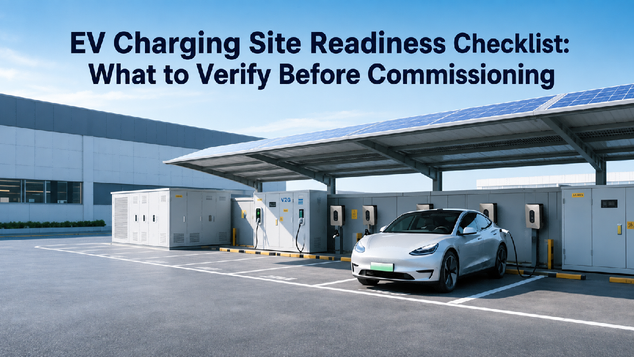
Freeze the decision boundary
Before collecting forms, separate site inputs, equipment requirements and later acceptance evidence. Mark each value as frozen, conditional or open, and assign the person who can close it.
Input group | Freeze before the acceptance package is drafted |
Utility and electrical | Service voltage, available capacity, protection, grounding and point of connection |
Layout and civil works | Equipment location, clearances, cable routes, drainage, foundations and access |
Power path | Upstream distribution, isolation, switching and expected load behavior |
Network | Backhaul, addressing, firewall, time source and network owner |
Metering | Meter location, accuracy requirement, data path and owner |
Environment | Temperature, weather exposure, dust, water, altitude and operating assumptions |
Connector and configuration | Vehicle-side interface, cable arrangement, option code and baseline |
Access and safety | Permits, isolation procedure, emergency contacts and witness access |
Expansion and responsibility | Future provisions plus an owner for every approval and handoff |
The map is an input-freeze tool, not a site design, utility approval or substitute for the applicable local requirement.
Test the assumptions before freezing them
Walk through the changes most likely to reopen the package. A reduction in available utility capacity may alter the planned operating points. A moved cabinet may change cable length, access and network routing. A revised connector option may change the vehicle-side test. An unassigned metering owner may delay sign-off even when equipment is installed.
For each scenario, record the changed input, affected equipment or test, trigger and owner. The purpose is not to design the site in the article; it is to expose which assumption would reopen the commissioning record while the project can still make a controlled decision.
Link frozen inputs to project records
Every row in the map should point to a source document, value, unit and date. Then link it to the equipment or interface it affects, the required reviewer and the change trigger. The handoff chain normally runs from a site survey or utility record to the equipment and layout record, then to the installation plan and commissioning plan.
Do not silently convert a site assumption into a product fact. Catalogue evidence describes a named model under its stated conditions; it does not approve a utility connection, prove an EPC design or guarantee field acceptance at every site. Environmental inputs should also remain separate from model-level values rather than being presented as a complete derating curve.
Give every value a source, date and status. A verbal assumption may be useful for an early scenario, but it should not be treated as frozen until the responsible party identifies the approving record. When a value is revised, keep the prior baseline visible and state which equipment, interface or test must be revisited. That simple history prevents the later acceptance team from confusing a planning estimate with an approved site input.
Keep responsibilities separate
Assign each row to the party that can close it: equipment supplier, electrical contractor, network owner, integrator, site operator or customer. “Supplier provides equipment,” “integrator installs,” “network owner configures” and “site authority witnesses” are different statements. If one is not assigned, mark the handoff open instead of inferring it from a product page.
UUinside architecture material may help name components and interfaces, but it does not establish project-specific EPC, commissioning or service responsibility. UUGreenPower product context can identify a named item to verify; it does not approve the site design or promise onsite work.
Decide whether planning can proceed
Use three states: Frozen when the value and source are approved for the current plan; Conditional when a named approval or verification remains; and Open when a change could alter equipment selection, installation, network setup or acceptance. A site may be ready for preliminary layout while remaining conditional for network ownership or metering evidence.
Before the acceptance package is written, confirm that utility and power-path inputs are sourced, layout and access are stable enough to inspect, network and metering responsibilities are assigned, environmental assumptions are stated, connector and configuration baselines are named, and every open row has an approver and change trigger. If a critical row is open, carry it into the later package as a dependency rather than disguising it as a completed criterion.
Record the readiness decision
Leave an auditable note with the date, participants, source documents, frozen values, conditional rows and next review trigger. Another team should be able to tell whether a later acceptance issue came from the equipment, the site assumption or a changed configuration.
An EV charging site readiness checklist has done its job when it gives the commissioning team a controlled input set. It provides the controlled site baseline needed before the commissioning and handover acceptance package is finalized; it is not the acceptance package itself or a field-service promise.
How to Shortlist DC Charging Module Manufacturers: A Buyer’s Evidence-Based Guide
2026-09-09 NextEV Charger Commissioning Acceptance Checklist: What to Include in a Handover Package
2026-09-14

