
2026-09-16
UUGreenPower
0
A platform can remain technically sound while its supply assumptions become uncertain. A model page may still be available, a supplier may still answer inquiries and the current design may still pass its tests. None of those facts alone proves that the same configuration will remain available, unchanged or supportable throughout a multi-year program.
An EV charger module supplier review should therefore continue after initial qualification. It should connect lifecycle status, product-change notifications and redesign triggers to the platform’s own change-control process. The method is useful for any EV charging solution; it does not constitute a profile or endorsement of a particular company.
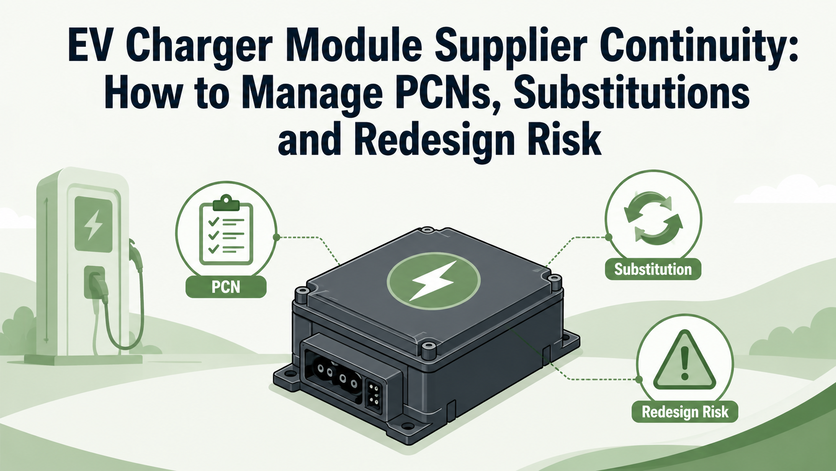
Define the continuity exposure
Start by listing what the platform depends on: exact model and revision, approved configuration, interface, firmware baseline, thermal conditions, connector or cable, test report, certificate scope and the commercial terms that affect replenishment. Mark which items are essential to the design and which have an approved alternative.
Then state the review horizon and decision point. A prototype, a first production release and a multi-year service commitment do not need identical monitoring. The evidence request should be proportionate to the design exposure, while still identifying the facts that would force a requalification or redesign.
Use a supplier continuity review matrix
Supplier Continuity Review Matrix | Evidence to request | What it can establish | What it cannot establish by itself |
Active-sale and lifecycle status | Current official status, lifecycle notice and end-of-life process | Whether the supplier has formally stated a current status or change path | Guaranteed future availability or a fixed commercial term |
PCN and substitution | Product-change notice, affected revisions, substitute and qualification plan | Which released configurations may be affected and what review is proposed | That a substitute is interchangeable without testing |
Forecast, MOQ and lead time | Written commercial terms, forecast assumptions and update cadence | The terms offered for the reviewed program | Factory capacity, global supply or future delivery performance |
Manufacturing and quality | Official company, production and quality evidence | The scope of the evidence supplied by the company | That a DC charging module factory label proves ownership, capacity or output |
Service and spares | Published or contracted support, spare and escalation scope | The support commitment that is actually documented | An automatic field-service SLA or local coverage |
Platform redesign impact | Interface, thermal, firmware and retest analysis | Which platform records must be reopened after a change | That the existing architecture is future-proof |
Use the matrix to name missing evidence, not to fill gaps with industry averages.
Treat labels as prompts for evidence
Procurement language may describe a candidate as an EV charger module manufacturer, a supplier or a DC charging module factory. Those labels frame the question; they do not answer whether the entity owns production, controls the design, can maintain the revision or can support the required term. Request the document that supports the underlying fact.
Product material can identify a model, operating boundary or interface. It cannot prove active sale, PCN practice, MOQ, lead time, factory capacity, QMS, service network or continuity. A model appearing in UUGreenPower materials is therefore useful product context, not a current availability or supply promise.
Connect PCN to the platform baseline
A PCN should be evaluated against the exact configuration in the platform, not only against a marketing name. Record the affected model, revision, date, reason, replacement, interface difference, thermal difference, firmware dependency and required regression test. Link the notice to drawings, software, test reports, certificates and the approved supplier record.
If a change is accepted, record who approved it and under which conditions. If the replacement is not demonstrated equivalent, create a redesign or requalification action. Do not assume that a lower-level component change leaves the integrated charger, vehicle interface or site acceptance unchanged.
Plan the monitoring cadence
Continuity review is a process, not a one-time questionnaire. Set a cadence based on program risk and define the events that trigger an early review: a lifecycle notice, a PCN, a long lead-time change, a failed forecast, a new market, a connector change, a firmware baseline change or a support-scope change.
For each event, assign an evidence owner and a decision date. A supplier statement, a contract, a public company document and a product manual should remain distinguishable. If a fact affects commercial delivery or service, use the company or contract evidence that actually covers it.
Decide what protects the platform
At the review gate, classify each dependency:
• Documented and monitored: the current evidence is adequate and an owner watches for change.
• Conditional: the design can proceed only with a defined PCN, substitute or requalification action.
• Unresolved: the missing company or commercial evidence could change the design decision, so the dependency remains open.
This method avoids two opposite mistakes. It does not treat a supplier label as proof of continuity, and it does not discard a technically suitable product simply because a company-level fact has not yet been documented. It keeps product fit and company continuity on separate tracks.
Before design freeze
Ask whether the exact model and revision are recorded, whether lifecycle and PCN channels are documented, whether substitution and regression rules are agreed, whether commercial terms are evidenced, and whether a platform change would reopen certification, interoperability, thermal or acceptance work. When UUGreenPower is one of the reviewed sources, use its materials for the product facts they actually state and keep company conclusions conditional until official company evidence is available.
The result is a defensible continuity decision: what is known, what could change, who must notify the team and which evidence would stop the release. That is more useful than a generic supplier promise and safer than assuming that today’s model page guarantees tomorrow’s platform.
EV Charger Connector and Protocol Changes: When to Recheck Interoperability and Certification
2026-09-15 NextDiscovering the Best Charging Solution: UUGreenPower
2024-09-30

