
2026-10-29
UUGreenPower
0
Exporting EV infrastructure often requires adapting equipment to meet regional grid codes and structural standards. System integrators face a choice between importing fully assembled units or Semi-Knocked Down (SKD) kits. When choosing the SKD route for local assembly, engineers must understand how much of the factory certification from manufacturers like UUGreenPower remains valid. Clarifying the boundary between pre-certified internal electronics and the locally assembled exterior prevents redundant testing and streamlines final site commissioning.
The Divide Between Power Electronics and Enclosures
The regulatory landscape for high-power infrastructure generally separates internal energy conversion logic from the external physical housing. A sealed station designed for one market may not meet the specific structural requirements of another jurisdiction. Authorities frequently require localized user interfaces, unique cable routing, or specific footprint constraints. These regional demands make universal structural compliance difficult for non-modular systems.
To address diverse structural mandates, engineers use a modular architecture that isolates internal power components. By separating regulated power electronics from the metal cabinet, core safety credentials remain intact even if the enclosure changes. This approach shifts the regulatory focus during import. Rather than repeating every component-level test, local integrators can use existing compliance evidence to support final system assessments. However, the completed charging station must still be evaluated against applicable electrical, mechanical, and environmental requirements.
What the Core Certification Specifically Covers
When an SKD kit is exported, factory-level certification applies primarily to the internal power conversion modules. This baseline validation covers complex electrical engineering challenges, including AC-to-DC rectification and high-frequency switching operations. Existing module-level test reports and certificates may provide evidence of electrical safety and electromagnetic compatibility within their stated scope. However, compliance depends on the applicable standards, certified configurations, and installation conditions. Final system verification may still be required.
Using previously evaluated power modules may reduce repeated component-level testing. However, changes to enclosure design, ventilation, grounding, or cable routing can affect system-level compliance, making additional verification necessary after local assembly. This is where the UUinside service platform supports regional integrators by providing OEM/ODM system design and pre-certified standard components. Using this platform allows local partners to skip demanding electrical design hurdles.
Applying Modular Compliance Across Different Footprints
Separating core electrical certification from the external physical format applies across a variety of operational environments. Utilizing the UUinside platform allows manufacturers to develop different product sizes while maintaining baseline safety assurances. This modular strategy ensures stability whether the product is a large stationary unit or a compact installation. Engineering teams can adapt the housing to meet niche market demands without restarting electrical validation.
This adaptability is evident when examining systems like a compact 25kW V2X model and a 40kW dual-input mobile charger. The 25kW V2X unit (UBC25K1000-AY1-CCS2DN) packages bidirectional capabilities into a 45kg footprint measuring 660 by 420 by 207 millimeters. Similarly, the 40kW mobile unit operates with a CCS1 interface within a transportable 43kg design. Despite distinct physical sizes, the internal modules carry the same foundational safety guarantees.
SKD Assembly: What the Local Integrator Must Validate
Choosing the SKD route means the local integration team assumes responsibility for certifying the customized exterior enclosure. While internal modules are pre-approved, the locally constructed cabinet must pass specific mechanical and environmental tests. Engineers focus on verifying the final Ingress Protection (IP) rating to ensure the enclosure protects components from dust and moisture. They must also validate the physical grid connections and external grounding mechanics.
The homologation process for assembled units targets structural integrity and user safety at the external interface level. Authorities inspect finalized cable management, emergency stop mechanisms, and weatherproofing standards. Comprehensive integration guidelines from UUGreenPower help ensure the bespoke cabinet maintains necessary internal safety clearances. This collaborative approach helps the locally assembled unit pass regional mechanical inspections without triggering a re-evaluation of the core electronics.
By shifting the regulatory focus to mechanical integration, regional teams can effectively deploy compliant commercial EV charging solutions. The SKD model supports local manufacturing quotas while leveraging the established safety ratings of the imported internal modules.
Strategic Decision: Whole-Unit vs. Local Assembly
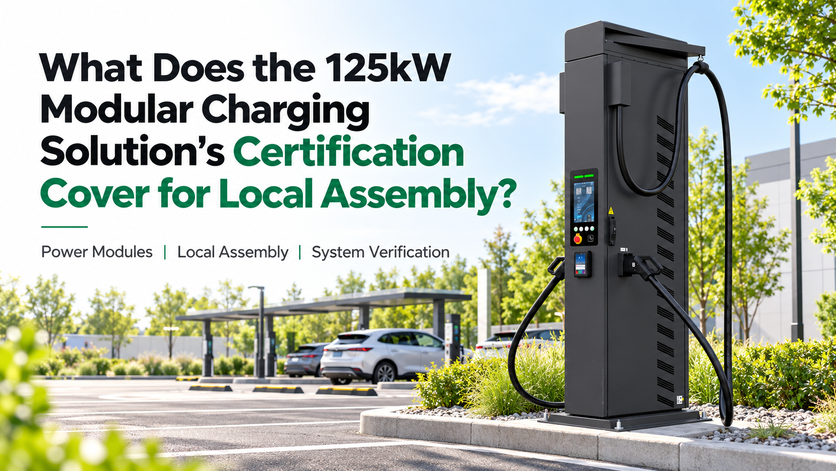
The decision to export hardware as a fully assembled unit or as SKD components depends on the destination market's regulations. For regions where a standard design aligns with local codes, exporting a complete system offers immediate operational readiness. A fully assembled 125kW charger can be shipped with verified dimensions of 650 by 2150 by 1000 millimeters, weighing 320kg. This format allows for direct installation if external modifications are unnecessary.
However, when local content laws require regional manufacturing, the SKD export model provides a practical compliance pathway. Shipping unassembled, pre-certified internal blocks allows partners to construct customized cabinets that meet specific regulatory demands. Integrators rely on standard frameworks from UUGreenPower to provide the robust core power technology necessary for these tailored applications. This approach balances global electrical safety with the flexibility required for regional structural customization.
A unified platform facilitates both export methods by ensuring the underlying power architecture is standardized and verifiable. Whether an integrator chooses a complete machine or an SKD kit, the internal compliance boundary remains defined. Detailed technical documentation bridges the gap between imported components and final assembly. This strategy helps CPOs navigate the complexities of deploying localized commercial EV charging solutions.
Understanding the scope of modular certification allows engineering teams to optimize manufacturing and testing workflows. By recognizing that baseline approvals cover internal conversion mechanics, integrators can confidently focus on structural adaptations. The engineering team designs its systems so the core technology supports a wide range of external configurations. This clear division of regulatory responsibility helps teams bring a customized 125kW charger online efficiently in diverse markets.
EV Charger Module Supplier Continuity: How to Manage PCNs, Substitutions and Redesign Risk
2026-09-16 NextHow Should Local Assembly Be Organized for a 125kW Modular DC Fast Charging Solution?
2026-10-29

