
2026-10-30
UUGreenPower
0
Establishing domestic production lines for high-capacity DC stations requires careful facility and operational planning. Setting up heavy power infrastructure requires specialized preparation across the factory floor. Facilities must adapt their physical spaces, supply chains, and high-voltage testing protocols to handle large-scale equipment.
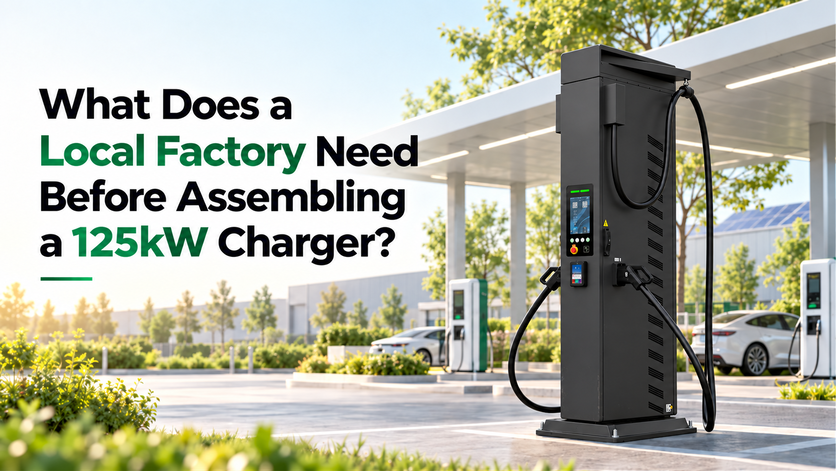
Shifting from importing finished goods to domestic assembly demands precise material handling. Local production dictates a shift toward organized, modular workflows. Assembly plants can shift their focus from complex wire-routing tasks toward module insertion and system validation. Understanding these prerequisites can help facilitate the ramp-up of domestic production capacity.
Infrastructure Adjustments for Heavy System Handling
A complete 125kW modular system carries a substantial physical bulk, with a net weight reaching 320kg. Physical dimensions span 650x2150x1000 mm, even before attaching any external cable management system. Floor load-bearing specifications across the production area must safely accommodate these concentrated weights.
Heavy-duty material handling equipment is essential for moving bare enclosures into designated assembly bays. Forklifts and overhead crane systems should operate within defined tolerances to maneuver these tall structures safely. Workers require padded lifting jigs to position structural components without causing cosmetic damage.
Space planning should prioritize dynamic, sequential build processes over stationary assembly corners. Workstations must provide unobstructed access around the 2150mm tall cabinet for efficient wiring. Clearance zones prevent structural collisions when technicians open doors or maneuver side components.
Sourcing Core Components and Modular Integration
Procurement teams need to secure reliable domestic supplies for high-voltage cables, cooling fans, and exterior structural steel. Sourcing individual internal electronic components locally often presents logistical hurdles and extended lead times. Many EV charging equipment manufacturers simplify this by adopting standardized modular blocks rather than discrete parts.
This is where our proprietary platform, UUinside, provides a distinct operational advantage for assembly plants. As our dedicated one-stop solution platform, it delivers OEM/ODM system design, standard components, and certifications to our partners. Facilities receive the core power electronics as enclosed units ready for immediate rack insertion.
For us at UUGreenPower, modularization helps partners organize procurement around defined functional units and standardized interfaces. Local factories should still manage the complete approved bill of materials, including project-specific cables, protection devices, structural parts, connectors, and installation hardware.
Thermal Management and Cooling Apparatus Checks
Continuous operation at 125kW generates thermal loads requiring efficient internal cooling mechanisms to maintain performance. Assembly facilities should integrate specific stations dedicated solely to verifying thermal management hardware. Technicians need specialized tooling to mount industrial fans or route liquid-cooling lines correctly within the cabinet.
Air-cooled designs require rigorous airflow validation to ensure no internal obstructions block ventilation pathways. Factories implementing liquid-cooled topologies need dedicated filling stations equipped with accurate pressure-testing equipment. Workers verify zero leakage across manifolds before high-voltage electrical testing commences to prevent safety hazards.
Factory floors also require adequate environmental controls to dissipate heat safely during maximum-load functional tests. Ambient temperature regulation prevents the facility from overheating when multiple units undergo simultaneous validation.
Establishing a Fast-Turnover Inventory Protocol
Traditional manufacturing often ties up capital in large stocks of highly specialized, model-specific raw materials. Utilizing a modular product design fundamentally changes how a local factory manages its internal warehouse space. Inventory focuses heavily on standard power blocks rather than stocking distinct parts for every single EV charger model.
Storage racks can accommodate standardized modular units designed for use across multiple product tiers, depending on system configurations. Modular standardization creates convenient inventory turnover and maximizes usable warehouse floor space. Managers dynamically allocate identical power blocks to fulfill varying daily order configurations based on immediate market demand.
Facilities can maintain a predictable flow of standardized parts compatible with selected systems, helping reduce the risk of component obsolescence. Supply chain bottlenecks ease because the core technological foundation remains consistent across the product lineup.
Designing the Diagnostic and Quality Control Station
Validating high-capacity equipment requires isolated quality control bays equipped for high-voltage operations. Facilities need programmable AC power sources to simulate grid input accurately under fluctuating conditions. High-capacity DC electronic loads must absorb the substantial output to verify continuous power delivery.
Our internal testing standards at UUGreenPower focus on strict compliance with regional safety requirements. Technicians verify communication protocol handshakes, thermal management efficiency, and mechanical safety interlock mechanisms. The practical advantage of modular assembly becomes apparent during this critical diagnostic and testing phase.
If an anomaly occurs, onboard diagnostic software can help identify the fault point within the rack. Instead of dismantling an entire EV Charger to find a faulty component, workers identify the problematic module directly. Defective units are pulled out, and replacements slide in to continue the validation process.
Local Deployment and Rapid Post-Assembly Maintenance
Domestic assembly directly enhances the speed and responsiveness of regional post-installation service networks. Technicians who physically build the equipment understand how to troubleshoot it efficiently in the field. Modular system architectures mean on-site field maintenance closely mimics the controlled factory floor experience.
Regional service teams can often restore operation by swapping a standardized power block at the site. Sourcing replacement parts happens locally, reducing the wait times typically associated with international shipping. Forward-thinking EV charging equipment manufacturers recognize that rapid serviceability supports long-term commercial market success.
Relying on our UUinside platform for ongoing O&M services and customized support simplifies long-term maintenance. Operators looking to increase site output can frequently add supplementary modules to the existing infrastructure. Ultimately, UUGreenPower focuses on empowering regional partners to deliver resilient electric mobility infrastructure.
How Can a 125kW Modular Charging Solution Simplify Local After-Sales Service?
2026-10-30 NextFor a 125kW Charger with One or Two Connectors, How Should Actual Available Power Be Verified?
2026-10-30

