
2026-11-02
UUGreenPower
0
Residential energy storage system (ESS) brands looking to add bidirectional EV charging must decide how the new function will fit into their existing electrical architecture. The challenge is not simply adding a charger. Battery interfaces, photovoltaic (PV) conversion, energy management, and grid connections must work together according to a clearly defined system design.
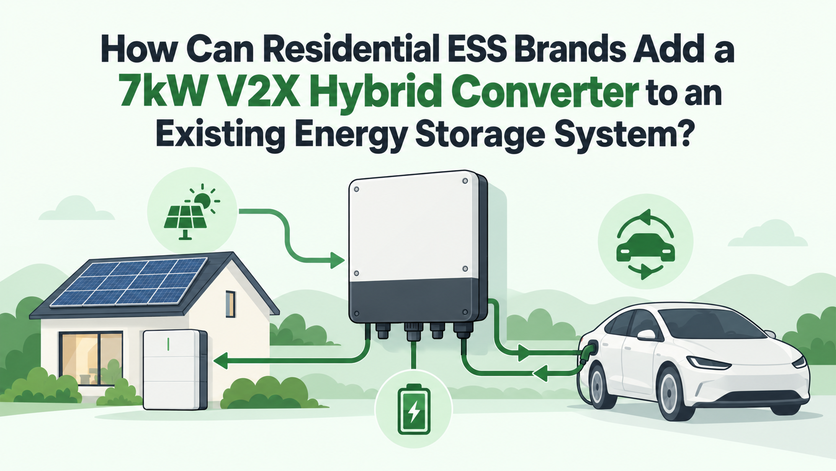
For manufacturers with an established ESS portfolio, the most practical starting point is to identify which functions already exist and which need to be introduced. At UUGreenPower, our residential charging products provide two relevant options for this evaluation: the UHS7KFE-CCS2BD, a 7kW single-phase hybrid converter with V2G, and the UHS7KFE-CCS2A, a 7kW single-phase hybrid converter listed for AC charging. Our different product positioning helps clarify the first integration decision: whether the upgrade requires bidirectional DC energy transfer or an AC charging function.
Start by Mapping the Existing ESS Architecture
Before choosing equipment, document the current system's power flow. Identify how PV electricity reaches the battery, how stored energy supplies household loads, and how the installation interacts with the grid. Also establish whether an existing controller coordinates these functions or whether separate devices manage them independently.
An established ESS may already contain PV conversion, battery management, metering, and energy control. Adding another device without defining the responsibilities of each component can create overlapping control functions or incompatible operating assumptions.
Our first recommendation is to create a system diagram showing the existing equipment, proposed converter, electrical connections, and communication interfaces. This makes it easier to determine whether the new device should supplement the existing architecture or become part of a more integrated configuration.
Determine Which Charging Function Is Required
The choice between AC charging and bidirectional DC charging depends on the intended operating modes. Brands should establish the required energy flow before evaluating individual product specifications.
The UHS7KFE-CCS2BD is listed as a 7kW V2G hybrid converter. Its functions integrate a PV inverter, power conversion system (PCS), V2G, and energy management system (EMS). The product supports direct EV charging using solar energy, supplying home loads from the EV battery, and returning power to the grid, subject to the supported configuration.
The UHS7KFE-CCS2A, meanwhile, is a 7kW single-phase hybrid converter with AC charging. It provides a useful comparison for brands assessing whether their product requirements call for an AC charging configuration or the specific bidirectional DC functionality of the V2G model. The final selection should follow the applicable product documentation rather than the rated power alone.
Verify Electrical and Communication Interfaces
After selecting the intended function, compare the converter's documented interfaces with the existing ESS. Review battery voltage limits, permitted charge and discharge currents, AC supply characteristics, protection arrangements, and the available connection points. Every relevant operating range must be checked against the equipment already installed.
Communication compatibility deserves equal attention. The battery management system, meter, and EMS may need to exchange operating information or commands with the proposed device. Check the supported protocols, data definitions, and control responsibilities before assuming that existing software can manage the additional equipment.
For example, an ESS brand may want to retain its existing battery and household energy controller while introducing V2G. That arrangement is feasible only if the electrical interfaces and control architecture support the intended integration. If they do not, the design may require additional engineering or a different equipment configuration.
Coordinate Energy Management Across the System
Bidirectional charging introduces decisions about where energy should flow and when. The EMS needs a defined operating strategy for PV generation, household consumption, battery charging, EV charging, and grid interaction.
Consider a home generating solar electricity during the day. The system may prioritize charging the EV from available PV energy. At another time, the configured system may use EV battery energy to supply household loads or export electricity to the grid, where the relevant equipment and installation support those functions.
Brands should define these priorities before commissioning. They must also establish how the system responds when PV output changes, battery limits are reached, or communication with a component is interrupted. A clear control hierarchy helps reduce the risk of conflicting commands and supports operation within each device's documented limits.
These system-level requirements are also important when selecting hardware for an energy storage solution. An energy storage charging module may be suitable for certain modular system architectures, whereas an integrated residential converter is designed for a different product category. Before selecting either option, brands should assess the required system-level functions and compatibility to determine whether the module is appropriate for their intended application.
Validate the Integrated Design Before Release
A successful integration requires more than confirming that the equipment powers on. Prepare a commissioning checklist covering electrical connections, communication, control logic, protection behavior, and the intended operating modes.
Testing should reflect the actual installation. Depending on the approved configuration, checks may include PV-to-EV charging, battery charge and discharge behavior, household load support, and grid energy exchange. Document expected responses and verify that transitions between operating modes follow the system design.
An energy storage charging module may be appropriate where the architecture calls for a dedicated power conversion component. An integrated residential converter, by contrast, combines functions that must be evaluated together. In either case, compatibility must be established through technical documentation and system testing rather than inferred from a product description.
Turn the Upgrade into a Defined Integration Process
For residential ESS brands, the path to adding 7kW bidirectional charging begins with a clear system diagram, a verified interface list, and a defined energy management strategy. These steps determine whether the existing architecture can accommodate the new function and what changes are required.
We at UUGreenPower recommend evaluating the intended operating modes first, then selecting the appropriate product configuration and validating the complete system before deployment. This approach keeps the decision focused on functional requirements, electrical compatibility, and control coordination, helping manufacturers develop an integration plan grounded in their actual ESS architecture.
For a 125kW Charger with One or Two Connectors, How Should Actual Available Power Be Verified?
2026-10-30 NextWhat Should the UltimateBox HEMS Control in a Residential V2X Energy System?
2026-11-02

