
2026-11-02
UUGreenPower
0
A household with rooftop solar, a stationary battery, and an electric vehicle must decide where available electricity will deliver the greatest value. Charging the car immediately can reduce the surplus available for evening use, while filling the home battery first may leave insufficient time to prepare the vehicle for an early departure.
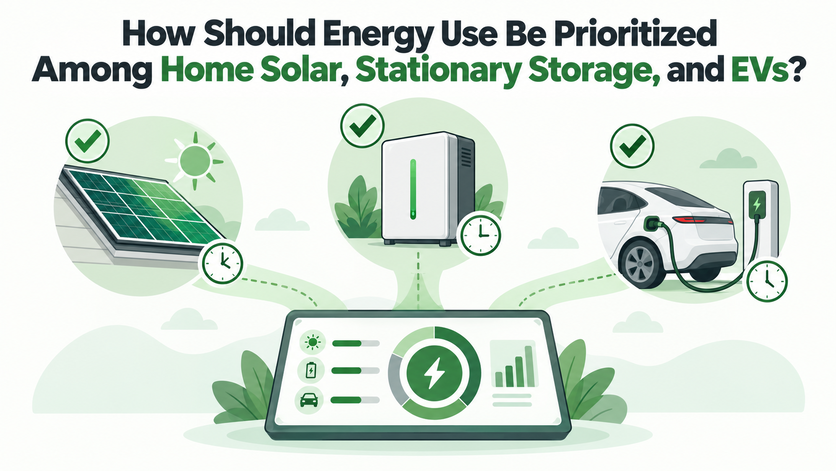
The answer is not to give one energy source permanent priority. A practical strategy starts with essential household demand and required driving range, then allocates remaining electricity according to solar production, storage needs, and the capabilities of the installed equipment.
Establish Priorities Around Daily Needs
Household electricity demand and vehicle readiness establish the boundaries for energy allocation. Refrigeration, lighting, and other necessary loads must remain supplied, while the EV needs enough charge for its next planned journey.
Imagine a household that generates substantial solar power around midday but uses most of its electricity after sunset. If the EV is parked at home during the day, charging it directly may meet its mobility needs without storing that energy first. If the vehicle is away, directing surplus generation into stationary storage may be more practical.
Flexible demand should therefore be scheduled around actual usage. Owners can decide how much energy the car needs before departure, what reserve the home battery should maintain, and which charging activities can wait. These requirements provide a clearer basis for managing energy than a fixed rule that always prioritizes one device.
How Should Available Solar Power Be Allocated First?
Direct solar consumption can reduce the need to move electricity through a storage cycle. During periods of surplus generation, a connected EV can absorb available power if its charging equipment supports the required control and operating conditions.
For example, a car that remains at home throughout the afternoon may benefit from solar charging before its owner returns in the evening. If the vehicle is unavailable, the same surplus can instead support stationary battery charging, subject to battery capacity and system limits.
At UUGreenPower, our UHS7KFE-CCS2A, a 7kW single-phase hybrid converter with AC charging, integrates photovoltaic conversion, power conversion, and energy management functions. It supports direct EV charging using solar energy while coordinating the wider residential energy system. This makes it relevant to households seeking to connect solar generation with vehicle charging rather than treating them as separate activities.
An energy storage charging module can also serve as part of the charging architecture, depending on the system design. However, the presence of charging hardware alone does not guarantee that solar power will automatically follow the household's preferred priority order. That depends on the installed controls and supported operating modes.
Reserve Stationary Storage for the Right Time
Stationary storage becomes valuable when solar generation and household demand occur at different times. A battery can retain some daytime surplus for later consumption, but its available capacity and reserve settings determine how much energy it can accept or deliver.
Consider a household that regularly experiences high evening demand. Preserving part of the solar surplus for household use may be more useful than directing every available kilowatt-hour into the EV. Conversely, a household with low evening demand and a vehicle that needs charging may reasonably prioritize the car.
Storage losses also influence the decision. Electricity converted and stored for later use cannot deliver all the original input energy because charging and discharging involve losses. Direct consumption is therefore worth considering whenever the load is available and the electricity can be used immediately.
A residential energy storage charging solution should match battery capacity and charging control to the home's consumption pattern. The objective is not necessarily to fill the battery every day, but to retain enough energy for the periods when stored power is most useful.
Decide Whether the EV Should Return Energy
An EV battery can serve as more than a transportation reserve when bidirectional charging is available. Instead of only drawing electricity from the home or grid, a compatible vehicle can send energy back through a bidirectional charging system, potentially supporting household demand or grid interaction.
The UBC22K1000-Y1-CCS2D, a 22kW V2X bidirectional DC charging and discharging solution, enables this two-way energy flow in a compatible system. For households, the value lies in having another potential source of energy when solar generation is low or stored household energy needs to be supplemented. Actual vehicle-to-home backup or grid-export operation depends on vehicle compatibility, system configuration, and the applicable connection requirements.
Vehicle energy should not be treated as freely available household storage. Discharging the car may reduce the range available for the next journey, so owners should establish a minimum vehicle charge before allowing energy to serve other purposes.
A residential energy storage charging solution that combines compatible charging and energy management functions can provide a framework for coordinating these decisions. Nevertheless, the precise operating rules must reflect the installed product's documented capabilities rather than assumptions about universal vehicle-to-home functionality.
Coordinate Solar, Storage, and EV Charging
Once household requirements are established, an energy management system can coordinate the supported functions according to configured rules. A possible strategy is to supply current household loads, charge the EV from available solar surplus when needed, and direct remaining surplus into stationary storage. Later, the battery can support household demand while maintaining the chosen reserve.
Different circumstances may justify a different allocation. An upcoming long journey could make vehicle charging the immediate priority, while an expected evening peak could favor stationary storage. Backup requirements may also influence how much energy should remain available in either battery.
UUGreenPower's residential energy architecture integrates photovoltaic generation, power conversion, charging, and energy management options. The appropriate configuration depends on the household's objectives, available equipment, and supported control functions.
Prioritize essential household demand and required driving readiness, use solar electricity directly when practical, and reserve storage for later needs that justify it. Bidirectional operation adds flexibility where compatible equipment supports it. A well-configured energy strategy adapts to the household's schedule instead of forcing solar, stationary storage, and EVs into one permanent order.
What Should the UltimateBox HEMS Control in a Residential V2X Energy System?
2026-11-02 NextWhat Site Layout Factors Matter for 22kW and 50kW DC Chargers?
2026-11-03

