
2026-11-03
UUGreenPower
0
A charging layout must fit the site as it actually operates. A hotel may have narrow parking bays beside a building, a shopping centre may need to preserve pedestrian routes, and a fleet depot may need enough clearance for vehicles to manoeuvre between charging positions. The choice between 22kW and 50kW DC chargers affects not only charging output but also how the installation fits within available space and electrical capacity.
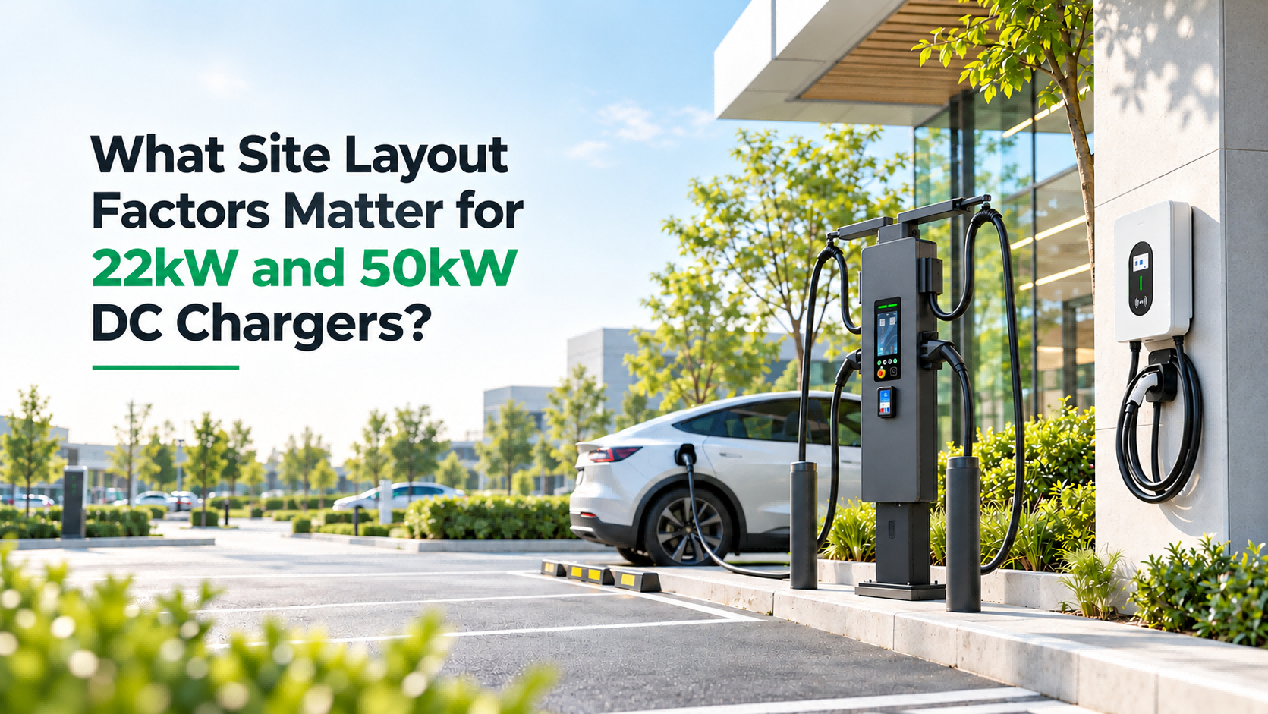
For commercial EV charging solutions, effective planning brings together parking geometry, cable access, equipment placement, and power distribution. Smaller DC chargers can be particularly useful where charging needs are spread across different types of destinations and the site cannot easily accommodate high power demand at every parking space.
Parking Geometry Sets the First Boundaries
Before selecting charger locations, map the parking bays, vehicle entry and exit paths, pedestrian routes, accessible spaces, and any existing obstacles. Columns, walls, kerbs, landscaping, and building entrances can restrict where equipment can be installed or how drivers approach a connector.
A compact wallbox can be attractive when floor space is limited because it can be mounted on a suitable wall or supporting structure, subject to the manufacturer's installation requirements.
Our 22kW wallbox DC charger is designed for indoor and outdoor charging environments, and its published dimensions are 446mm wide, 688mm high, and 176.2mm deep. These measurements help planners assess the physical envelope before finalising a position. For a closer look at how a 22kW integrated DC charging solution is installed at an actual customer site in Australia, watch the on-site installation video here: https://youtu.be/biLnSkjeRXc.
A 50kW installation requires an initial layout review, including confirmation of the selected model’s dimensions, mounting method, ventilation requirements, and service clearances. For the UC50K1000-AY2-CCS2, the specified stand column measures 1800 × 380 × 300 mm (H × W × D) and weighs 65 kg. These figures refer to the stand column; the charger’s own dimensions and required installation clearances should be confirmed separately. Rated power alone does not determine the total installation footprint.
Cable Reach Must Work with Real Parking Movements
A charger can fit neatly on a drawing yet prove awkward in daily use if the cable cannot comfortably reach the vehicle inlet. Cable routing should account for the location of charging ports, the direction vehicles park, and whether the cable crosses pedestrian paths or vehicle circulation areas.
For example, a row of head-in parking spaces may require a different mounting position from angled bays or parallel parking. Planners should test the proposed arrangement against the vehicles expected to use the site rather than assuming every charging inlet occupies the same position.
Maintenance access matters too. Equipment should remain accessible for inspection and servicing without forcing technicians to work in unnecessarily restricted spaces. Cable management, mounting hardware, and any protective structures should be checked against the chosen charger's installation documentation.
Use Power Capacity to Shape Charger Distribution
The site's electrical capacity can influence both charger rating and placement. A 50kW unit has a higher maximum rated output than a 22kW unit, so several 50kW chargers operating simultaneously may create a greater potential demand on the supply.
At locations with limited spare capacity, distributing lower-power DC chargers across suitable parking spaces may be more practical than concentrating charging demand at a few higher-rated points. Hotels, offices, shopping centres, industrial parks, and scenic destinations are among the applications identified for our 22kW uuinside wallbox charger.
Consider a commercial property that wants to provide charging in several parking areas but has limited electrical capacity available for EVs. A layout using appropriately rated 22kW units may give the project team more flexibility when allocating power across the site. Whether the installation can support the planned number of chargers still depends on existing building loads, simultaneous charging demand, and the electrical design.
The 50kW option is worth evaluating where shorter dwell times or higher energy requirements justify the additional output. The decision should follow a site load assessment, not simply the number of parking bays available.
Match the Installation Environment to the Equipment
Indoor car parks and exposed outdoor destinations impose different physical requirements. Rain, dust, ambient temperature, humidity, and potential impact from vehicles can all affect equipment selection and installation planning.
Our 22kW wallbox charger specifies IP65 protection and independent air-duct cooling. These documented characteristics can inform the environmental assessment, but the final installation must still follow the product's operating limits and mounting instructions.
Site teams should also confirm the available supply connection, cable routes from the electrical distribution equipment, isolation and protection arrangements, and the space needed for installation work. Applicable local electrical and building requirements must be checked for the actual project.
Plan the Charging Layout as a Complete System
The most effective layout connects hardware placement with the wider system architecture. Charger positions affect cable runs, electrical distribution, maintenance access, and how easily the site can accommodate additional charging points later.
Through UUinside, our one-stop charging solution and service platform, we support OEM/ODM system design, standard components, customization, certification services, and operation and maintenance planning. These services can help manufacturers and integrators coordinate charger architecture and project requirements rather than treating the charger enclosure as an isolated component.
For a project involving several charging areas, the team can define the parking arrangement, target charger ratings, connector requirements, electrical capacity, and installation environment before confirming the system configuration. Equipment-specific dimensions and technical limits must be verified for each selected model.
Build the Layout Around How the Site Is Used
A successful charging layout is not simply the maximum number of chargers that fit into a parking area. It must provide workable cable access, preserve vehicle and pedestrian movement, accommodate electrical infrastructure, and leave enough space for maintenance.
For many destination sites, a 22kW wallbox can be a practical option because its compact form and lower individual power demand may suit a wider range of locations with limited space or grid capacity. A 50kW DC charger becomes more compelling where higher charging output is needed within shorter parking windows.
At UUGreenPower, we approach site planning by starting with the physical and electrical constraints, then matching charger configuration to the site's actual operating pattern. That sequence helps project teams decide where each charging point belongs before committing to the final installation design.
How Should Energy Use Be Prioritized Among Home Solar, Stationary Storage, and EVs?
2026-11-02 NextWhich Site Conditions Determine the Choice Between 22kW and 50kW DC Charging at Real Australian Installations?
2026-11-03

