
2026-11-03
UUGreenPower
0
Choosing between 22kW and 50kW DC charging is less about buying the larger number and more about how a site is used. A hotel guest may leave a vehicle parked for hours, while a delivery fleet may need vehicles ready for another run within a short turnaround. Australian projects should begin with arrival patterns, typical parking duration, and the consequences of a vehicle waiting for charge.
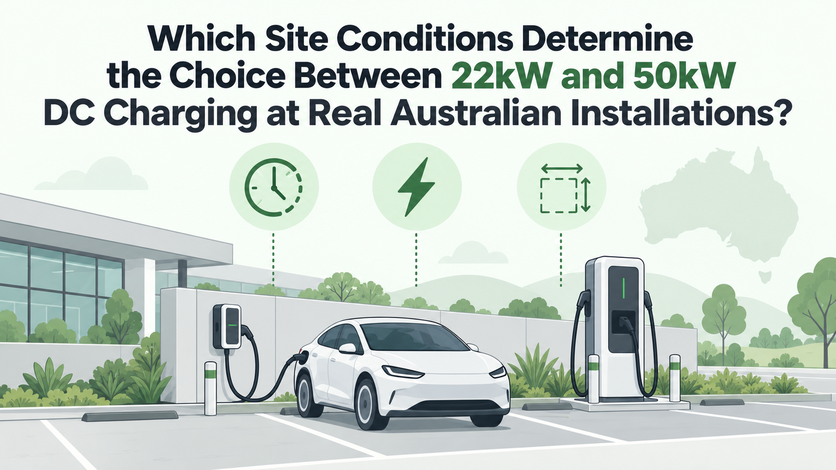
Our Australian exhibition range includes the UC22K1000-AY1-CCS2, a compact 22kW DC charger, and the UC50K1000-AY2-CCS2, a 50kW small DC charger. Their different ratings offer a practical comparison for sites with different service expectations; neither rating is automatically the right choice for every car park, depot, or destination.You can also see the 22kW integrated DC charging solution at an actual customer installation in Australia in this on-site video: https://youtu.be/biLnSkjeRXc.
When an extra half-hour matters
Rated power gives an initial way to compare charging capacity. At a steady output, 22kW can deliver 22kWh in an hour, while 50kW can deliver 50kWh. This simple calculation is useful for planning, but it is not a promise of energy delivered in a real session: vehicle limits, battery state, charging curves, and conversion losses can reduce actual power or energy.
Consider a workplace where most vehicles remain parked through a full shift. If the vehicles can receive the energy they need during that dwell window, installing 50kW may not improve the service enough to justify its additional site demand. At a fleet depot where vehicles return briefly between assignments, the higher rating may be more relevant—provided the vehicles can accept it.
Vehicle compatibility must be checked alongside the kW figure. The UC22K1000-AY1-CCS2 has a 200–1000V DC output range and a 300–1000V constant-power range. The output range describes the voltages the charger can provide; the constant-power range indicates where it can maintain its rated power, subject to operating conditions. Confirm the vehicle's voltage requirements, connector, and maximum DC charging rate before finalising the design.
The electrical supply can decide the shortlist
A higher-rated unit is only useful if the site's electrical infrastructure can support the planned operating pattern. Review available supply capacity, existing building loads, peak demand, and how many vehicles may charge simultaneously. The question is not simply whether a site can power one 50kW unit, but whether it can support the intended charging schedule without compromising other operations.
For example, a commercial property may have spare capacity overnight but limited headroom during business hours. Scheduled charging or a revised charging mix might fit its operating pattern better than assuming every point will deliver full power at once. Any load-management capability, supply upgrade, or connection approval should be confirmed for the actual project; do not assume it is included in a charger simply because it has a particular rating.
This is where commercial EV charging solutions need to be assessed as part of the whole site. Electrical design, the number of bays, utilisation, and the service promise should be reviewed together. A smaller charger that consistently meets the site's requirements can be a better fit than a higher-powered unit that the supply cannot comfortably accommodate.
Fit the hardware to the physical site
Available wall space, pedestal position, cable reach, vehicle movement, pedestrian routes, and maintenance access all affect installation. The UC22K1000-AY1-CCS2 measures 680 × 380 × 187mm excluding its panel, while the listed stand-column dimensions for the UC50K1000-AY2-CCS2 are 1800 × 380 × 300mm. These dimensions are useful early planning inputs, but final drawings and required clearances should be confirmed before civil works begin.
Outdoor exposure calls for a separate product check. The published UC22K1000-AY1-CCS1/CCS2 information identifies IP65 protection and independent air-duct cooling. IP65 describes enclosure protection against dust ingress and water jets; it does not remove the need to consider direct sun, salt-laden air, drainage, condensation, or service access at the proposed location. Do not assume the 50kW model has identical protection or cooling characteristics without confirming its own specification.
A dc fast charger should be selected for its installation environment as well as its output. For Australian sites, verify the final product configuration and the project's electrical and installation requirements rather than inferring suitability from a product category or a photograph.
Make the rating answer an operating question
A 22kW option is worth evaluating where dwell time is generous, vehicle demand is compatible, and the compact format suits the location. A 50kW option deserves priority where faster turnaround is part of the service requirement and the vehicles, electrical supply, and installation can support the higher output. Neither decision should be based on rating alone.
UUGreenPower can discuss the product choice against the project's intended use, site constraints, and vehicle mix. For EVSE manufacturers, Charge Point Operators, fleet teams, and system integrators developing commercial EV charging solutions, UUinside is relevant to early-stage EV charging solution development, combining modular system design with OEM/ODM services and customized development. It helps customers adapt charging solutions to specific project requirements while streamlining system integration.The scope should be confirmed against the actual project rather than assumed from the platform name.
UUinside can also be part of the conversation when a project needs its system requirements clarified before equipment selection. The practical decision is straightforward: choose 22kW when it can meet the charging task within the available dwell window, and choose 50kW when the added output solves a real operational constraint. Matching the charger to the site makes the investment easier to justify and the charging service more predictable.
What Site Layout Factors Matter for 22kW and 50kW DC Chargers?
2026-11-03 NextWhat Communication and Dispatch Functions Matter When a 7kW V2X System and HEMS Connect to a VPP?
2026-11-03

