
2026-11-03
UUGreenPower
0
Virtual Power Plants aggregate distributed home batteries and EVs to act like a single utility-scale generator. Connecting a bidirectional residential unit into these networks relies heavily on robust communication and precise dispatch translation. Operators need high confidence that local household assets will respond to frequency deviations within tight millisecond windows. Success requires bridging local site loads directly with broader grid balancing requirements and dynamic market signals.
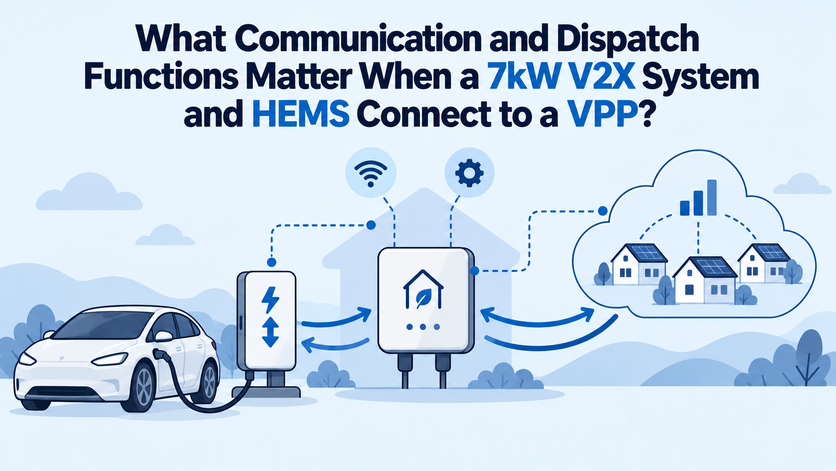
Bridging Residential Assets to Grid Operator Commands
Connected households can serve as active nodes within the energy network, with telemetry data exchanged with central dispatch servers as required by the system configuration and operational needs. Raw hardware capacity holds little value without a verified digital handshake confirming system availability and precise state-of-charge data. Smart units constantly broadcast their maximum discharge capability so that grid aggregators can issue highly accurate capacity reservations. Secure data tunnels prevent unauthorized interference with these critical grid-support telemetry streams.
Operators must receive continuous, real-time updates regarding the connected vehicle's battery status and immediate local household energy demand. Executing v2x commands requires the hardware to balance driver mobility needs against lucrative grid support opportunities. Intelligent logic in the local controller manages power flow so that grid signals do not inadvertently drain a vehicle battery below user-defined mobility thresholds.
Data Translation Between Local Management and Utility Gateways
Home Energy Management Systems sit directly between the bidirectional charger and the external regional utility network. Intelligent HEMS controllers dictate whether solar generation flows into the vehicle, supports appliances, or exports outward. The communication architecture should define how the charger, HEMS, cloud platform, and VPP aggregator exchange operating data and dispatch commands. Depending on the deployment, this may involve charging protocols, device-level interfaces, cloud APIs, or market-specific communication standards. Compatibility should be verified for the complete system rather than assumed from support for one protocol alone. Open communication standards facilitate seamless data translation without creating proprietary software bottlenecks.
Engineering teams prioritize rapid protocol conversion to prevent signal drops during critical peak-shaving market events. Central software platforms can command local hardware to reverse current flow based on pre-set economic triggers and utility API calls. Homeowners maximize their financial returns because the entire integrated system naturally aligns charging behavior with favorable tariff windows and peak demand periods.
Response Performance and Control Coordination in VPP Applications
Virtual power plants (VPPs) coordinate distributed energy resources to help respond to changing grid conditions. Depending on the application and applicable market requirements, participating assets may need to adjust their power output in response to dispatch signals. The effectiveness of this process can depend on communication latency, equipment response characteristics, and the coordination between control systems and power conversion hardware.
Effective control logic can help coordinate charging and discharging operations in response to dispatch requests. The implementation of these functions depends on the capabilities of the connected equipment, system configuration, and operational requirements. For bidirectional energy applications, coordination between power conversion hardware and supervisory control systems can support transitions between importing and exporting power, subject to equipment capabilities and applicable operating constraints.
For vehicle-to-everything (V2X) applications, reliable system integration involves considering communication performance, control coordination, and compatibility with the local electrical infrastructure. These factors can help guide the design of energy management solutions that support grid interaction while accounting for residential power requirements.
Converting Digital Signals into Bidirectional Power Flow
Power electronics play an important role in translating software-based control commands into physical power conversion and grid-interaction functions. An energy storage charging module may form part of a broader energy system, depending on the application and system architecture. Its role in supporting grid-related functions depends on the module's capabilities and its integration with other system components.
For residential applications that combine energy storage with electric vehicle charging, UUGreenPower offers the UHS7KFE-CCS2BD, a 7kW single-phase hybrid converter with V2G capability, listed under its Residential ESS with EV Charging Solution category. This product serves a different role from a standalone energy storage charging module and is intended for a residential energy system application. When evaluating installation options, factors such as equipment dimensions, weight, electrical requirements, and available installation space should be considered in relation to the specific project.
How Should Local Grid Constraints Affect VPP Dispatch?
Because the 7kW V2X hybrid converter is a single-phase residential device, VPP dispatch should remain within the electrical limits approved for the household connection. The HEMS or aggregator may need to account for site import or export limits, local voltage conditions, equipment availability, and any restrictions imposed by the distribution network.
Grid-support functions should only be claimed where they are documented for the installed product and approved by the relevant network or market program. Capabilities such as reactive-power control or phase-balancing should not be assumed unless they are explicitly supported by the selected hardware and system configuration.
Navigating Hardware Reliability During Continuous Cycle Demands
Participating in dynamic energy markets forces equipment to endure significantly higher daily operational cycles than standard smart chargers. Constant toggling between charging and discharging accelerates component wear unless the foundational architecture mitigates concentrated thermal stress. Highly optimized cooling pathways become critical when the unit runs multiple dispatch events every single day. Prolonged grid participation requires durable internal power stage designs to prevent unexpected off-line statuses.
Long-term profitability of any residential grid-support installation directly depends upon a highly resilient energy storage charging module. Central operators require consistent performance, and equipment that frequently overheats or fails to sustain its promised output risks being disqualified from active aggregation pools. Sustaining continuous power delivery ensures the hardware remains a reliable node for utility operators during severe grid fluctuations.
Integrating residential sites into dynamic energy markets involves more than bidirectional power flow. It also requires coordinated communication, effective translation between HEMS protocols, and reliable system operation. We at UUGreenPower support these functions through hardware designed for residential energy management and grid interaction, helping facilitate the integration of household energy systems into virtual power plants.
Which Site Conditions Determine the Choice Between 22kW and 50kW DC Charging at Real Australian Installations?
2026-11-03 NextHow Should Hardware and Software Integration Boundaries Be Defined When Residential ESS Brands Add V2X?
2026-11-04

