
2026-11-04
UUGreenPower
0
Adding vehicle-to-everything (V2X) functionality to a residential energy storage system (ESS) changes how energy flows through the home and how those flows are controlled. A system may need to coordinate photovoltaic (PV) generation, stationary batteries, EV charging, household consumption, and grid interaction. If hardware and software responsibilities are poorly defined, conflicting commands and unclear fault ownership can complicate system integration.
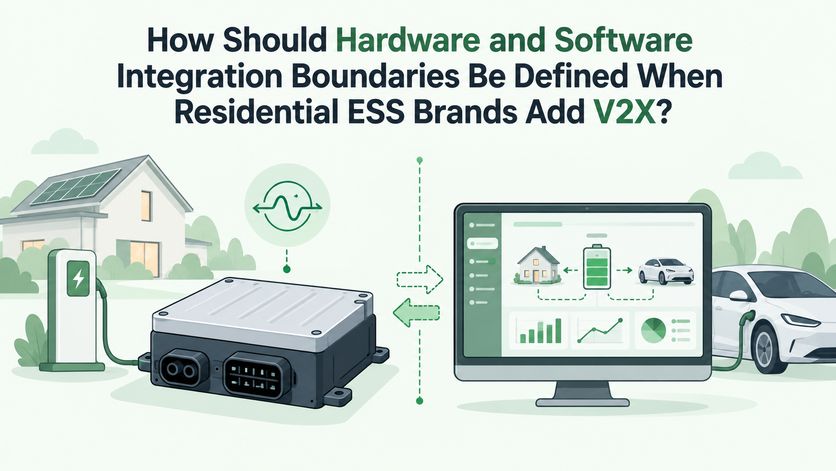
Residential ESS brands should establish a clear boundary between power-conversion execution and system-level energy management. Hardware should control its supported electrical operating modes, while software coordinates when and where energy should flow. This division allows manufacturers to extend their product capabilities without requiring every component to manage the entire household energy system.
Separate Power Execution from Energy Decisions
Hardware and software perform different functions within a V2X architecture. Power electronics execute electrical conversion, whereas an energy management system (EMS) determines how available energy should be allocated across connected devices.
Consider a home with solar panels, a stationary battery, and an EV. The EMS might prioritize charging the vehicle during periods of solar generation while reserving stored energy for household demand. The charging equipment then executes the requested operation within its documented capabilities.
Keep Conversion Control Close to the Hardware
The equipment manufacturer should retain responsibility for the functions directly associated with power conversion. These include implementing supported charging and discharging modes, controlling the conversion process according to the product design, and enforcing documented operating limits.
An energy storage charging module illustrates this distinction. Our portfolio includes power modules for EV charging and energy storage applications, including bidirectional AC/DC conversion. Such hardware provides the conversion capability needed by a larger system, but conversion capability alone does not establish responsibility for household energy scheduling.
The system integrator must determine which controller issues operating requests, which component executes them, and how the resulting operating state is communicated. Module-level commands and feedback should follow the actual product specification rather than assumptions about a universal interface.
Let the EMS Coordinate Household Energy
Software becomes more important as the number of energy sources and destinations increases. The EMS must coordinate PV generation, stationary storage, EV charging demand, and household consumption without assuming that all connected devices support identical functions.
Imagine a home generating surplus solar power during the day. The EMS can prioritize using that energy to charge the EV. If household demand increases, the controller can revise the allocation. Where the installed equipment supports vehicle-to-home (V2H) operation, it may also request energy from the vehicle to supply household loads.
UUGreenPower’s residential PV-storage-charging-discharging architecture provides a relevant example. The UHS7KFE-CCS2BD is a 7 kW residential unit designed to combine these functions within one product. In this type of integrated architecture, system designers must establish which functions are handled internally and which decisions remain with a higher-level energy controller.
The distinction is architectural rather than simply a matter of product size. Combining several functions in one unit may reduce the number of separate devices involved, but it does not eliminate the need to define control ownership, command interfaces, and operating conditions.
Design Interfaces Around Operating States and Faults
A well-defined hardware/software boundary requires more than a connection between the EMS and the charger. The integration specification should identify supported operating modes, command parameters, status feedback, and the behavior expected when a requested operation cannot proceed.
For example, an EMS might request that an EV discharge energy to support household consumption. The specification should establish how the equipment accepts the request, reports its actual operating state, and communicates an unavailable or interrupted operation. The exact signals and transition rules must come from the relevant product documentation.
Fault handling requires similarly explicit ownership. Hardware should enforce its documented operating limits and report relevant conditions through its supported interface. The system controller should use that information to revise energy-allocation decisions or stop requesting an operation that is no longer available.
Engineers should also define transitions between charging, discharging, standby, and fault states wherever those modes are supported. An energy storage charging module must be integrated according to its actual control specification, including the commands it accepts and the feedback it provides. Testing should confirm that the equipment and EMS respond consistently to normal requests and abnormal conditions.
Use Product Architecture to Validate the Boundary
Product architecture determines how control responsibilities are distributed in practice. An integrated residential unit, such as our UHS7KFE-CCS2BD, combines PV, storage, charging, and discharging functions in a single product. A system integrator must therefore establish how its internal controls interact with any external EMS and which controller owns household-level scheduling.
A separate bidirectional charging unit creates a different integration question: how should the charger exchange operating requests and status information with the residential ESS controller? At UUGreenPower, our 22 kW bidirectional DC charging and discharging solution provides a relevant example of equipment intended to support energy flow in both directions. The precise division of functions must still follow the selected product’s documented architecture.
These examples show why V2X integration should begin with a functional control map rather than a list of product capabilities. For each required function, engineers should identify the responsible component, the information it needs, the commands it exchanges, and the conditions under which it can operate.
Conclusion
When residential ESS brands add V2X capabilities, power-conversion equipment should remain responsible for executing supported electrical When residential ESS brands add V2X capabilities, power-conversion equipment should remain responsible for executing supported electrical operating modes and enforcing its specified operating limits, while the designated system controller coordinates household-level energy allocation.
Operating modes and enforcing its specified operating limits, while the designated system controller coordinates household-level energy allocation. The boundary becomes effective only when command ownership, status feedback, operating limits, and fault responsibilities are clearly specified.
For UUGreenPower and other equipment manufacturers, the objective is not to place every decision in hardware or software. It is to ensure that each component performs a defined role and that the complete system coordinates those roles through documented, testable interfaces.
What Communication and Dispatch Functions Matter When a 7kW V2X System and HEMS Connect to a VPP?
2026-11-03 NextWhich Control Responsibilities Should EV Charging Equipment Brands Retain When Expanding into Home Energy Applications?
2026-11-04

