
2026-11-04
UUGreenPower
0
Expanding from EV charging into residential energy applications changes the control responsibilities of an equipment manufacturer. A standalone charger primarily manages power delivery to a vehicle, while a home energy system may coordinate EV charging, photovoltaic (PV) generation, battery storage, household loads, and grid interaction. EV charging brands must therefore decide which functions they should control directly and which should be coordinated by a home energy management system (EMS).
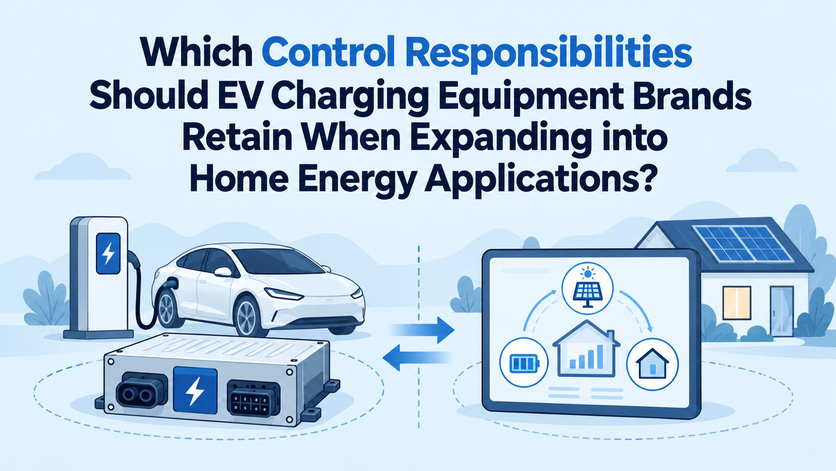
We believe the key is to retain control over power-conversion behavior and supported operating modes while providing clear interfaces for system-level energy management. This division allows equipment manufacturers to protect the integrity of their core technology without unnecessarily taking ownership of every household energy decision.
Why Home Energy Changes the Control Boundary
A residential energy system must respond to changing energy availability and household demand. Solar generation may fluctuate, a vehicle may need charging before departure, and a stationary battery may be required to support household consumption. These priorities extend beyond the responsibilities of an individual charging unit.
The control architecture should distinguish between deciding how energy is allocated and executing the requested power flow. The home EMS can coordinate household priorities, while the charging equipment manages its own supported operating conditions. Without this separation, system integrators may face uncertainty over which component determines operating modes, issues commands, and reports actual status.
Retain Direct Control of Power Conversion and Bidirectional Operation
Power conversion is a core responsibility that EV charging equipment brands should retain. Manufacturers develop and validate the control behavior of their power electronics, so external controllers should not replace equipment-level regulation. Instead, an EMS should communicate permissible operating requests through the product's defined interface.
Bidirectional charging makes this distinction especially important. Unlike conventional one-way charging, bidirectional operation supports energy flow in both directions, subject to the capabilities of the equipment and the wider system. The equipment manufacturer should define how its product implements supported charging and discharging modes, while the system controller determines when those modes are needed.
UUGreenPower's portfolio includes bidirectional charging and discharging products for vehicle-to-everything (V2X) applications. For an energy storage charging module, the relevant design boundary includes its documented input and output characteristics, supported operating range, and control interface. A system integrator should not assume that a module independently manages household energy allocation simply because it supports energy storage applications.
Coordinate Charging with Storage, Solar, and Home Loads
Home energy coordination requires a broader view than charger-level control. The EMS must consider the relationship between available PV generation, storage, vehicle charging demand, and household consumption. Its role is to translate those priorities into operating requests that the connected equipment can execute.
Imagine a home with solar panels and an EV connected during the day. If the household prioritizes using available solar energy for vehicle charging, the EMS can request an appropriate charging mode. If solar generation decreases or household demand rises, the EMS may revise its allocation. The charging equipment remains responsible for implementing the requested power flow within its documented limits.
A residential energy storage charging solution should consequently be designed around coordinated functions rather than treated as a charger and battery operating independently. At UUGreenPower, our residential ESS architecture integrates PV, PCS, V2G or AC charging, and EMS functions. Supported applications include direct EV charging from solar energy, using the EV battery to support home loads during outages, and returning energy to the grid where the complete installation, vehicle, protection scheme, and local connection requirements support those operating modes.
These functions depend on the capabilities of the complete installation. Equipment documentation and system design must establish which component manages each operating decision and which interfaces exchange commands and status information.
Make System Interfaces and Operating Modes Explicit
Control responsibilities become easier to verify when they are defined against real operating scenarios. For each mode, the system specification should identify the initiating condition, decision-making component, requested action, expected equipment response, and reported status.
During normal charging, the EMS may schedule vehicle charging around household energy priorities. During vehicle-to-home (V2H) operation, a compatible system may direct energy from the vehicle to household loads. During grid export, the controller may request energy delivery to the grid where the installed equipment and system support that function. In every case, the distinction between a system-level request and equipment-level execution should remain explicit.
An energy storage charging module must be integrated according to its actual interface specification and supported operating envelope. Engineers should verify command definitions, status feedback, operating-mode transitions, and documented limits instead of assuming that different products share identical controls.
Define Control Responsibilities Through Product Architecture
Our residential and bidirectional portfolio at UUGreenPower illustrates how this division can apply across different equipment configurations. The UHS7KFE-CCS2BD is a 7 kW residential PV-storage-charging-discharging unit, while the UBC25K1000-AY1-CCS2DN is a 25 kW V2X product. Our portfolio also includes a 7 kW single-phase hybrid converter with V2G, a 7 kW stacked hybrid energy storage system with V2G, and a 22 kW V2X bidirectional DC charging and discharging solution.
These products serve different system architectures, so control allocation must reflect each product's documented functions rather than its power rating alone. A hybrid residential unit may combine several energy functions, whereas a bidirectional charging product may form part of a larger installation with separate storage and energy-management components.
For EVSE manufacturers and system integrators, the practical task is to map each required function to the appropriate controller. Equipment-level control should remain with the device responsible for power conversion; household scheduling and energy allocation should reside at the designated system-control level. Interface definitions must then connect the two without implying unsupported capabilities.
Conclusion
EV charging brands expanding into home energy applications should retain responsibility for power conversion, supported charging and discharging modes, and the documented operating limits of their equipment. Household energy allocation can be coordinated by the EMS, provided the system architecture defines clear commands, feedback, and operating boundaries.
At UUGreenPower, this distinction provides a practical basis for integrating residential charging, storage, solar energy, and bidirectional power flow. The objective is not to control every household energy decision, but to ensure that each device executes its assigned role within a clearly defined and verifiable system architecture.
How Should Hardware and Software Integration Boundaries Be Defined When Residential ESS Brands Add V2X?
2026-11-04 NextHow Can Energy Partners Distinguish Home Backup Capability from Grid-Interactive Eligibility When Evaluating V2X?
2026-11-04

