
2026-11-04
UUGreenPower
0
A bidirectional EV charger may transfer energy from a vehicle to another destination, but that capability alone does not prove it can power a home during an outage or export electricity to the grid. Energy partners evaluating residential systems need to distinguish these outcomes before recommending equipment, designing installations, or making performance claims.
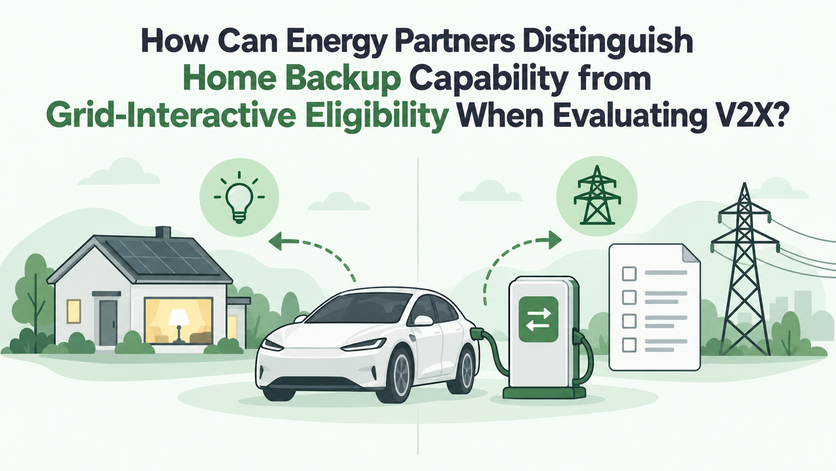
Home backup and grid interaction involve different operating conditions. Backup requires a system capable of supplying designated household loads when normal grid power is unavailable. Grid export requires compatible equipment and compliance with the applicable interconnection requirements. At UUGreenPower, we approach residential V2X evaluation by separating the product's documented bidirectional power-flow capabilities from the additional system and market conditions required for home backup or grid export.
Two Operating Modes, Two Different Questions
Home backup asks whether energy stored in an EV or stationary battery can reach household loads after the utility supply fails. Grid-interactive operation asks whether the system can exchange energy with the electricity network under the required technical and regulatory conditions.
These are separate evaluations. A charger may support bidirectional energy transfer without supporting islanded operation, in which the home is electrically separated from the utility grid. Likewise, a system capable of supplying local loads during an outage is not automatically authorized to export electricity while connected to the grid.
Energy partners should assess each capability independently. Product descriptions, electrical architecture, operating modes, and approval documentation must support the specific claim being made. The term V2X describes a range of energy-transfer applications; it should not be treated as proof that every application is available in every installation.
Verify the Complete Backup Power Path
Backup capability depends on the complete electrical path between the energy source and the household loads. Evaluators should establish whether the system can isolate the home from the grid, convert vehicle battery energy into usable power, and maintain the intended supply during an outage.
Transfer arrangements, protection, grounding, and the supported backup operating mode also require verification. A grid-connected charger cannot be assumed to energize a building during a power failure simply because it supports reverse energy flow. The equipment and installation must explicitly support the intended backup configuration.
Consider a household that wants to keep essential appliances running during an outage. The energy partner must identify which loads can be supplied, whether the installed configuration supports backup operation, and what power or operating restrictions apply. A product's nominal charging rating does not establish the available backup power or duration by itself.
We address this distinction in our residential ESS with EV charging portfolio, which includes the UBC22K1000-Y1-CCS2D, a 22 kW bidirectional DC charging and discharging solution. Its product documentation describes using EV battery energy to support home backup. Partners should still verify the intended system configuration and its documented operating conditions before promising uninterrupted household power.
Treat Grid Export as a Separate Eligibility Check
Grid interaction requires a different evaluation. Bidirectional hardware establishes a technical means of transferring energy; it does not independently establish permission to export electricity through a particular installation.
Energy partners should verify applicable utility requirements, local grid-connection rules, protection arrangements, and any required metering or authorization. Requirements depend on the deployment jurisdiction, so eligibility must be assessed for the actual market and installation rather than inferred from a general product description.
The distinction is especially important when evaluating v2x products. Vehicle-to-home (V2H) operation supplies energy to household loads, whereas vehicle-to-grid (V2G) operation involves energy exchange with the electricity network. Although both can involve discharging an EV battery, their system configurations and approval requirements may differ.
Before describing a product as grid-export-ready, partners should obtain evidence of its supported grid-connected operating modes and the documentation applicable to the target market. If approval has not been confirmed, the claim should remain limited to the documented bidirectional capability.
Evaluate the Vehicle, Converter, and Control System Together
Neither backup operation nor grid export can be evaluated solely from a charger specification. The EV must support the required discharge function, the converter must support the intended power flow, and the wider system must coordinate the selected operating mode. Compatibility can depend on the vehicle model and the implementation of its charging and communication systems.
An energy storage charging module can provide a conversion building block for an integrated installation, but its functions should not be confused with those of the complete system. Partners need to distinguish module-level capabilities from those of the charger, energy management system (EMS), inverter, battery, and site protection arrangements.
Control responsibilities also matter. The EMS may decide when energy should be supplied to household loads or exported, but the equipment must implement only supported operating modes. The integration specification should establish how commands, operating states, and fault information are exchanged, especially when the requested energy flow becomes unavailable.
Build a Verification Process for Energy Partners
A disciplined evaluation prevents unsupported capability claims before a project reaches installation.
First, define the intended scenario: outage backup, grid export, or both. Second, obtain product documentation identifying supported modes and operating limits. Third, verify compatibility among the vehicle, bidirectional charger, energy storage equipment, and control system.
Next, confirm installation requirements for the target market. For backup, examine grid isolation, transfer behavior, and the intended loads. For export, confirm the applicable grid-interconnection requirements and necessary approvals. Finally, request evidence that the complete configuration has been validated for the operating mode being advertised.
This process also clarifies commercial responsibilities. Manufacturers can document product functions and operating limits; installers and system integrators can verify the proposed installation; and energy partners can confirm whether the complete solution meets the intended application and market requirements.
Make the Final Decision Against the Intended Use
The decisive question is not simply whether a V2X product can discharge an EV battery. It is whether the proposed system can deliver energy to the intended destination under the conditions that matter to the project.
For backup, partners need evidence of a supported outage operating mode and a verified path to the designated household loads. For grid export, they need evidence of compatible bidirectional operation and the applicable interconnection approvals. A project requiring both must satisfy both sets of conditions.
At UUGreenPower, we see these as distinct evaluation criteria rather than interchangeable product benefits. Establishing them separately gives distributors, installers, and system integrators a more defensible basis for selecting equipment and specifying what a residential V2X installation can actually deliver.
Which Control Responsibilities Should EV Charging Equipment Brands Retain When Expanding into Home Energy Applications?
2026-11-04 Next22kW vs. 50kW Integrated DC Charging Solutions: How to Choose Based on Dwell Time and Charging Demand?
2026-11-05

