
2026-11-05
UUGreenPower
0
A charging site does not always need the highest available power to meet drivers’ needs. At a hotel, workplace, or shopping centre, vehicles may remain parked for several hours. At a fleet depot with frequent departures, the same parking duration may be unavailable. Electrical supply capacity introduces another constraint, particularly at existing commercial properties where upgrading the connection may be costly or difficult.
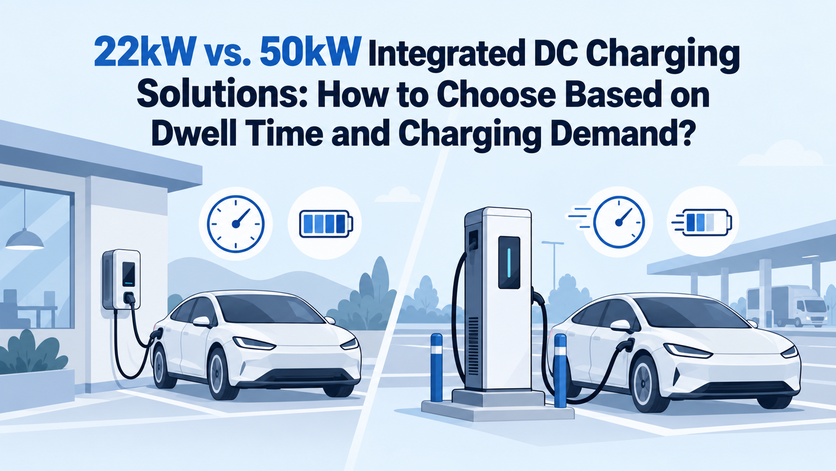
Choosing between 22kW and 50kW integrated DC charging solutions means balancing energy demand, parking duration, and site capacity. For many destinations, lower-power DC charging offers a practical way to expand charging access across diverse locations without automatically designing around the demands of higher-power equipment.
Dwell Time Reveals the Required Charging Power
Dwell time describes how long a vehicle remains available for charging. Charging demand is the energy it needs before departure. Together, these variables determine whether a 22kW charger can meet operational requirements or whether a higher rating deserves consideration.
A simple theoretical calculation illustrates the difference. At continuous rated output, a 22kW charger could deliver 22kWh in one hour, compared with 50kWh from a 50kW unit. Actual energy delivery depends on the vehicle’s charging acceptance, battery state of charge, conversion losses, and operating conditions.
Imagine a workplace where employees park throughout the working day. A 22kW charger may provide sufficient energy during that period, making higher output unnecessary for the intended use. A delivery vehicle that stops briefly between routes faces a different requirement: limited dwell time may make additional charging power operationally valuable.
Before specifying equipment, operators should calculate typical energy requirements per session, identify peak arrival periods, and estimate how many vehicles will charge simultaneously. These figures turn a broad power comparison into a site-specific decision.
Why Lower-Power DC Charging Expands Site Options
Electrical capacity can influence both project feasibility and the number of charging points a property can support. A 50kW unit has a higher maximum rated output than a 22kW unit, potentially placing greater demand on the supply when operating at full power. Actual requirements depend on the complete electrical installation and concurrent loads.
Lower-power DC charging is therefore worth considering wherever vehicles remain parked long enough to receive the required energy. UUGreenPower lists the UC22K1000-AY1-CCS1/CCS2 for applications including personal residences, villa areas, shopping centres, industrial parks, scenic destinations, hotels, and other destination-charging locations.
The UC22K1000-AY1-CCS2 fits naturally into this discussion. Its published specifications include a 200–1000V DC output range, a 300–1000V constant-power range, and IP65 protection. The wide constant-power range supports evaluation across different EV battery voltage platforms, subject to vehicle and connector compatibility.
For property owners, the advantage of considering lower-power units is flexibility. Rather than prioritising maximum output at every parking space, planners can assess whether appropriately rated chargers distributed across more spaces would better match parking patterns and available electrical capacity. Lower power does not guarantee that an upgrade will be unnecessary, but it creates another option for constrained sites.
Which Rating Fits Each Operating Scenario?
The distinction becomes clearer when charging equipment is assessed against the way a location actually operates.
Destination charging: Hotels, offices, and shopping centres can prioritise 22kW where parking durations are long enough to meet energy requirements. A lower individual power demand may also make it easier to evaluate multiple charging bays within an existing supply budget.
Fleet operations: Fleet managers should compare departure schedules with the energy required for the next journey. Vehicles parked overnight may not need the same output as vehicles returning to service after a short stop. Where schedules vary significantly, a combination of power ratings may be worth assessing.
Short-stop charging: A 50kW EV charger is more relevant where vehicles need greater energy delivery during limited parking windows. However, higher rated output only provides practical value when the vehicle can accept that power and the site can supply it.
For commercial EV charging solutions, the best configuration depends on the energy required per visit rather than a general preference for either rating. The Australian exhibition lineup includes our UC22K1000-AY1-CCS2 and UC50K1000-AY2-CCS2, giving project teams two rated-power options to evaluate against these operating scenarios. The 50kW model’s complete electrical specifications should be confirmed from its applicable technical documentation before procurement.
From Power Selection to Project Implementation
A suitable rating is only the beginning of a reliable installation. Engineers must assess incoming supply capacity, existing building loads, protective devices, wiring, and expected simultaneous charging. Connector configuration, communications, environmental conditions, and applicable Australian installation requirements also need verification.
This broader planning process is where UUinside becomes relevant. As UUGreenPower’s one-stop charging solution and service platform, UUinside provides OEM/ODM system design, standard components, certification support, customization, and operation and maintenance support. These capabilities support manufacturers and integrators developing charging systems around defined project requirements, rather than treating charger selection as an isolated hardware purchase.
A project team can first define the required power, target market, installation environment, and connector configuration, then evaluate the system design and supporting services. The platform does not replace site-specific electrical engineering or product-level verification; it provides a broader framework for developing and supporting the charging solution.
Select for the Energy Required, Not the Highest Rating
A 22kW solution is a strong candidate when vehicles have longer dwell times, charging demand is manageable, and site capacity is constrained. A 50kW EV charger is more compelling when short parking windows make higher output necessary and the electrical infrastructure can accommodate it.
For commercial EV charging solutions, the most effective decision starts with measured demand and realistic parking patterns. At UUGreenPower, our small DC charging options give project planners a basis for evaluating different deployment needs, while UUinside can support the wider system design and service requirements. The objective is to deliver the energy vehicles need, across the locations that need charging, without specifying more power than the application justifies.
How Can Energy Partners Distinguish Home Backup Capability from Grid-Interactive Eligibility When Evaluating V2X?
2026-11-04 NextHow Does Available Site Power Capacity Affect the Choice Between 22kW and 50kW DC Charging?
2026-11-05

