
2026-11-05
UUGreenPower
0
Available site power capacity can determine how many EV chargers a commercial property can support without upgrading its electrical infrastructure. A hotel or office building may have limited spare capacity during business hours, while a fleet depot may need several vehicles charging simultaneously. Choosing a charger without accounting for these constraints can lead to costly redesigns or insufficient charging capacity.
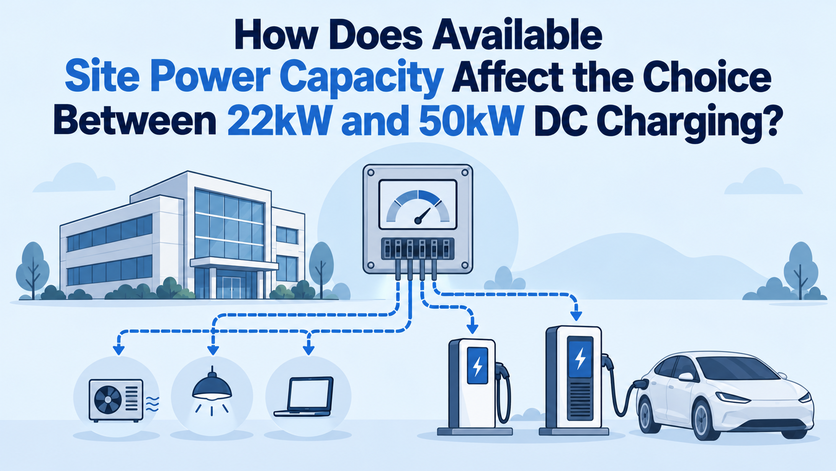
The decision between 22kW and 50kW DC charging starts with the site's usable power budget, not simply the charging speed required by individual vehicles. For commercial EV charging solutions, engineers must balance energy demand, parking duration, existing building loads, and the number of charging points the electrical system can support.
Establish the Power Available for EV Charging
A building's incoming supply rating does not represent the power available exclusively for charging. Lighting, HVAC equipment, machinery, and other electrical loads already consume part of that capacity.
Engineers should establish the site's maximum demand, review existing and planned loads, and determine how much capacity can be allocated to EV charging. Peak demand matters more than average consumption when assessing whether the installation can operate reliably during its busiest periods.
Consider a commercial property with limited spare capacity during working hours. Installing several 50kW chargers may create a substantially higher potential demand than deploying appropriately rated 22kW units. The final decision depends on how much energy vehicles require and how long they remain parked.
A useful starting point is to calculate the energy required per charging session, identify peak arrival periods, and estimate the number of vehicles charging concurrently. These figures help establish whether the site needs higher individual charging power or a more distributed charging configuration.
Understand the Electrical Difference Between 22kW and 50kW
A charger's rated power indicates its nominal maximum output under specified operating conditions. At full rated output, a 50kW unit requires more power than a 22kW unit, although the actual upstream electrical demand also depends on conversion efficiency, power factor, and input configuration.
The difference in potential energy delivery is straightforward. At continuous rated output, a 22kW charger could theoretically deliver 22kWh in one hour, compared with 50kWh from a 50kW charger. Actual delivery depends on vehicle acceptance limits, battery state of charge, conversion losses, and other operating conditions.
Electrical compatibility matters alongside rated power. Our 22kW UC22K1000-AY1-CCS2 model has a documented DC output range of 200–1000V and a constant-power range of 300–1000V.
The constant-power range identifies the voltage interval over which the charger is specified to maintain its rated power, subject to its operating limits. Engineers should compare these parameters with the target vehicles' charging requirements rather than assuming every EV can use the full rated output.
Why Lower-Power DC Charging Can Suit More Sites
Limited electrical capacity does not necessarily mean a charging project must be abandoned. Lower-power DC charging provides another option for locations where vehicles stay parked long enough to receive the required energy without the maximum output of a higher-rated charger.
Our 22kW charger is suitable for residences, hotels, shopping centres, industrial parks, and scenic destinations. These locations have different parking patterns, but many can accommodate longer charging sessions than high-turnover charging stops.
For property owners and charge point operators, this creates an opportunity to evaluate charging access across more parking spaces instead of concentrating the available power on a smaller number of high-rated units. Whether that arrangement works depends on the total site load, charging schedules, and electrical design.
Lower-power equipment does not automatically eliminate supply upgrades. However, its lower individual maximum demand can give project planners more flexibility, particularly when extending charging access to existing commercial buildings. This makes power allocation a central part of evaluating dc fast charging solutions, alongside the energy requirements of the vehicles being served.
Account for Simultaneous Loads and Future Expansion
A site that can support one charger may not be able to support several operating at full output. Engineers must assess combined charging demand alongside building loads, protective devices, cable sizing, and the site's supply characteristics.
Dynamic load management can help allocate available power across multiple charging points according to a configured site limit. For example, charging power can be adjusted as building demand changes, subject to the installed control system and equipment compatibility. Such controls can improve the use of available capacity, but they do not replace appropriate electrical design.
Future expansion deserves equal attention. A depot may initially require only a few charging points but later need additional vehicles, longer operating hours, or higher throughput. Evaluating these scenarios early helps determine whether to install lower-power units, introduce load management, stage deployment, or investigate a supply upgrade.
For commercial EV charging solutions, the most practical configuration is one that meets current operational requirements without unnecessarily restricting future development.
Connect Charger Selection with System Design
At UUGreenPower, we recognise that choosing a charger involves more than specifying its output rating. Manufacturers and system integrators must also coordinate component selection, electrical architecture, customization, certification requirements, and ongoing service arrangements.
Our UUinside platform provides a one-stop charging solution and service offering that includes OEM/ODM system design, standard components, certification services, customization, and operation and maintenance (O&M). These services can support project teams that need to develop a charging system around specific site requirements rather than select hardware in isolation.
The platform's role is to support the wider solution and service workflow; the suitability of an individual charger still depends on verified specifications and site engineering. At UUGreenPower, we encourage project teams to establish the power budget and operating requirements before finalising their equipment configuration.
Let the Site Constraints Shape the Decision
A 22kW charger is worth evaluating first when parking durations are relatively long, energy demand is manageable, and spare electrical capacity is limited. A 50kW charger is more appropriate to investigate when vehicles need greater energy delivery within shorter charging windows and the site can accommodate the additional demand.
DC fast charging solutions should be selected according to the relationship between available electrical capacity and actual charging requirements. A carefully planned lower-power installation may serve a wider range of destinations, while higher-power equipment remains valuable where operational turnaround justifies it. The engineering priority is to deliver sufficient energy within the site's real constraints, rather than design around a rated output that the application does not require.
22kW vs. 50kW Integrated DC Charging Solutions: How to Choose Based on Dwell Time and Charging Demand?
2026-11-05 Next50kW Single-Connector vs. Dual-Connector 2×25kW: How to Choose Based on Vehicle Arrival Patterns?
2026-11-05

