
2026-11-05
UUGreenPower
0
Choosing between a single-connector 50kW charger and a dual-connector configuration rated at 2×25kW is not simply a question of how many vehicles a charger can connect. The more important consideration is how vehicles arrive, how long they remain parked, and how much power each vehicle needs during its charging session.
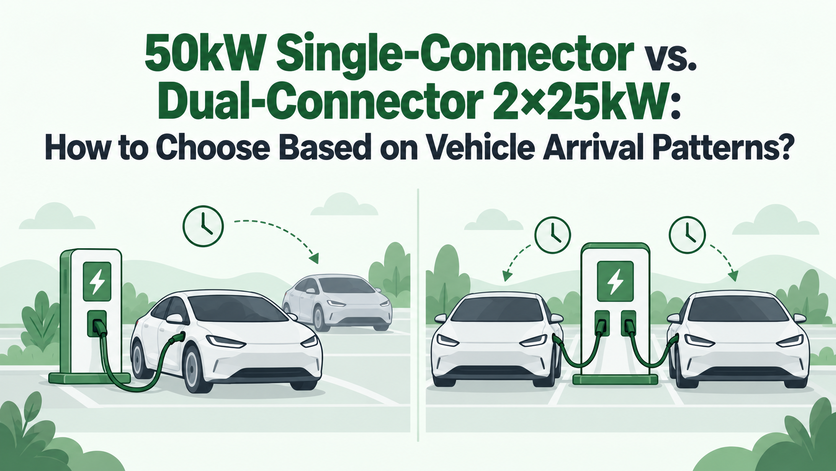
Both configurations offer 50kW of nominal combined capacity, but they distribute that capacity differently. A single-connector configuration can direct the available output to one vehicle, while a dual-connector configuration may support charging two vehicles simultaneously, depending on the specific model, rated output, power-sharing logic, and supported operating modes.
At UUGreenPower, we approach charging deployment as a system-design decision. The right configuration should reflect actual operating patterns, site constraints, and long-term service requirements rather than connector count alone.
Start with Arrival Patterns, Not Connector Count
Before comparing hardware, operators should examine vehicle arrival frequency, average dwell time, peak-period demand, and the proportion of vehicles that charge simultaneously. These factors reveal whether the main challenge is delivering sufficient power to one vehicle or accommodating multiple vehicles within the same time window.
For example, a fleet depot where vehicles return in scheduled batches may experience concentrated demand during a short period. A commercial parking facility may instead see vehicles arrive throughout the day and remain parked for several hours. Although both sites may require 50kW of total charging capacity, their operational priorities are different.
Operators should also consider vehicle battery capacity and charging acceptance limits. A charger’s rated output does not guarantee that every vehicle will draw that amount throughout a session. The vehicle’s battery condition, state of charge, and onboard charging system can affect actual power demand.
When a Single 50kW Connector Is the Better Fit
A single-connector 50kW configuration is worth considering when vehicles arrive one after another, require relatively high charging power, or need to complete charging within a limited dwell time. Concentrating the available output on one vehicle can be advantageous when simultaneous charging is not a frequent requirement.
This arrangement may suit a fleet service point with staggered departures, a roadside charging location with relatively short stops, or a site where vehicles are usually charged sequentially. It can also simplify the operating model when staff direct vehicles to a charger as each charging session finishes.
However, operators should assess what happens during peak periods. If several vehicles arrive together, a single connector may create a queue even when the charger has sufficient total capacity over the course of a day. The relevant question is not only how much energy the charger can deliver, but whether it can deliver that energy at the times vehicles need it.
When Dual 25kW Connectors Make Better Use of Arrivals
A dual-connector configuration rated at 2×25kW can be attractive when two vehicles commonly arrive together and can both make productive use of a 25kW allocation. Instead of waiting for the first vehicle to finish, the second vehicle may begin charging immediately, improving access during busy periods.
This can be useful in fleet parking areas, workplace charging facilities, and commercial sites where vehicles remain parked long enough to accept a lower power allocation. In these environments, reducing waiting time may be more valuable than maximizing the instantaneous output to a single vehicle.
The key qualification is that the actual power-sharing design must be verified. Two connectors do not automatically mean that each vehicle will continuously receive 25kW under every operating condition. Operators should confirm whether the charger can maintain its stated rated output when both connectors are in use, or whether the available power must be shared between the two vehicles.
They should also determine whether power allocation is fixed or dynamically adjusted according to each vehicle's charging demand. When only one connector is active, it is important to verify whether the unused connector's power capacity can be reassigned to the active vehicle, subject to the charger's rated output, vehicle acceptance limits, and the system's power-sharing configuration.
A dual-connector design is therefore most effective when its simultaneous-charging capability matches the site's arrival pattern and the vehicles' energy requirements.
Evaluate Charging Demand and Power Allocation
A simple energy calculation illustrates the trade-off. If a vehicle needs 20kWh of energy, a constant 50kW output would theoretically deliver that energy in about 24 minutes. At a constant 25kW, the same amount would take about 48 minutes.
These figures are illustrative calculations, not predictions of actual session duration. Real charging power can vary with the vehicle, battery state of charge, temperature, and charging curve. The calculation also assumes that the full stated power is available to the vehicle throughout the period.
For a site serving two vehicles at once, the longer individual charging time may be acceptable if both vehicles can charge during their planned dwell periods. Conversely, if vehicles must leave quickly and each requires substantial energy, directing the available power to one vehicle at a time may better match operational needs.
When evaluating commercial EV charging solutions, compare expected energy delivery, queueing, simultaneous demand, and vehicle turnaround—not just the headline power rating. A useful assessment should include typical and peak arrival periods, rather than relying exclusively on daily average utilization.
Match Charger Configuration to the Deployment Model
Hardware selection is only one part of a successful deployment. Operators also need to consider installation requirements, certification, integration with site systems, maintenance arrangements, and the ability to adapt the solution as vehicle numbers or charging patterns change.
As a one-stop charging solution and service platform, our UUinside supports OEM/ODM system design, standard components, certification, customization, and operation and maintenance (O&M). These capabilities are relevant when a project needs to align charger architecture with a particular site layout, operating model, or deployment requirement. They also help buyers evaluate the complete solution rather than treating the charger as an isolated piece of equipment.
For instance, our UC50K1000-AY2-CCS2 50kW DC charger provides a relevant product reference when assessing a 50kW charging deployment. The final choice between a single-connector and dual-connector arrangement should still be based on the specific configuration, connector availability, and verified power-allocation specifications required by the project.
When assessing a 50kW EV charger, buyers should confirm its output characteristics, connector configuration, control strategy, installation conditions, and service support. OEM/ODM customization may also be worth discussing when standard configurations do not align with the site's operational requirements.
Conclusion: Choose for the Site’s Real Bottleneck
A single-connector 50kW charger is generally worth evaluating when individual vehicles need concentrated power and arrivals are sufficiently staggered. A dual-connector 2×25kW configuration may be more suitable when two vehicles frequently need to charge at the same time and their dwell periods can accommodate the lower individual allocation.
The decision should follow measured arrival patterns, energy requirements, and queueing behavior. At UUGreenPower, our one-stop approach brings system design, components, certification, customization, and O&M into that evaluation, helping operators consider not only initial charging capacity but also how the installation will function over time. The strongest configuration is the one that resolves the site’s actual operational bottleneck.
How Does Available Site Power Capacity Affect the Choice Between 22kW and 50kW DC Charging?
2026-11-05 Next22kW Wallbox DC Charging Module Pack or Complete Wallbox DC Charger: How to Choose Based on In-House Integration Capability
2026-11-06

