
2026-11-06
UUGreenPower
0
For an EV charger manufacturer, choosing between a charging module pack and a complete wallbox DC charger is fundamentally a decision about engineering responsibility. Both routes can support a 22kW charging product, but they leave different amounts of work with the buyer.
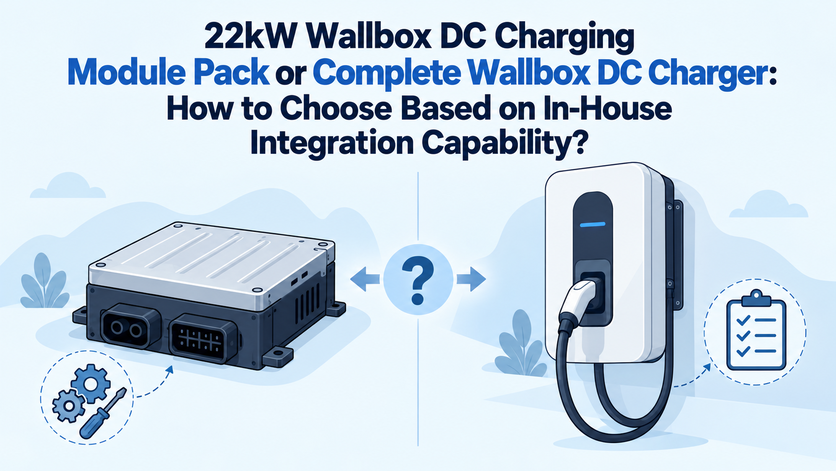
A module pack gives the engineering team a power-conversion component to incorporate into its own charger design. A complete charger provides a more integrated product, reducing the need to develop every system-level function independently. The right choice depends on whether your organization has the people, processes, test facilities, and time to take responsibility for integration.
At UUGreenPower, we provide both the 22kW Wallbox DC Charging Module Pack URP100022 and the UC22K1000-AY1-CCS1/CCS2 wallbox DC charger. They serve different procurement needs, so the decision should begin with your intended product and the capabilities of your team, rather than the assumption that one option is universally better.
Choose a Module Pack When You Have Integration Capability
A module pack does not constitute a complete charger by itself. The finished product still requires coordinated AC-side protection, DC output distribution, charger control, communications, user interface, connector and cable integration, cooling, mechanical design, and safety logic. The manufacturer must also validate these functions together at system level.
The URP100022 is a 22kW DC charging module pack designed for wallbox charger integration. Its published specifications include a 200–1000V DC output range and a constant-power range of 300–1000V. The unit measures 361.5 × 96 × 637.5mm and weighs less than 25kg, giving engineers defined mechanical and electrical parameters to consider during product development.
However, a module pack does not automatically make a finished charger. Before procurement, confirm exactly what the package includes and which functions remain your responsibility. These may include system protection coordination, mounting, airflow, control integration, connector behavior, software, finished-product testing, and compliance work.
This route is especially suitable for manufacturers that already have an experienced power-electronics team, an established production process, and a product roadmap requiring a distinctive enclosure or customized system architecture. The module can become part of a repeatable platform rather than a one-off development exercise.
Choose a Complete Charger to Reduce System-Level Work
If your organization has limited charger-design resources, buying a complete unit may be more practical. It can reduce the amount of mechanical and electrical design your team must undertake before moving into product evaluation, deployment planning, or commercial operations.
The UC22K1000-AY1-CCS1/CCS2 is a complete 22kW wallbox DC charger with a 200–1000V output range, a 300–1000V constant-power range, IP65 protection, and independent air-duct cooling. Its published enclosure dimensions are 446 × 688 × 176.2 mm, with a weight below 60 kg. The integrated product also includes LCD and communication interfaces such as 4G, RJ45, and Bluetooth.
A complete unit does not remove every implementation task. Choosing a complete wallbox reduces the amount of charger-level architecture the buyer must develop, but it does not eliminate deployment responsibilities. Buyers still need to verify connector compatibility, backend communication, site electrical conditions, installation requirements, commissioning procedures, and applicable market approvals.
For operators or businesses that do not intend to manufacture their own charging hardware, this route can avoid building an integration capability that is not central to their business.
Compare the Work Behind Each Option
Purchase price alone rarely captures the full cost of these two approaches. Evaluate the engineering work and project responsibilities that sit outside the quoted hardware.
With a module pack, budget for integration engineering, interface definition, prototype assembly, thermal validation, fault testing, software coordination, and production verification. Your team should also define who owns the final configuration and how engineering changes will be managed.
With a complete charger, focus on product-level validation, installation readiness, communications and backend compatibility, local compliance, and service arrangements. Ask which tests and documents are supplied, which remain outstanding, and who is responsible for closing each requirement.
For either route, request clear specifications and an agreed verification plan. A component-level result does not automatically prove the performance or compliance of the finished charging system. Likewise, a complete charger still needs to be evaluated against the conditions and requirements of its intended deployment.
These checks are essential when comparing modular EV charging solutions: the value depends not only on which hardware you buy, but also on whether your organization can complete the remaining work reliably and economically.
Use a Clear Decision Rule
Choose a module pack when your team can own the charger architecture, integration testing, production controls, and continuing product support—and when that control creates a real commercial advantage. Choose a complete wallbox charger when your priority is to reduce development responsibilities and concentrate on deployment, distribution, or charging operations.
If you want more support between buying a component and developing a finished product, UUinside offers another route. It is our one-stop charging solution and service platform, supporting OEM/ODM system design, standardized components, customization, certification support, procurement, and operation and maintenance planning. It is a development and service platform, not a single charger model. The precise project scope and responsibilities should still be agreed in advance.
Before issuing a request for quotation, document your target power, connector, voltage range, installation environment, customization requirements, and expected production volume. Then list the integration tasks your own team can confidently complete. This makes it easier to compare modular EV charging solutions on total engineering effort, delivery risk, and long-term ownership—not just the initial hardware price.
Our approach at UUGreenPower is to help customers identify the product route that matches their actual integration capability. If you have a mature charger platform, a module pack may provide the flexibility you need.
If you want to minimize in-house system development, a complete wallbox DC charger may be the more direct choice. For projects requiring broader development support, UUinside can help structure the path from component selection to a defined charging-system solution.
50kW Single-Connector vs. Dual-Connector 2×25kW: How to Choose Based on Vehicle Arrival Patterns?
2026-11-05 NextWhen Does the UR100060E (EU) 60kW Charging Module Make More Sense Than Lower-Power Modules?
2026-11-06

