
2026-11-06
UUGreenPower
0
A charging station's required output should determine its module configuration, not the other way around. If an EVSE manufacturer is designing a high-power cabinet, the choice between a 60kW module and lower-power alternatives affects how many conversion units are needed, how they are integrated, and how the system can be expanded.
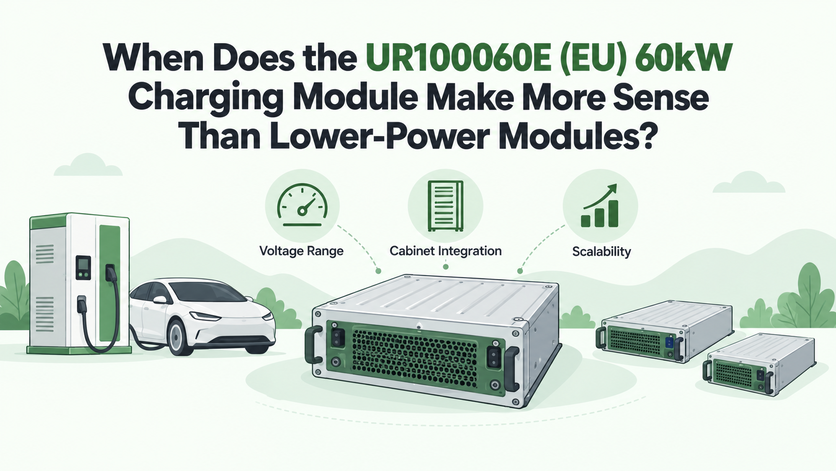
The UR100060E (EU) from UUGreenPower delivers 62.5kW of constant power across 300–1000VDC. Its output voltage range extends from 150VDC to 1000VDC. These characteristics make it worth evaluating for charging systems that need substantial output power alongside broad voltage coverage.
Start by calculating the cabinet's required DC output. For example, a hypothetical 240kW cabinet could use six 40kW modules for 240kW of nominal module capacity. Four UR100060E (EU) modules would provide 250kW of nominal module capacity, so the final system output would need to be limited and coordinated according to the approved cabinet design. Actual sizing must account for the selected module's rated output, operating conditions, and system design requirements.
Calculate What Fewer, Higher-Power Modules Change
Module count affects cabinet architecture. A design using fewer, higher-power units may simplify the number of conversion modules that need to be integrated, monitored, and accommodated within the available enclosure. However, the final cabinet layout also depends on cooling arrangements, electrical distribution, controller design, and service clearances.
Consider a system integrator developing a public fast-charging cabinet for multiple charging dispensers. If the required power exceeds what a small group of lower-power modules can deliver, a 60kW charging module may help reach the target with fewer units. The engineering team must still determine how power is allocated across dispensers and whether simultaneous charging requirements can be met.
Parallel expansion is another consideration. The UR100060E (EU) supports parallel connection of up to 60 modules, providing a documented scaling option for larger power-conversion systems. That figure describes module-level parallel capability; it does not independently establish the achievable output, redundancy, or charging performance of a complete station.
Check Voltage Coverage Before Comparing Kilowatts
A high power rating does not guarantee that a module can maintain that output at every battery voltage. The relationship between voltage, current, and power explains why:
Power = Voltage × Current.
As voltage decreases, delivering the same power requires more current. A module may therefore reach its current limit before delivering its rated power at a particular voltage.
The UR100060E (EU) supports 62.5kW constant-power output from 300VDC to 1000VDC. Its maximum output current is approximately 208.3A, corresponding to 62.5kW at 300V. At 1000V, the same power corresponds to 62.5A. These operating points illustrate how current requirements change across the constant-power range.
For a charging station serving vehicles with different battery voltage platforms, this broad constant-power window can simplify module selection. Engineers should nevertheless verify the vehicle's required voltage, current, and charging profile against the complete operating envelope. The module's 150–1000VDC output range must not be mistaken for a guarantee of rated power throughout that entire range.
Account for Input Supply, Heat, and Service Requirements
The AC input conditions can influence whether a module fits the intended power cabinet. The UR100060E (EU) supports an input voltage range of 260–530VAC, a rated-load power factor of at least 0.99, and total harmonic distortion of input current no greater than 5% above half load. These parameters help engineers assess electrical integration, but they do not replace a site-specific supply assessment.
Thermal management deserves equal attention. The module uses intelligent air cooling and supports an operating temperature range of −40°C to 75°C, with derating beginning at 55°C. Derating means available output may decrease as temperature rises; the maximum operating temperature should not be interpreted as a promise of full power at that temperature.
Peak efficiency is specified at 97.5% or higher, while rated efficiency is at least 97%. These figures are relevant when estimating conversion losses and thermal loads, although actual results depend on operating conditions. Cabinet designers must assess airflow, ambient temperature, and heat removal for the complete assembly.
Service requirements also influence the comparison. The UR100060E (EU) supports hot swapping, CAN communication, automatic address identification, and manual address setting. These functions can support module replacement and system monitoring, subject to the cabinet's implementation and maintenance procedures.
Know When 60kW Is the Better Engineering Fit
A 60kW-class design deserves consideration when the station needs substantial output, broad constant-power voltage coverage, and a scalable module architecture. It may be less compelling where the required cabinet power is modest, available space or electrical supply imposes tighter limits, or a lower-power configuration already meets the charging requirement.
For manufacturers developing an EV charging solution, the decision should follow a clear sequence: define the required cabinet output, establish vehicle voltage and current requirements, calculate module quantity, and verify input supply and thermal conditions. Compare alternatives using the same operating assumptions rather than nominal kilowatts alone.
At UUGreenPower, our UR100060E (EU) provides a specific combination of 62.5kW constant-power output, a 300–1000VDC constant-power range, and parallel expansion capability. UUGreenPower can help project teams evaluate whether those characteristics match their intended system architecture.
The strongest case for this module is not simply that it delivers more power than a smaller unit. It is that its output rating, voltage envelope, and integration features align with the charging cabinet's actual requirements. When those conditions are satisfied, the higher-power architecture becomes an engineering decision supported by measurable system needs.
22kW Wallbox DC Charging Module Pack or Complete Wallbox DC Charger: How to Choose Based on In-House Integration Capability
2026-11-06 NextHow Does UR100060E (EU) Efficiency Affect Charger Heat and Cooling Needs?
2026-11-06

