
2026-11-09
UUGreenPower
0
Selecting a charging module requires more than matching its rated output to a cabinet's power target. Engineers must establish whether the incoming AC supply falls within the module's operating range and whether the installation can manage the heat generated during conversion. For projects considering the UR100060E (EU), these two checks directly influence system integration and expected operating performance.
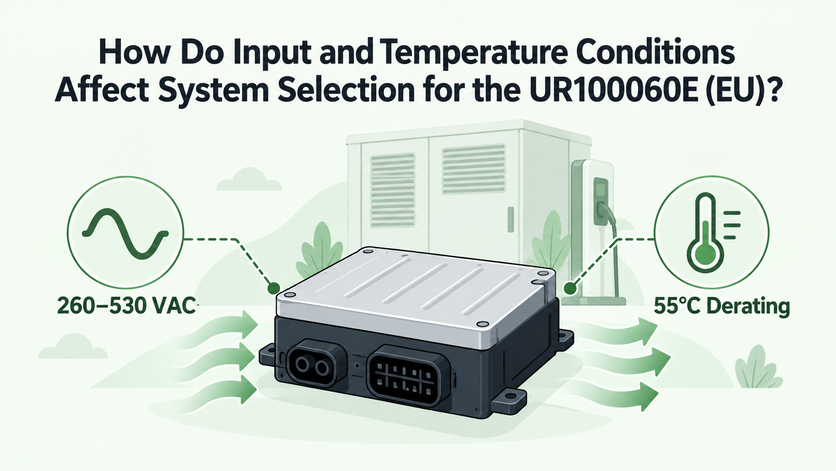
The module supports an AC input voltage range of 260–530VAC, with a maximum input current of 120A. Its rated-load power factor is at least 0.99, and input current total harmonic distortion (THDi) is no greater than 5% above half load. Together, these parameters help engineers assess electrical integration, but they do not replace measurements of the actual supply.
Understand What the Wide Input Range Does—and Does Not—Solve
A wide input voltage range gives an EV charging module flexibility across different AC supply conditions. However, a nominal voltage reading alone cannot establish whether the complete charging system will operate as intended. Engineers should verify voltage variation, frequency, available current, and the capacity of upstream electrical equipment.
The UR100060E (EU) is rated for 50/60Hz systems and specifies an input-frequency range of 55±10Hz, corresponding to approximately 45–65Hz. The wider operating range should not be interpreted as meaning that every frequency within that window represents an equally suitable nominal supply condition.
The supply arrangement must satisfy the applicable input requirements rather than relying on the voltage range alone. If measured conditions approach the operating limits, the system designer should verify the expected behaviour against the relevant technical documentation.
Power factor and THDi also serve different purposes. Power factor describes the relationship between real power and apparent power, while THDi indicates harmonic distortion in input current. The module's power factor specification of at least 0.99 applies at rated output load; its THDi limit applies above half load. Keeping those conditions attached to the figures prevents misleading comparisons between products tested at different operating points.
For a project evaluating a 1000V charging module, the DC output specification should be reviewed separately from AC input compatibility. The UR100060E (EU) provides 150–1000VDC output, with 62.5kW constant-power operation from 300–1000VDC. A suitable DC range does not eliminate the need to verify the installation's AC supply.
Treat 55°C as an Output-Planning Threshold
Ambient temperature becomes particularly important when a module operates in a hot environment or inside a cabinet containing multiple power-conversion units. The UR100060E (EU) has a specified operating temperature range of −40°C to 75°C, with derating beginning at 55°C. These figures describe different limits: the operating range identifies the stated temperature envelope, while the derating threshold indicates where output reduction begins.
Consider a charging station installed in a location exposed to strong afternoon heat. Even if the module remains within its stated operating temperature range, operation above 55°C may require the system designer to account for reduced available output. Treating 75°C as a guaranteed full-power operating point would therefore be incorrect.
Derating means limiting output under specified conditions to accommodate the operating environment. Its exact effect cannot be calculated from the threshold alone; the applicable derating curve or technical data is needed to determine available power at a particular temperature.
This distinction matters when the charging cabinet must deliver a defined output during peak demand. Engineers should establish the expected module operating temperature under realistic load and ambient conditions, then verify whether the resulting output remains sufficient for the intended charging duty.
Design the Cooling Path Around the Real Environment
The UR100060E (EU) uses intelligent air cooling. Consequently, the thermal assessment should consider the complete installation rather than the module in isolation. Cabinet airflow, air inlet and outlet positioning, nearby heat sources, and the temperature of the air entering the equipment all affect the environment in which the module operates.
Conversion efficiency is relevant to this assessment. The module's published peak efficiency is at least 97.5%, while rated efficiency is at least 97%. At 62.5kW output and 97% efficiency, estimated input power is approximately 64.43kW, leaving about 1.93kW as conversion loss. This illustrates the approximate thermal load from the module at that operating point rather than guaranteeing identical loss across all voltages, temperatures, and load levels.
A multi-module cabinet requires particular attention because several units can contribute heat to the same enclosure. Thermal planning should therefore reflect the intended module count, expected loading, and surrounding ambient temperature. The goal is to prevent cabinet conditions from pushing module operation into an unintended derating region.
Validate the Operating Envelope Before Final Selection
UUGreenPower recommends evaluating the UR100060E (EU) against the actual electrical and environmental requirements of the charging system. A practical review should establish the measured AC voltage and frequency, available supply capacity, expected ambient temperature, cabinet cooling arrangement, and required DC output under peak operating conditions.
The module's input voltage range, power factor, and harmonic-distortion specification help determine electrical suitability. Its temperature range and 55°C derating threshold establish important thermal design boundaries. Neither set of parameters should be assessed independently of the other: electrical loading affects conversion losses, while thermal conditions influence the output that can be sustained.
For an EV charging module intended for demanding installations, the decisive question is whether the complete system can meet its required charging output under the conditions it will actually encounter. A design that satisfies the voltage specification but overlooks thermal derating may not meet its intended power target during hot periods.
The UR100060E (EU) is a strong candidate when its input range, output characteristics, and cooling requirements align with the project's operating envelope. Confirming those conditions before final selection gives system integrators a sounder basis for cabinet design, power planning, and deployment decisions.
How Does UR100060E (EU) Efficiency Affect Charger Heat and Cooling Needs?
2026-11-06 NextWhat Communication Should Be Checked Before Integrating the UR100060E (EU) with a Charger Controller?
2026-11-09

