
2026-08-03
UUGreenPower
0
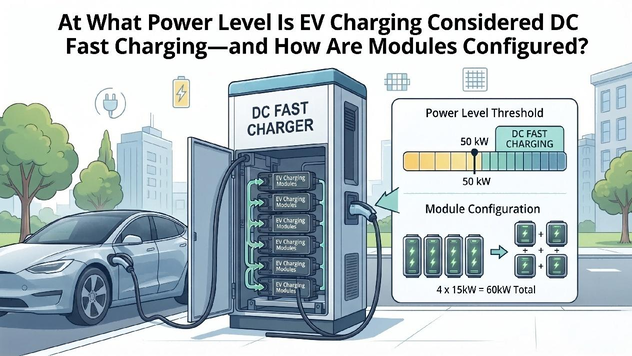
DC fast charging is better defined by the charging method and use case than by one global power number. The charger supplies controlled DC directly to the vehicle battery through an off-board conversion system. An EV charging module performs that conversion inside the equipment, but terms such as fast, rapid and high-power are used differently across markets. A 30 kW unit may serve a destination site effectively, while a highway location may be designed around much higher cabinet output.
Practical Definitions of DC Fast-Charging Power
Power bands are useful for discussion, but they are not universal technical classifications. Lower-output DC equipment can suit workplaces, dealerships, urban parking or commercial vehicles with modest acceptance rates. Medium- and higher-output systems are more common where vehicles have short dwell times or high daily utilization. The correct question is not simply whether a number qualifies as “fast.” It is whether the charger can deliver the energy required during the available charging window.
Nameplate Power and Vehicle-Acceptance Limits
Nameplate power is not guaranteed vehicle power. A charger's rated output is an upper boundary, not a promise that every connected EV will receive that power. The vehicle battery-management system limits current according to battery voltage, temperature, state of charge and cell conditions. Connector current, cable temperature, cabinet temperature, site load limits and simultaneous charging can reduce output further. This is why two vehicles connected to the same charger can show very different charging power.
Building Total Cabinet Output with Parallel Modules
Charger power is commonly assembled from several parallel conversion units. A 120 kW cabinet could, in principle, use four 30 kW units or three 40 kW units, provided their electrical, thermal and control characteristics fit the design. The EV charging module count must also account for the desired current at low battery voltage, thermal derating, multiport allocation and the response to one unavailable unit. Simple rated-power division is only the first calculation.
Voltage can be as important as kW. Power equals voltage multiplied by current. Delivering 120 kW to a lower-voltage vehicle requires more current than delivering the same power to a higher-voltage vehicle. A charger can therefore reach its current limit before it reaches its advertised kW rating. Engineers should review the constant-power range, maximum current and output curve across the expected vehicle voltage window. A wide maximum-voltage figure alone does not prove strong performance at every voltage.
Duty Cycle and Site-Use Requirements
Duty cycle changes the design. A fleet depot may run chargers for long scheduled periods, while a public highway site may experience short but intense peaks. Shopping centers and workplaces may accept slower energy delivery because vehicles remain parked longer. Ambient temperature, altitude, ventilation and service strategy also affect continuous output. Module configuration should be based on realistic session data and thermal conditions rather than on a single peak-power target.
Module Configuration for Real-World Charging Demand
When comparing a fast charging power module, buyers should map the full operating envelope: output voltage, maximum current, constant-power region, efficiency at representative loads, derating, parallel behavior and fault isolation. Then test the proposed count against the worst relevant case. A configuration that produces the target kW at one voltage may not do so at another, and a dual-port charger may require additional capacity or dynamic allocation logic.
Energy Delivery and Dwell-Time Validation
Use energy delivered as the reality check. Suppose a vehicle needs 45 kWh before departure and will remain connected for 90 minutes. The site must deliver an average of 30 kW over that window, plus appropriate margin for ramping, tapering and operating conditions. A higher nameplate may help if the vehicle can accept it, but it is not automatically necessary. Working backward from required energy and dwell time prevents labels such as “fast” from replacing an actual charging calculation.
There is no responsible one-number answer to when DC charging becomes “fast.” The right EV charging module configuration follows vehicle mix, dwell time, voltage range, connector current, cooling and power-allocation strategy. UUGreenPower offers module categories for different DC charging applications, with final suitability determined by current product data and complete-system validation.
Where Does the Charging Module Fit Inside a DC Fast Charger?
2026-08-03 NextUUinside : How the One-Stop DC Fast Charger Model Works
2026-08-03

