
2026-08-04
UUGreenPower
0
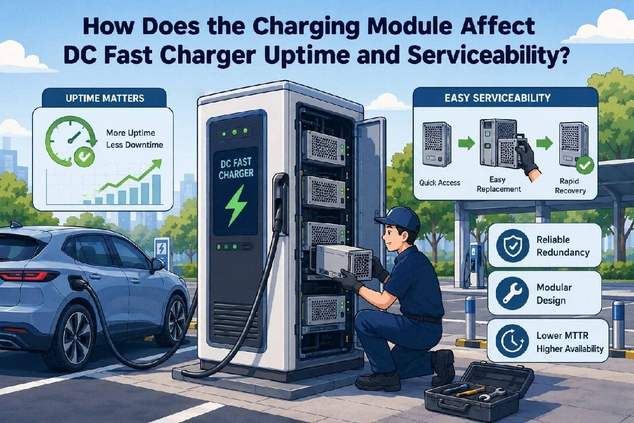
Uptime describes how long equipment remains operating, while availability asks whether it can deliver the intended service when requested. Reliability concerns how often failures occur; serviceability concerns how quickly faults can be diagnosed and corrected. The EV charging module influences all four, but charger availability also depends on connectors, contactors, cooling, controllers, communications, the site supply and the field-service process.
Electrical and Thermal Factors Behind Charger Uptime
Conversion losses become heat, and repeated operation near a temperature or current boundary can increase component stress. Stable current sharing prevents one parallel unit from carrying an excessive share of the load. Appropriate derating keeps operation inside validated limits when ambient temperature rises or airflow falls. Engineers should review performance across the real duty cycle, not only at a comfortable laboratory point, because public and fleet chargers can experience long sessions and rapid changes in requested power.
Fault containment can preserve partial service. If the architecture allows one failed unit to be isolated, the charger may continue at reduced output rather than stopping completely. This is often called graceful derating. It requires correct contactor or distribution design, controller logic and alarm handling; it is not guaranteed merely because several units are installed. The system must know which unit failed, prevent unsafe re-entry and communicate the reduced capability accurately to operators and users.
Diagnostics, Fault Containment, and Field Service
The EV charging module should provide clear status, measurements and fault codes, but the charger controller must time-stamp and preserve that information. Remote logs help a service team distinguish a module alarm from blocked airflow, a cabinet sensor fault or an upstream power event. Useful diagnostics include the operating point before the fault, temperature data, communication state and recurrence history. A vague “charger unavailable” message is not enough for efficient troubleshooting.
Physical replacement must be designed safely. Accessible placement, safe isolation, lifting or handling provisions, keyed connectors and defined torque requirements all influence repair time. Filters, fans or coolant circuits need inspection intervals that reflect the site environment. Replacement procedures should state whether calibration, firmware alignment or commissioning tests are required. Serviceability is weakened when a nominally replaceable unit can only be reached after unrelated assemblies are removed.
Spares, Revision Control, and Buyer Verification
A spare should match the approved electrical, mechanical and software configuration. Manufacturers need model and revision records, compatibility rules and change notifications. Operators should know whether mixed hardware revisions can share current and whether controller firmware recognizes each approved unit. Stocking a visually similar part without those controls can prolong downtime or create inconsistent behavior across a module pool.
Buyer Documentation and Acceptance Criteria
Questions buyers should ask. Documentation for a DC fast charging module should explain fault coverage, alarm definitions, thermal derating, current-sharing behavior, enable and shutdown sequences, firmware management and replacement conditions. At charger level, buyers should ask what happens after a single fault, which events require a site visit, what can be diagnosed remotely and how the system is restored. Complete-charger tests should include realistic environmental and failure scenarios.
Root-Cause Isolation Before Part Replacement
Avoid replacing parts before identifying the layer. A low-power complaint can originate from vehicle tapering, site load management, cable temperature, blocked cabinet airflow or an unavailable conversion unit. Good service logic compares the vehicle request with commanded and measured output before assigning blame. This small diagnostic discipline protects uptime because it sends the correct technician and part to the site. It also creates useful trend data: repeated thermal alarms at one location suggest an installation issue that a replacement alone will not resolve.
Measurable Availability and Restoration Targets
Availability targets should be written as measurable system outcomes, including permitted reduced-power operation and restoration time. That gives designers a basis for deciding whether reserve units, remote resets, on-site spares or additional sensors are required.
An EV charging module supports charger availability when it is paired with thermal margin, fault containment, usable diagnostics and disciplined field procedures. It cannot create uptime on its own. UUGreenPower publishes module information for integrators, while actual service performance depends on the complete charger, site infrastructure and service organization.
UUinside : How the One-Stop DC Fast Charger Model Works
2026-08-03 NextHow Do DC Fast Charging Modules Make EV Fast Charging Possible?
2026-08-04

