
2026-08-04
UUGreenPower
0
EV fast charging becomes possible when high-power conversion takes place outside the vehicle. Instead of sending AC power through the vehicle’s onboard charger, a DC fast charger converts the incoming electricity within the charging equipment and supplies regulated DC directly to the traction battery. At the center of this process is the DC fast charging module, which turns available input power into the controlled voltage and current requested by the charging system.
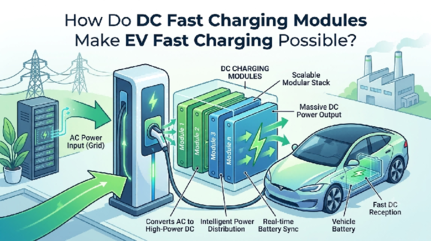
The module is essential, but it does not determine charging speed on its own. The complete result depends on the vehicle battery, the charger controller, the number of active power units, the output cable, thermal conditions, and the power available at the site. Fast charging is therefore a coordinated process in which the conversion stage provides usable DC power while the vehicle and charger continuously define safe operating limits.
External Conversion and Direct Battery Delivery
During conventional AC charging, the charging point supplies alternating current and the onboard charger inside the EV converts it to direct current. Because the onboard charger must fit inside the vehicle, its size, mass, cooling capacity, and rated output are restricted. These physical limits make it suitable for routine charging, but they also constrain the amount of power that can be processed through the onboard path.
A DC fast charger moves the main conversion equipment outside the vehicle. The charger can use larger power-electronic components, dedicated airflow or liquid cooling, and several power units working together. Once the vehicle and charger complete their safety checks, the controlled DC output bypasses the onboard charger and reaches the battery through the vehicle’s high-voltage charging path.
Voltage and Current Control Throughout the Session
An EV battery cannot accept one fixed level of power from the beginning to the end of a session. The vehicle’s battery-management system communicates allowable voltage and current limits to the charging equipment. The charger controller compares those requests with its own available capacity and then commands the active power units to produce an appropriate output.
At a lower state of charge, the vehicle may permit relatively high current. As battery voltage, temperature, or state of charge rises, the allowable current may hold steady, fluctuate, or taper. The conversion stage must respond smoothly so that output remains within the limits of the battery, connector, cable, protection devices, and charger cabinet. This continuous adjustment is one of the main reasons DC fast charging requires precise power electronics rather than a simple fixed DC supply.
Parallel Power Units and Higher Charger Output
A high-output charger commonly combines several independent power units in parallel. The charger controller enables the required units, shares the current demand among them, and monitors their operating status. When the requested output increases, additional units can be activated. When the requested power falls, some units may be reduced or placed on standby according to the charger design.
This arrangement allows charger manufacturers to create different cabinet power ratings from repeatable conversion units. However, multiplying the rated power of one unit by the number installed does not automatically define the real output available to a vehicle. Designers must also consider the output-voltage range, maximum current, current-sharing accuracy, simultaneous charging ports, thermal derating, and the power allocation strategy used by the controller.
Efficiency and Thermal Management at High Power
Every conversion stage produces some electrical loss, and most of that loss becomes heat. At high output, even a small loss percentage can create a significant thermal load. Semiconductor devices, magnetic components, switching control, airflow paths, coolant conditions, and cabinet layout all influence whether the charger can sustain its intended output without excessive temperature rise or protective derating.
For a DC fast charging module, conversion efficiency must be evaluated across the expected input, output-voltage, current, and ambient-temperature ranges. A strong peak-efficiency value is useful, but continuous fast-charging performance also depends on operation at partial load, lower battery voltages, high ambient temperatures, restricted airflow, dust accumulation, altitude, and repeated charging sessions.
The Limits That Still Shape Charging Speed
The charger cannot force the battery to accept more power than the vehicle permits. Battery chemistry, pack voltage, state of charge, cell temperature, battery-conditioning strategy, and the vehicle’s charging curve all affect the final rate. The site may also impose a power limit, while connector temperature, cable capacity, cabinet temperature, or simultaneous sessions can reduce the output available to one vehicle.
In practical terms, a DC fast charging module makes high-power charging possible by converting energy efficiently, regulating output accurately, and responding to the charger controller in real time. The complete charging speed still emerges from the interaction of the vehicle, charger, and site. UUGreenPower develops core charging components for manufacturers and integrators building DC charging equipment, while the final selection and configuration should always be based on current technical documentation and complete-system validation.
How Does the Charging Module Affect DC Fast Charger Uptime and Serviceability?
2026-08-04 NextHow Does SiC Technology Improve Efficiency and Power Density in a 40kW Charging Module?
2026-08-04

