
2026-08-04
UUGreenPower
0
Packing 40 kW into a compact enclosure increases switching, conduction and thermal demands. An EV charging module must keep semiconductors, magnetics and capacitors within their temperature limits while regulating output across a wide vehicle voltage range. Silicon carbide, usually abbreviated SiC, gives designers useful device characteristics for this task, but it does not automatically make every design efficient, compact or reliable.
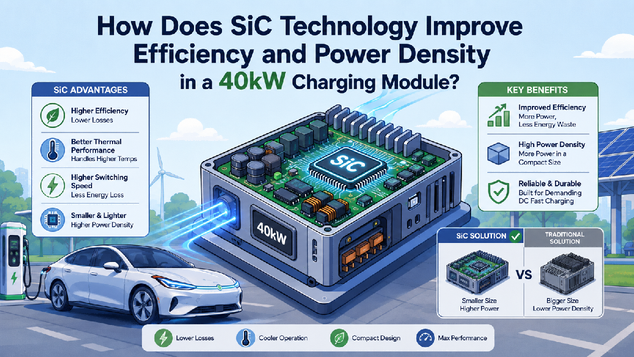
SiC Effects on Power-Conversion Performance
Compared with many conventional silicon power devices, SiC devices can offer lower switching losses and operate effectively at higher switching frequencies and junction temperatures. Higher frequency can reduce the size of some magnetic and filtering components. Lower loss can reduce the heat that must be removed for a given output. These advantages can support higher power density, provided gate drive, layout, insulation and electromagnetic compatibility are engineered around the faster switching behavior.
Why the surrounding design still determines the result. Fast switching can increase voltage overshoot and electromagnetic noise if the circuit layout and control are poor. Magnetics, capacitors, fans, heat sinks and connectors still create losses and occupy space. The cooling path must move heat from semiconductor junctions through interfaces and into the surrounding air or coolant. A successful design therefore balances switching frequency, efficiency, component stress, acoustic behavior and compliance instead of maximizing one characteristic in isolation.
Efficiency and Power-Density Evaluation
No EV charging module has the same efficiency at every input voltage, output voltage, load and temperature. Auxiliary power and cooling demand become more significant at light load, while conduction and thermal effects change at high load. Buyers should request an efficiency map or representative curves, along with stated test conditions. Peak efficiency is useful, but rated and partial-load performance often describe real operation more accurately.
Catalogue Data and Model-Specific Performance
What the official catalogue example shows. The supplied Product Catalogue 2026V3 lists model UR100040SW-SiC(EU) with 40 kW constant power from 300 to 1000 VDC, an output range of 150 to 1000 VDC, rated efficiency above 96% and peak efficiency of at least 97%. It also lists power factor of at least 0.99 and THDi of no more than 5% under specified conditions. These figures belong to that exact model and document revision; they should not be generalized to every SiC design.
Power density must be judged in the cabinet. A small module chassis does not represent the complete installed volume. External fans, ducts, filters, coolant hardware, cable bend radius, clearances and service access also occupy space. High density can increase local heat concentration, so cabinet airflow and exhaust recirculation require careful analysis. Buyers should compare usable cabinet kW per volume under the required ambient conditions rather than relying only on a module's enclosure dimensions.
Buyer Checks for a 40kW Charging Module
A 40kw charging module comparison should cover the constant-power curve, maximum current, efficiency map, derating, standby demand, temperature range, acoustic data, cooling interface, EMC evidence, parallel behavior and protection response. The evaluation should also confirm whether the quoted performance is continuous, which input and output conditions were used and how altitude or blocked filters affect the result.
System-Level Factors Beyond Semiconductor Choice
Do not use SiC as the only selection filter. Two SiC-based products can deliver different results because topology, components, firmware, manufacturing controls and cooling are not identical. Conversely, an established silicon design may be appropriate for a less demanding application. Buyers should define the required output envelope, environment and cabinet limits first, then evaluate measured product performance. Semiconductor material is a useful design clue, not a substitute for efficiency curves, thermal testing and controlled reliability evidence.
From Semiconductor Potential to Product Performance
In other words, SiC creates design opportunity; the finished product demonstrates whether that opportunity was converted into useful performance. The comparison should remain evidence based and tied to the intended cabinet.
SiC can help an EV charging module combine high output, wide voltage coverage and compact packaging, but device choice is only the starting point. UUGreenPower lists SiC-based 40 kW options; final engineering decisions should follow the latest datasheet, cabinet thermal analysis and complete-charger tests.
How Do DC Fast Charging Modules Make EV Fast Charging Possible?
2026-08-04 NextHow Does a DC Fast Charger Share Charging Modules Between Two Charging Ports?
2026-08-05

