
2026-08-05
UUGreenPower
0
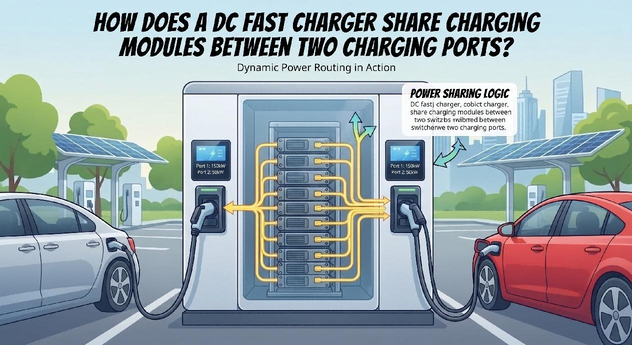
A dual-port charger may publish a total cabinet rating, a maximum rating for each port and a lower combined result when both ports are active. The EV charging module pool supplies controllable conversion capacity, while contactors, DC distribution and controller logic assign that capacity to each charging session. The split is therefore an active system decision, not necessarily a permanent 50/50 division.
Fixed and Dynamic Power Allocation
In a fixed design, a defined group of conversion units serves each connector. A 200 kW cabinet might reserve one group for port A and another for port B. This can simplify switching and fault containment, but unused capacity on one side may not be available to the other vehicle. The practical result depends on whether the groups are electrically isolated, how the cabinet is wired and whether reassignment is permitted.
Dynamic allocation follows real demand. Dynamic systems can move available capacity between ports as vehicle requests change. If only one vehicle is connected, it may receive most of the available cabinet power within its own limits. When a second vehicle arrives, the controller redistributes active units or current according to a defined policy. Some designs use a fixed minimum for each port plus a shared pool, balancing predictable service with better use of idle capacity.
Vehicle Limits and Safe Power Switching
Assigning more EV charging module capacity does not force the vehicle to accept more power. Battery voltage, temperature, state of charge and the vehicle's charging curve determine the requested current. A high-state-of-charge vehicle may release capacity that can be assigned to another port. The controller must repeatedly compare both vehicle requests with connector current, cable temperature, cabinet temperature and site supply limits.
Switching must not create unsafe transients. Power reassignment involves more than a software number. The design may need contactor sequencing, pre-charge, voltage matching and confirmation that no unintended path exists between outputs. The controller should command units to ramp safely before switching and verify the new topology afterward. If one unit faults, the cabinet must isolate it and decide whether to continue at reduced power, reallocate capacity or stop a session.
Operator and Buyer Verification
Changing power can be normal in a shared system, but unexplained changes can look like a fault. The display or app should distinguish cabinet sharing from vehicle-requested tapering where possible. Operators also need session and event data showing how power was allocated. This information helps evaluate utilization, resolve complaints and improve allocation policies without assuming that every low-power period indicates defective hardware.
Buyer Requirements and Commissioning Checks
What buyers should ask. Documentation for a DC fast charging module should describe parallel current sharing, command response, minimum stable output, enable and disable behavior and fault reporting. At charger level, buyers should ask how power is divided, how quickly it can move, whether reassignment interrupts a session, what happens after a unit fault and whether either port has a guaranteed minimum under simultaneous use.
Allocation Policy in Dual-Port Scenarios
An example shows why policies matter. If two vehicles request 150 kW from a 200 kW cabinet, the charger cannot satisfy both requests simultaneously. It might divide power equally, preserve a guaranteed minimum and allocate the remainder by arrival order, or prioritize a fleet vehicle with an earlier departure. Each policy produces a different user experience even though the hardware rating is unchanged. Operators should select and disclose the policy that matches the site rather than assume dynamic allocation has one universal behavior.
Dual-Port Commissioning and Transition Testing
Commissioning should verify the chosen policy with two vehicle simulators across arrival, taper and disconnect events. Logs should show which limit controlled each port so later field behavior can be explained from evidence.
Dual-port charging is a coordinated allocation problem. The EV charging module provides controllable units of power, while cabinet hardware and software decide how those units are used safely. UUGreenPower supplies module options for integration; the finished charger's allocation policy and switching behavior must be designed and validated by the system provider.
How Does SiC Technology Improve Efficiency and Power Density in a 40kW Charging Module?
2026-08-04 NextHow Can Buyers Verify UL, CE, and IEC Documentation for an EV charging Module?
2026-08-05

