
2026-08-05
UUGreenPower
0
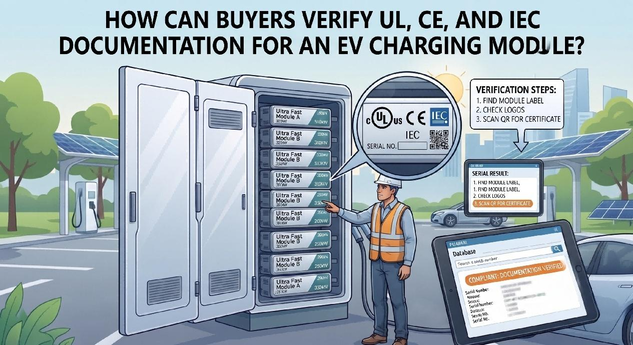
IEC develops and publishes international standards. CE marking is a manufacturer's declaration that a product placed on the relevant European market meets applicable EU legislation. UL marks and other North American certification marks generally indicate third-party evaluation for a defined product, scope and set of requirements. An EV charging module can therefore have different documents for different markets, and a generic statement of “UL/CE/IEC certified” is not enough for due diligence.
Product Identity and Document-Scope Verification
The model number, electrical rating, hardware revision and, where relevant, firmware version on the controlled document should match the offered unit. Buyers should record the issuing organization, certificate or report number, listed standards, scope, conditions and current status. A certificate covering a product family may include only specific variants. A similar name, different suffix or later design change should be checked rather than assumed to be covered.
Understand what each document proves. A declaration of conformity is not the same as a third-party certificate, and a certificate is not the same as a full test report. A CB certificate may support national certification applications but does not itself create market access everywhere. Installation instructions and conditions of acceptability can be as important as the front page because they define cooling, protection, enclosure or electrical limits used during evaluation. Buyers should ask which document supports which claim.
Component Evidence and Finished-Charger Compliance
Certification for an EV charging module can support a charger program, but it does not replace evaluation of the cabinet, busbars, protection, connector, cable, controller, EMC performance and installation instructions. If the module is installed with different cooling, supply conditions or protective devices, additional assessment may be required. The finished product manufacturer remains responsible for the complete charger's conformity and the technical file required in the target market.
Verify records at the source. Where the issuing body provides a public database, search by certificate number and exact model rather than relying only on a PDF supplied by a salesperson. Check the certificate holder, production location if listed, issue date, status and standard edition. For CE documentation, review the responsible manufacturer's declaration, applicable directives or regulations, harmonized standards and authorized signature. If information conflicts, request controlled clarification from the document owner.
Revision Control, Traceability, and Common Red Flags
Compliance evidence can be undermined by uncontrolled component, firmware or factory changes. Purchase specifications should require change notification and identify which revisions are approved. Incoming inspection should confirm model labels and traceability. If a critical component changes, the manufacturer and conformity-assessment body may need to determine whether testing or document updates are required. This process should continue after initial approval, not end when the first sample passes.
Evidence Packages and Common Red Flags
Build a traceable review package. For a power module for EV charger, request the relevant certificate, declaration, test-report reference, installation conditions, critical-component information, model list and revision history. Create a simple matrix linking each target market to required evidence, responsible party and verification status. This avoids labeling unrelated files as a single “certificate package” and makes missing information visible before the charger enters formal assessment.
Documentation Red Flags and Source Verification
Watch for common red flags. Documents deserve further review when model numbers are missing, certificate holders differ without explanation, standard editions are unclear or pages appear to combine several unrelated products. A marketing statement should not be treated as controlled evidence. Buyers should also question files that cannot be found in the issuing body's database when such a database exists. A discrepancy does not automatically mean a product is invalid, but it should be resolved in writing before the evidence is used.
Approval Records and Revision Traceability
The review record should be retained with the approved product revision. That way, purchasing and engineering can confirm that later shipments still match the evidence originally assessed, and any change can trigger a deliberate compliance review.
Document verification is a model-by-model, revision-by-revision and market-by-market process. The EV charging module evidence must align with the finished charger's compliance plan and installed conditions. UUGreenPower publishes product and certification information for integrators; buyers should confirm the latest controlled documents with the supplier and their chosen conformity-assessment route.
How Does a DC Fast Charger Share Charging Modules Between Two Charging Ports?
2026-08-05 NextHow Do AC/DC and DC/DC Charging Modules Differ in EV charging Systems?
2026-08-05

