
2026-08-05
UUGreenPower
0
An AC/DC EV charging module accepts alternating current from the grid and produces regulated direct current for a vehicle battery or DC bus. A DC/DC unit starts with a DC source, such as an energy-storage bus, and changes its voltage and current to suit another DC domain. Both regulate power electronically, but their input conditions, isolation requirements and surrounding protection can be very different.
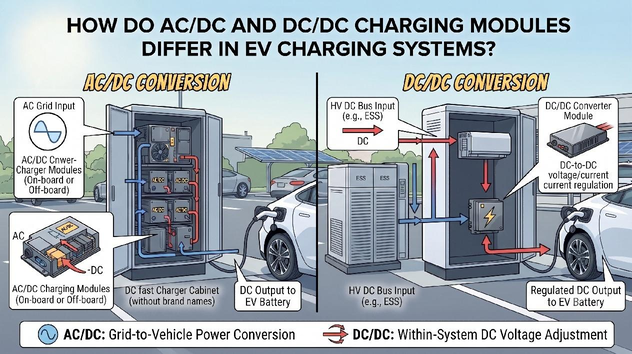
AC/DC and DC/DC Conversion Applications
Most conventional grid-connected fast chargers require an AC/DC stage. The unit draws three-phase AC, shapes the input current, creates an internal DC link and regulates the output requested by the charger controller. Input power factor, current harmonics and grid disturbances matter at this stage because the facility sees the combined behavior of every active unit. The cabinet still provides upstream protection, switching, distribution and system-level monitoring.
Where DC/DC conversion appears. DC/DC units are used when a charger receives energy from an existing DC source or bus. Examples include battery-supported charging sites, solar-plus-storage architectures and systems with a centralized DC link. The converter matches two voltage domains and regulates current instead of connecting them directly. Depending on the design, it may also provide galvanic isolation and bidirectional operation. Those characteristics must be specified explicitly rather than assumed from the term “DC/DC.”
Architecture-Driven Converter Selection
A storage-supported site can use several valid architectures. In an AC-coupled arrangement, storage and the charger each connect through their own conversion equipment to a common AC system. In a DC-coupled arrangement, storage and vehicle charging may share a controlled DC bus. The EV charging module choice follows that architecture. An AC/DC unit cannot simply replace a DC/DC unit because the source, grounding, fault energy and control assumptions are different.
Safety and Control Across DC Architectures
Safety and control remain system responsibilities. The supervisory controller coordinates pre-charge, contactors, insulation monitoring, voltage matching and the vehicle communication sequence. A DC/DC converter does not make direct battery-to-battery wiring acceptable. The storage battery and EV battery can have different voltage ranges, states of charge and fault capabilities. The system must prevent uncontrolled inrush, reverse current and unsafe energization while respecting limits from both battery-management systems.
Bidirectional Operation and Engineering Verification
Some converters are designed for one-way energy flow; others can control power in both directions. The latter may be required when the storage bus must be charged and discharged through the same hardware or when vehicle-to-grid functions are planned. Directional capability must be supported by power stages, sensing, firmware, protection and certification. It cannot be enabled safely through a software setting on hardware designed only for one-way operation.
Converter Interface and Performance Comparison
What engineers should compare. For an electric vehicle charging module, verify the input type and range, output envelope, galvanic isolation, direction of energy flow, grounding concept, current-sharing behavior, communication interface, derating and protection coordination. Ask for curves at representative voltage combinations, not only one rated point. Complete-system analysis should cover short-circuit energy, DC contactor ratings, discharge paths and transitions between grid, storage and vehicle power sources.
Energy-Path Mapping Before Module Selection
Use a one-line architecture test. Write the source and destination explicitly: “three-phase AC to vehicle DC,” “storage DC bus to vehicle DC” or “storage DC to grid AC.” This simple sentence often exposes an incorrect component assumption before detailed design begins. If power must flow in both directions, state that as well. Engineers can then identify which stage performs isolation, which controller owns each battery limit and which protective devices interrupt faults in every operating mode.
After the energy path is clear, selection becomes a comparison of real interface ranges and safety functions instead of a search for similar terminology. This is especially valuable in projects combining the grid, solar generation, stationary storage and EV charging.
AC/DC and DC/DC describe the conversion path, not the complete charger. The correct EV charging module follows the station's energy source, bus architecture, control plan and safety case. UUGreenPower lists high-power and energy-storage charging categories; current model documentation and system validation should guide final selection.
How Can Buyers Verify UL, CE, and IEC Documentation for an EV charging Module?
2026-08-05 NextWhy Does Power Factor Matter in a DC Fast Charging Module?
2026-08-06

