
2026-08-07
UUGreenPower
0
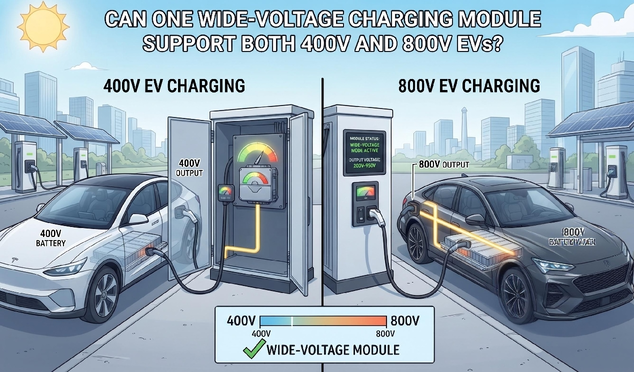
“400 V” and “800 V” describe broad vehicle platform classes, not fixed battery voltages. Actual pack voltage changes with cell chemistry, series configuration and state of charge. A wide-range EV charging module can support vehicles from both classes only when its voltage and current envelope covers their real charging windows. A maximum output of 1000 V alone does not prove complete compatibility.
Full Output Curves Beyond Platform Voltage Labels
Every conversion unit has an operating range and limits that change across it. Maximum current can restrict power at lower battery voltage, while voltage limits can restrict high-voltage packs near the top of charge. The constant-power region shows where rated output can be sustained. Below that region, current may be capped; above it, other control or component limits may apply. Buyers should request the complete curve rather than infer performance from the model name.
A simple power example shows the issue. Power equals voltage multiplied by current. Delivering 120 kW at 400 V requires about 300 A, while the same power at 800 V requires about 150 A. If a charger or connector can provide only 200 A, it cannot deliver 120 kW at 400 V even when its module pool has enough rated kW. The vehicle's own request may reduce these values further because of temperature or state of charge.
Complete High-Voltage Path Verification
The EV charging module is only one boundary. Contactors, busbars, insulation monitoring, measurement circuits, cables, connectors and discharge paths must all handle the required voltage and current. Creepage, clearance and enclosure design must follow the applicable safety plan. A wide-voltage module installed in a cabinet designed for a narrower range does not make the complete charger wide-voltage capable.
Control Accuracy and Voltage Transition Behavior
Control accuracy and transitions deserve attention. Low-current operation at high voltage and high-current operation at low voltage can challenge measurement and control in different ways. Engineers should review voltage and current accuracy, ripple, ramp rate, overshoot and minimum stable output. Pre-charge, contactor switching and stop behavior should be tested across the full range. Fault thresholds must protect the system without causing nuisance trips during normal vehicle-request changes.
Interoperability and Real-World Compatibility
Vehicle and charger must support a compatible connector and communication standard. The controller must interpret the vehicle request and command the module pool correctly. Cable temperature sensing and connector current rating can reduce output independently of the module. Regional vehicle versions may also differ. Compatibility is therefore demonstrated at the complete-charger level with representative vehicles or approved simulators.
Buyer Review and Compatibility-Matrix Testing
What buyers should review. For a 1000V charging module, compare rated and absolute voltage ranges, constant-power curve, maximum current, accuracy, ripple, efficiency, derating and protection thresholds. Map those values against representative low- and high-voltage charging curves. Then test normal charging, tapering, stop sequences and faults at both ends of the operating range. A paper match is a useful screen, not final proof.
Compatibility Matrices Beyond Voltage Labels
Avoid treating platform voltage as a quality ranking. An 800 V platform is not automatically faster in every session, and a 400 V vehicle is not automatically slow. Battery size, chemistry, thermal control, charging curve, connector current and charger capability all influence the result. Platform voltage changes the electrical design tradeoffs, especially current at a given power. Buyers should match infrastructure to the actual vehicles they expect rather than use the voltage label as a stand-alone performance claim.
A practical compatibility matrix lists representative vehicle minimum and maximum charging voltage, maximum current and connector standard against the charger's complete output curve. Any gap becomes visible before interoperability testing. The matrix should be maintained as the target vehicle population changes, because a design validated for today's mix may need review when a new low-voltage commercial vehicle or high-voltage passenger platform is added.
One EV charging module can serve both platform classes when its full operating envelope and every surrounding charger component are compatible. UUGreenPower lists wide-voltage charging modules; the latest model specification and complete-system validation should determine suitability for a particular vehicle mix.
How Much Charging Power Does an EV Fleet Depot Need—and What Module Configuration Fits?
2026-08-07 NextHow Many Charging Modules Does a DC Fast Charger Need?
2026-08-10

