
2026-08-10
UUGreenPower
0
A first estimate divides target charger power by the rated power of one EV charging module. A 160 kW target using 40 kW units suggests four active units. This calculation establishes an ideal count at one rated condition. It does not show whether the charger can deliver that power at the vehicle's voltage, in high ambient temperature, during two simultaneous sessions or after one unit is unavailable.
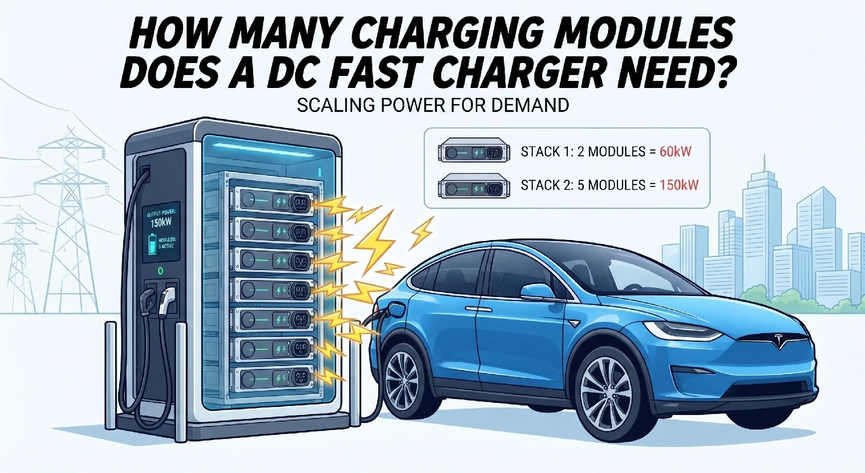
Module Count Across Voltage, Current, and Temperature
At lower battery voltage, more current is needed to deliver the same kW. The unit may reach its maximum current before rated power, so four nominal 40 kW units may produce less than 160 kW at that point. Engineers should place the expected vehicle-voltage window over the module's output curve and calculate combined current. Connector, cable, busbar and contactor limits must be included in the same review.
Account for thermal derating. Rated output is normally defined under stated conditions. High ambient temperature, altitude, restricted airflow or a loaded cabinet can reduce continuous capability. The EV charging module count should be checked at the project's worst relevant thermal condition. Adding units without improving airflow can make matters worse by increasing heat density, so cabinet thermal design and module quantity must be developed together.
Fault Tolerance, Multiport Use, and Serviceability
If four units are required for full output, losing one may reduce the charger to roughly three-quarters of its theoretical module capacity. This may be acceptable if the charger continues safely at reduced power. Projects with higher availability targets may include reserve capacity, but the cabinet must be able to isolate a fault and redistribute commands. Redundancy is a system feature, not simply an extra unconnected spare.
Multiport allocation changes the count. A dual-port charger needs a clear simultaneous-use policy. Fixed groups can reserve units for each connector, while dynamic allocation can move available capacity. The count should support any guaranteed per-port minimum, the maximum combined output and switching strategy. Vehicle requests change continuously, so the controller must keep active units within their stable operating range while avoiding excessive on-off cycling.
Serviceability and Revision Control
Service and revision control affect the architecture. More units create more electrical connections, airflow paths and controller addresses. The design needs accessible replacement, safe isolation and defined firmware compatibility. Approved spares should match the pool's current-sharing and communication behavior. Maintenance teams also need to know whether one replacement can be commissioned without taking the entire cabinet out of service.
Complete-Architecture Calculation and Validation
UUinside materials show single-PMU and dual-PMU configurations assembled from ACU, PMU, DCU and DSU components. These examples help relate the DC fast charging power module count to connector current, cabinet distribution and system roles instead of using a power ratio in isolation. The current official configuration table and project-specific electrical review should always control the final quantity.
Calculation Workflow and Commissioning Validation
Work one calculation through all limits. For a proposed 200 kW cabinet, first calculate the rated unit count. Next, calculate combined current at the lowest target vehicle voltage, apply the documented thermal derating and reserve any capacity required for degraded operation. Finally, apply connector and site limits. The smallest result among those checks is the usable system capability at that condition. This sequence prevents the initial division result from being mistaken for guaranteed charger output.
Assumption Records and Design Traceability
The final count should be recorded together with these assumptions. If the target voltage range, ambient condition, connector rating or redundancy objective changes, the calculation can be repeated transparently. Without that record, later teams may see only the quantity on the bill of materials and assume it was selected by simple division, losing the engineering rationale needed for safe product changes.
Commissioning measurements should then confirm current sharing and thermal performance with the full approved unit count active.
The correct EV charging module count is the number required across real voltage, current, thermal, redundancy and multiport conditions—not just rated kW. UUGreenPower provides module and UUinside configuration resources; final quantities require a complete electrical, thermal and control assessment.
Can One Wide-Voltage Charging Module Support Both 400V and 800V EVs?
2026-08-07 NextHow Should Charger Manufacturers Match a Charging Module to the Commercial Use Case?
2026-08-10

