
2026-08-10
UUGreenPower
0
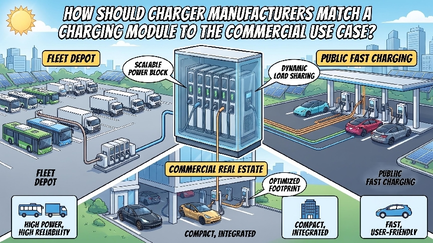
A highway site, fleet depot, shopping center, office park, port and industrial yard can have very different dwell times, utilization, vehicle types, dust exposure and service access. Selecting an EV charging module begins with the charging task, not a single maximum-power target. Engineers should define who will charge, how much energy is needed, how long vehicles remain and what happens if one connector is unavailable.
Power and Voltage Matching for Commercial Vehicles
Short highway stops can require high connector power, but the vehicle's charging curve still determines what is accepted. Workplace and destination sites may deliver the required energy over a longer stay. Fleet sites depend on departure schedules and route energy. The right output should therefore be based on energy delivered within the operating window, not on the assumption that the highest possible nameplate always creates the best fit.
Map the real vehicle voltage range. Vehicle categories can differ in battery voltage, maximum current and communication standard. The EV charging module must cover the expected voltage window and provide sufficient current at its lower end. Connector and cable limits should be included. A wide maximum voltage without an appropriate constant-power range may not deliver the expected result for every vehicle at the site.
Cooling and Serviceability for Site Conditions
Ambient temperature, altitude, humidity, dust, salt, rain exposure and solar loading affect the charger. Module cooling relies on the cabinet's airflow or coolant path, so filter loading and exhaust recirculation matter. An indoor laboratory rating should not be transferred to a roadside enclosure without thermal validation. Environmental protection ratings address defined ingress tests; they do not eliminate the need for cooling, drainage and maintenance.
Consider utilization and service access. A charger used continuously by a fleet experiences a different thermal duty cycle from a lightly used destination unit. Remote locations may need stronger diagnostics and a clear degraded-operation strategy. Dense urban sites can impose acoustic limits or restricted maintenance space. Manufacturers should define how faults are isolated, what can be diagnosed remotely, which parts are replaceable and how approved spares are controlled.
Cabinet Integration and Selection Risk Control
The conversion unit must match airflow direction, mounting, connectors, busbars, communication, current sharing and protection. The controller should support alarms, firmware governance and graceful derating. A unit that performs well alone can behave poorly if hot exhaust is drawn into its intake or parallel commands are not coordinated. Integration tests should use the actual cabinet with all intended units active.
Use-Case Checklist and Selection Review
Build a use-case review checklist. For a DC EV charger module, compare the output envelope, efficiency map, thermal derating, acoustic data, cooling interface, protections, certification evidence and change-control process. Then review the target site: vehicle mix, dwell time, simultaneous demand, climate, enclosure, maintenance plan and local compliance route. The selection is complete only when both sides of that comparison align.
Common selection mistakes. Frequent errors include choosing only by rated kW, ignoring current at low vehicle voltage, applying an ingress rating as a thermal rating and assuming component certification covers the finished charger. Another mistake is designing for an average day without checking peak duty or maintenance access. A short, multidisciplinary review involving electrical, thermal, software, compliance and service teams can reveal these mismatches before the cabinet layout and procurement specification become fixed.
Application Records and Change Review
Manufacturers can turn the review into a reusable application questionnaire. It should collect vehicle voltage, connector current, session pattern, climate, enclosure, airflow, site supply, backend functions and target markets. The completed questionnaire provides context for supplier recommendations and becomes part of the design record. This reduces the chance that an otherwise capable component is selected for conditions that were never disclosed or evaluated.
Assumption Changes and Requalification Triggers
When conditions later change, the same record shows which assumptions need to be reviewed instead of restarting selection from memory.
Commercial fit comes from aligning the EV charging module with vehicles, duty cycle, environment, cabinet and service model. One configuration cannot be assumed to suit every site category. UUGreenPower offers several module categories for integration; the latest datasheets and complete-system validation should guide each application.
How Many Charging Modules Does a DC Fast Charger Need?
2026-08-10 NextCan an IP65 EV charging Module Overheat? What Engineers Should Know
2026-08-10

