
2026-08-10
UUGreenPower
0
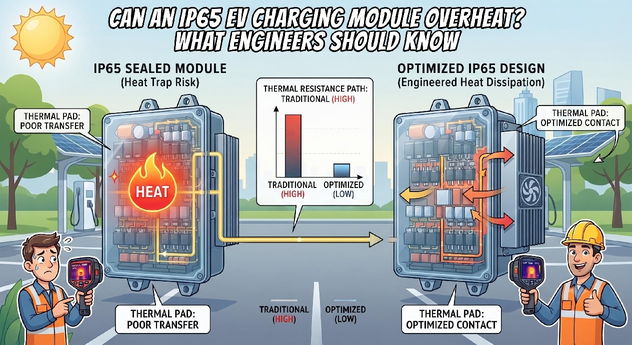
IP65 addresses enclosure protection against dust and water jets under defined test conditions. It does not mean an EV charging module cannot overheat, and it does not guarantee full output at every ambient temperature. Temperature depends on internal power loss, cooling capacity, installation, solar loading, altitude, airflow or coolant condition and the duration of high-power operation. Ingress protection and thermal performance are separate design questions.
Heat Generation Inside an IP65 Charging Module
No converter is 100% efficient. Semiconductor switching and conduction, magnetics, capacitors, connectors and auxiliary circuits all create losses. At tens of kilowatts, even a small percentage becomes meaningful heat that must leave the enclosure. If heat generation exceeds the cooling path's capacity, internal temperature rises. The module may then reduce output or shut down to protect itself, even though its enclosure continues to meet an IP rating.
Cooling Capacity and Thermal Derating
A protected enclosure limits direct exchange with the surrounding environment, so designers need a deliberate heat-transfer path. Depending on the product, heat may move through internal circulation, fans, heat exchangers, cold plates or the enclosure structure. The cabinet must support the cooling method defined by the manufacturer. Adding an IP65 unit to an unventilated cabinet does not remove the heat generated by the unit or by neighboring equipment.
Derating is controlled operation, not necessarily a defect. An IP65 EV charging module may reduce output as internal or ambient temperature approaches a defined threshold. This keeps critical components within validated limits. Derating should be documented so the charger controller can display and manage reduced capability rather than repeatedly resetting the unit. A shutdown threshold provides further protection, but frequent thermal shutdowns indicate that the installed cooling or duty cycle needs review.
Catalogue Ratings and Derating Conditions
What the catalogue example means. The supplied Product Catalogue 2026V3 lists UR100030-IP65(EU) and UR100040-IP65(EU) with operation from -40 to 75°C and derating from 55°C. It lists 30 kW and 40 kW constant-power versions from 300 to 1000 VDC and an output range of 150 to 1000 VDC. These figures apply to the identified models under specified conditions; the latest controlled datasheet and installation instructions prevail.
Installed Thermal-Environment Validation
Module inlet temperature can exceed the weather-station temperature because of solar gain, nearby exhaust, blocked filters or recirculated hot air. Altitude can reduce air density and cooling effectiveness. Dust can accumulate on heat-transfer surfaces even when it does not enter protected internal zones. Engineers should measure the actual air or coolant condition at the module interface during worst-case operation, not assume it equals the general outdoor temperature.
What engineers should verify. For an IP65 charging module, review the thermal path, ambient and inlet definitions, derating curve, alarm thresholds, cooling maintenance, mounting orientation and required clearances. Validate the complete cabinet with filters, solar loading, altitude and adjacent active units represented. Tests should include sustained output, changing vehicle voltage, partial fan or cooling degradation and the controller's response to thermal alarms.
Worst-Case Scenarios and Field Monitoring
A realistic overheating scenario. Consider an outdoor cabinet operating in strong sun after its filter has collected dust. Hot exhaust from upper units recirculates toward lower intakes, while two vehicles request sustained output. None of these conditions contradicts an IP65 claim, yet together they can push inlet temperature above the assumed value. Instrumenting several cabinet locations during validation helps identify the real thermal bottleneck and supports alarm thresholds and maintenance intervals based on evidence.
Temperature Trending and Predictive Maintenance
Field monitoring can then compare inlet, outlet and internal temperature trends with output power. A gradual rise across months may indicate filter loading or cooling degradation before shutdowns occur. Maintenance teams can respond to the underlying thermal path rather than treating each alarm as an isolated event. This connects enclosure protection, cooling design and operations into one reliability strategy.
IP65 can improve environmental protection, but it cannot eliminate heat. A reliable EV charging module installation still needs controlled cooling, correct monitoring and a clear derating strategy. UUGreenPower lists IP65 module options; use the latest datasheet and complete-charger thermal testing before deployment.
How Should Charger Manufacturers Match a Charging Module to the Commercial Use Case?
2026-08-10 NextHow Do Standardized Components Improve EV Charger Manufacturing?
2026-08-11

