
2026-08-11
UUGreenPower
0
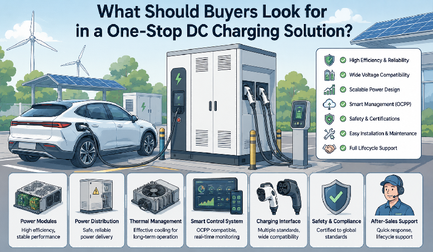
A one-stop DC charging solution should connect system architecture, core components, compliance planning, customization, supply coordination and operations support. It should not simply place unrelated items on a catalogue page. Buyers need to understand which parts are engineered together, what evidence supports their interfaces and which responsibilities remain with the charger brand, installer, backend operator and local conformity-assessment body.
Requirements and Architecture Definition
The provider should first confirm target markets, power, connector types, vehicle voltage range, simultaneous-port behavior, environment, software functions and expected duty cycle. Without this baseline, later design and certification work can move in different directions. A clear requirements document should identify owners, assumptions and acceptance criteria. It should also state which items are standard, configurable or subject to project-specific development.
Look for a coherent component architecture. UUinside presents PMU, ACU, DCU, DSU, CMS and optional POS roles as a coordinated component set. This helps buyers see how power conversion, AC input, DC distribution, the user-facing dispenser, cable management and payment hardware interact. The value of the charging solution lies in defined interfaces and tested coordination. Buyers should ask for architecture diagrams, electrical limits, communication ownership and approved configuration rules.
Certification, Customization, and Change Control
A provider may support standards mapping, sample preparation, technical documents and communication with test laboratories, but the exact scope should be written down. Component certificates do not replace finished-charger evaluation. Buyers should identify who owns the technical file, declarations, labels, installation instructions and change notifications. Target-market evidence should match exact models and revisions instead of being described only as general certification experience.
Customization requires change control. Connector, enclosure, display, firmware, language or payment changes can affect electrical, thermal, usability or compliance behavior. A sound process records the request, analyzes its impact, controls the design revision and defines required retesting. Buyers should ask how customized features are maintained through pilot production and later updates. Uncontrolled “small changes” are a common source of inconsistency between tested samples and production units.
Operations Support and Provider Responsibilities
Remote diagnostics, log ownership, firmware governance, alarm mapping, spare-component planning and field procedures should not be postponed until chargers are deployed. The provider should explain how faults are triaged, which updates require validation and how approved replacements are identified. Service information should connect module-level alarms to charger-level actions so operators can distinguish hardware, site-supply and communication problems.
Provider Comparison and Responsibility Mapping
Questions for comparing providers. A provider of electric vehicle charging solutions should explain architecture ownership, interface documentation, verification evidence, software boundaries, certification support, manufacturing controls and after-deployment responsibilities. Buyers should request a deliverables matrix and review exclusions as carefully as inclusions. A one-stop offer is strongest when every handoff is visible and testable, not when it promises to remove all project-specific decisions.
Proposal Warning Signs and Scope Gaps
Warning signs in a one-stop proposal. Buyers should pause when responsibilities are described only in broad marketing language, component certificates are presented as finished-charger approval or software ownership is undefined. The proposal should not assume that customization has no effect on testing. It should also state how controlled documents, updates, diagnostics and field feedback are handled after launch. Specific boundaries make collaboration easier because each party can verify what it must provide and accept.
Responsibility Matrix and Acceptance Points
A useful final document is a responsibility matrix covering requirements, design, components, firmware, certification samples, production tests, installation inputs and field support. Each row should have one accountable owner and defined evidence. This does not make the project rigid; it gives changes a clear route. Buyers can then judge a one-stop offer by how well the work connects, rather than by how many services appear in a brochure.
The matrix can also define acceptance points so both parties know when each deliverable is complete and ready for the next stage.
The strongest charging solution is traceable from requirements through integration, verification and operations. UUinside combines system design, standardized components, certification support, customized development, operations services and coordinated procurement. UUGreenPower provides this platform context, while every project still requires its own defined and validated scope.
How Do Standardized Components Improve EV Charger Manufacturing?
2026-08-11 NextWhat Challenges Do EV Charger Manufacturers Face in Global Markets?
2026-08-11

